
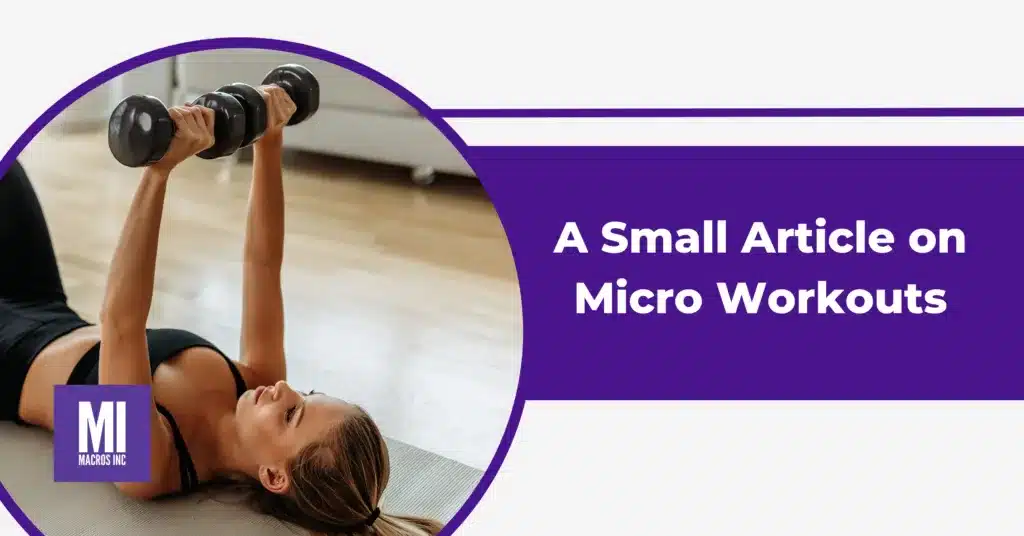
Anybody who lived through the 90s and 2000s can remember all those daytime infomercials: “Ten minute abs,” “Five Minute Full Workouts,” and the infamous Thigh Master. Call now, and get a second one free!
Cut to modern times, though, and we all know that much of that was grossly over exaggerated, if not flat out false advertisement. All the equipment gathering dust in our closets can attest to that. Given the track record, it seems like short workouts are ineffective for long term results. But are they really?
Enter micro workouts. Today, we’ll be discussing what they are, and their potential advantages and limitations. And this time, you don’t even have to buy a thing.
Jump to a Topic
A Small Article on Micro Workouts
What Are Micro Workouts?
Micro workouts consist of short duration, moderate to high activity exercise. These typically consist of things like circuit training, bodyweight exercises, or using small, portable equipment like dumbbells, bands, etc. The duration of each workout is typically somewhere under 10 minutes. These workouts can be implemented once to multiple times across the day, depending on goals and abilities.
While such modest durations seem ineffective at first glance, there is an emerging body of evidence that supports the use of mini workouts for overall fitness and health. Reported benefits include increases in quality of life, increased strength, and even potentially comparable results to longer training sessions. More research is likely needed, but there’s at least enough out there to suggest micro workouts have some benefits for the typical person.
Advantages
Duration
This is likely the first advantage most think of regarding micro workouts. They simply don’t take up a lot of time. Because of this, they are significantly easier to fit into one’s day. Similarly, these little snippets can be much more amenable to a daily schedule than a dedicated session at the gym. Examples include a brief one before work, periodically throughout the workday, or when traveling. Despite being short, several micro workouts throughout the day can add up to significant amounts of activity by the end of it.
Accessibility
Mini workouts are very easy to scale and tailor to different levels of fitness and experience. This allows people from all backgrounds and with different limitations to complete the same workout. While this is generally true of most workout regimens, the coupling of accessibility with short workouts makes micro workouts particularly appealing. For example, if a training circuit asks for push ups, they can be done on the knees to make them easier, or with elevated feet to make them more challenging.
Flexibility
Unlike more conventional training, micro workouts can adapt to whatever equipment is on hand. Classic strength programs revolve around free weights, cables, and machines. However, micro workouts can pull from everything including bands, small dumbbells, bodyweight, etc. This allows micro workouts to be much more accessible in virtually any location, as opposed to restricted to a commercial or home gym. Depending on the micro workout, they can be done anywhere from the bedroom to the workplace.
Limitations
Micro workouts are excellent for keeping you moving throughout the day and adding additional activity where you would otherwise be sedentary. While the two terms are often seen as interchangeable, they do have different meanings, and different places in your fitness regimen. Before we evaluate them in the context of micro workouts, let’s examine the two terms a bit more closely.
Training vs. Exercise
Exercise is defined as physical activity that you do to make your body strong and healthy. This includes any activity that taxes one’s heart rate, flexibility, or muscles. If it gets you moving, it can be a form of exercise. Swimming, running, walking, and biking are all common examples. Exercise has a host of health benefits, e.g. increasing cardiovascular health, preventing age-related muscle loss, and even decreasing all-cause mortality.
Training can be interpreted as exercise + progression. It adds a pre-planned, gradual progression scheme to the exercise in question. This forces the body to adapt to the training stimulus, increasing performance over time. Intensity also does not necessarily dictate exercise vs. training. A gut-wrenching workout may be solid exercise, but poor training. Conversely, a training session may feel surprisingly easy yet be more conducive to long term progress. In the long term, training tends to provide better results than just exercise alone.
Let’s take weightlifting and running as two examples. Each can be used for both exercise and training purposes. With exercise, you can push your muscles to failure with weights or run until you can’t anymore. Each would definitely tax the body and provide one heck of an exercise session. However, where do you go from there? Without some sort of standard, it’s unclear how you’ll get better at either.
With weight training, the goal is to add weight to each lift. This makes the muscles exert increasing levels of force, which helps stimulate muscle and strength gain. Similarly, running may focus on gradually running further, or lowering overall time on a set distance. A proper training program will set discrete targets to aim for from session to session and allow for factors like rest and recovery.
Where Do Micro Workouts Fall?
In light of above, I can contend that while micro workouts are good exercise, they may be insufficient for training.
Ultimately, the strengths of micro workouts are a double-edged sword. The short duration, accessible nature, and flexible form of these workouts make them an excellent source of exercise. They’re easy and convenient to do, they get the blood pumping, and provide a bit of extra calorie burn. In new trainees, they can even have a bit of a training effect, building some strength and endurance.
Unfortunately, it’s those exact same qualities that make micro workouts a poor form of training. A proper training program generally has a set number of movements, an ideal set of equipment in mind, and a discrete progression scheme. These requirements tend to be difficult to apply to workouts of this nature. Can you keep adding weight to your squats at the office? Or continue adding minutes to your planks when your workout window is only so long?
None of this is to say that micro workouts are useless. When implemented as intended, they are quite valuable in their contributions to your overall fitness. They simply have a specific role to play. It’s like the old saying goes: Always use the right tool for the job.
Conclusion
While we’re still learning more about micro workouts, what can be said for sure is that increases in overall activity are almost universally beneficial. These workouts can be an excellent addition to your daily routine, particularly if you tend to have a sedentary job, sit for extended periods of time, or simply want to get some extra movement in. Play around with what you do, where, and how, and reap the benefits!
Try our nutrition coaching, for free!
Be the next success story. Over 30,000 have trusted Macros Inc to transform their health.
Simply fill out the form below to start your 14-day risk-free journey. Let's achieve your goals together!
