
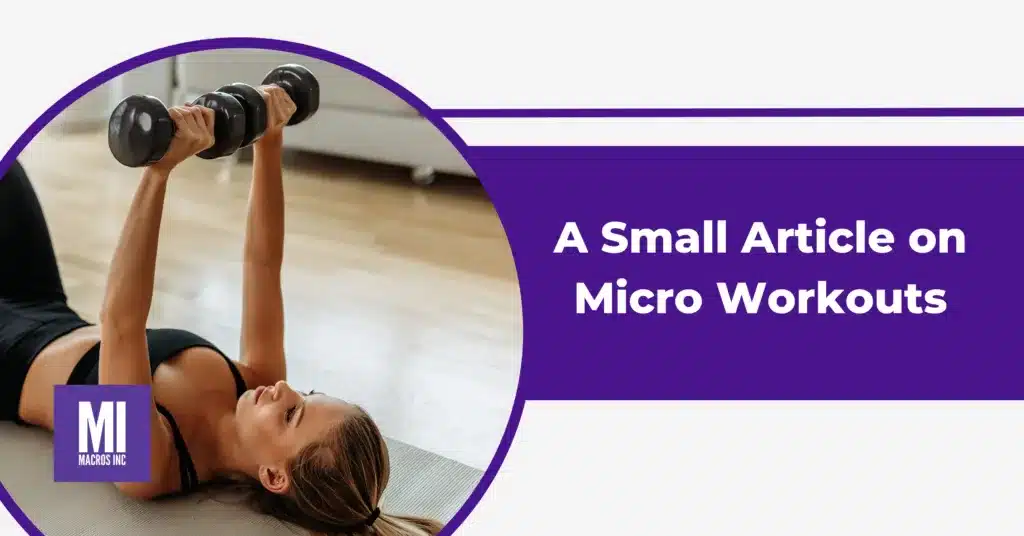
Anybody who lived through the 90s and 2000s can remember all those daytime infomercials: “Ten minute abs,” “Five Minute Full Workouts,” and the infamous Thigh Master. Call now, and get a second one free!
Cut to modern times, though, and we all know that much of that was grossly over exaggerated, if not flat out false advertisement. All the equipment gathering dust in our closets can attest to that. Given the track record, it seems like short workouts are ineffective for long term results. But are they really?
Enter micro workouts. Today, we’ll be discussing what they are, and their potential advantages and limitations. And this time, you don’t even have to buy a thing.
Jump to a Topic
What Are Micro Workouts?
Micro workouts consist of short duration, moderate to high intensity exercise. These typically involve things like circuit training, bodyweight exercises, or using small portable equipment like dumbbells or bands. The duration of each workout is typically somewhere under 10 minutes. They can be done once or multiple times across the day, depending on goals and abilities.
While such modest durations seem ineffective at first glance, there is an emerging body of evidence that supports the use of mini workouts for overall fitness and health. Reported benefits include increases in quality of life, increased strength, and even potentially comparable results to longer training sessions. More research is likely needed, but there’s at least enough out there to suggest micro workouts have real benefits for the typical person.
They also contribute to your non-exercise activity thermogenesis (NEAT), which is all the movement you do outside of structured training. For people with sedentary jobs, scattered micro workouts throughout the day can meaningfully increase total daily energy expenditure without requiring a gym visit.
Advantages
Duration
This is likely the first advantage most think of. Micro workouts simply don’t take up a lot of time, which makes them significantly easier to fit into your day. A brief one before work, a few sets between meetings, a quick circuit while traveling. Despite being short, several micro workouts throughout the day can add up to significant amounts of activity by the end of it.
Accessibility
Mini workouts are very easy to scale for different levels of fitness and experience. If a training circuit asks for push ups, they can be done on the knees to make them easier, or with elevated feet to make them more challenging. The coupling of accessibility with short duration makes micro workouts particularly appealing for people who are just getting started with regular movement.
Flexibility
Unlike more conventional training, micro workouts can adapt to whatever equipment is on hand. Bands, small dumbbells, bodyweight, a park bench, a hotel room floor. This makes them accessible in virtually any location, as opposed to being restricted to a gym. If you can find a few square feet of space, you can do a micro workout.
Free Workout Programs
Want structured short sessions instead of ad hoc micro workouts? Our programs include options that take 30 minutes or less, with built-in progression so your fitness actually improves over time.
Limitations
Micro workouts are excellent for keeping you moving throughout the day and adding activity where you would otherwise be sedentary. But there’s an important distinction to make between exercise and training, because micro workouts are better at one than the other.
Exercise vs. Training
Exercise is defined as physical activity that makes your body stronger and healthier. Swimming, running, walking, biking. If it gets you moving, it counts. The health benefits are well documented: better cardiovascular health, protection against age-related muscle loss, and even reduced all-cause mortality.
Training is exercise plus progression. It adds a pre-planned, gradual increase in demands to the exercise in question, which forces your body to adapt and get stronger over time. A gut-wrenching workout may be solid exercise, but poor training. Conversely, a training session may feel surprisingly easy yet be more conducive to long-term progress. In the long run, training tends to provide better results than exercise alone because it has a direction.
Take weightlifting as an example. You can push your muscles to failure and get a great exercise session. But without a plan to add weight to the bar over time, it’s unclear how you’ll get stronger from one session to the next. A proper training program sets discrete targets from session to session and accounts for rest and recovery. That structured approach is what separates people who get results from people who just get tired.
Where Do Micro Workouts Fall?
In light of the above, micro workouts are good exercise but insufficient for training.
Their strengths are a double-edged sword. The short duration, accessible nature, and flexible form make them an excellent source of daily movement. They’re easy to do, they get the blood pumping, and they provide extra calorie burn. In newer trainees, they can even build some strength and endurance. But those same qualities make them a poor substitute for a structured training program. A proper program has set movements, progression from session to session, and enough volume to drive real adaptation. Those requirements are hard to meet in under 10 minutes with whatever equipment happens to be nearby.
None of this is to say that micro workouts are useless. When implemented as intended, they are quite valuable in their contributions to your overall fitness. They simply have a specific role to play. It’s like the old saying goes: always use the right tool for the job.
How to Get the Best of Both
The most practical approach is to use micro workouts alongside a structured program, not instead of one. Your structured sessions handle the progressive overload that builds strength and muscle over time. The micro workouts fill in the gaps: extra movement on rest days, a quick circuit during a lunch break, some bodyweight work when you’re traveling and can’t get to a gym.
If your main barrier is time, it’s worth knowing that a structured training session doesn’t have to be an hour long. Our 30-Minute Home Workout Plan finishes in half an hour with dumbbells. The Beginner Home Workout Plan uses zero equipment and takes under 40 minutes. Both include progression built in, which is what separates them from a random micro workout.
And if time is genuinely limited to 20 minutes, a timed-interval program like our home bodyweight programs can deliver a structured session with progression in a fraction of the time people assume training requires.
The Bottom Line
Increases in overall activity are almost universally beneficial. Micro workouts are a genuine tool for that, particularly if you have a sedentary job, sit for extended periods, or simply want to get more movement into your day. Use them for what they’re good at: boosting daily activity, maintaining mobility, and staying consistent with movement when life gets busy.
For building strength, muscle, and long-term progress, pair them with a structured program that includes progressive overload. That’s where the real results live. If you’re not sure where to start, our guide to choosing the right workout plan walks through the decision, or you can browse all of our programs and find one that fits your schedule and equipment.
No gimmicks. No restrictions.
Start your journey with expert coaching, personalized nutrition, and real results, absolutely free for two weeks.