30-Minute Home Workout Plan
Three 30-minute sessions per week using dumbbells and bodyweight. Every workout designed to be completed in half an hour, with no time wasted and no exercise filler.
Program Overview
The biggest barrier to training at home is not equipment or knowledge. It is time. Most people can find 30 minutes three days per week. Not everyone can find an hour. This program is built around that constraint. Every session is designed to be completed in 30 minutes or less, including a brief warm-up. No filler exercises, no excessive rest periods, no time spent setting up complicated equipment. Four exercises per session, straight sets, in and out. The sessions are short but they are not easy.
The research on training volume is clear: the total work you do across a week matters more than the length of any individual session. Three focused 30-minute sessions per week provides enough stimulus to build muscle and strength for most people, provided the exercises are well chosen and the effort is genuine.
Who Is This For?
This program is for anyone who wants to train at home but cannot commit to longer sessions. This plan is right for you if:
- You have 30 minutes three days per week to train
- You own or have access to a pair of adjustable dumbbells
- You want every minute of your training to count
- You are a beginner or early intermediate lifter
- You prefer short focused sessions over long gym visits
If you have more time available and want more volume per session, check our other home programs for options with five exercises per session and more variation.
Weekly Schedule
Phase 1: Learn the Format (Weeks 1-4)
Four exercises per session, all at 3 sets with 60 second rest. Every session designed to be completed in 30 minutes or less. Crunches sit at 12-15 reps, everything else at 10-12.
Start a timer when you begin your first working set. With 60 to 90 seconds rest and four exercises at 3 sets each, you should finish between 22 and 28 minutes. If you are running over 30 minutes, your rest periods are too long. Tighten them up.
Hold a dumbbell vertically against your chest. Squat down keeping your torso upright, elbows tracking between your knees. Drive through your heels to stand.
Lie flat on a bench or the floor, dumbbells at chest level. Press up to full extension, then lower under control.
Hinge at the hips with a flat back, dumbbells hanging. Row both up to your lower ribs, squeeze your back, then lower with control.
Lie on your back with knees bent, feet flat on the floor. Curl your upper body off the floor by flexing through your abs, pause at the top, then lower with control. No equipment needed.
Hold dumbbells in front of your thighs. Push your hips back, lower along your legs until you feel a hamstring stretch. Drive your hips forward to return.
Seated or standing, dumbbells at shoulder height. Press overhead to full extension, lower with control.
One hand on a bench or chair, row the dumbbell to your hip with the other. Squeeze your back at the top, lower slowly.
Hold dumbbells at your sides. Step back, lower your back knee toward the floor, drive through the front heel to return. All reps on one leg before switching.
Stand with a wide stance, toes pointed outward. Hold one dumbbell vertically in front of you with both hands. Squat down by pushing your knees out over your toes, keeping your torso upright. Drive through your heels to stand.
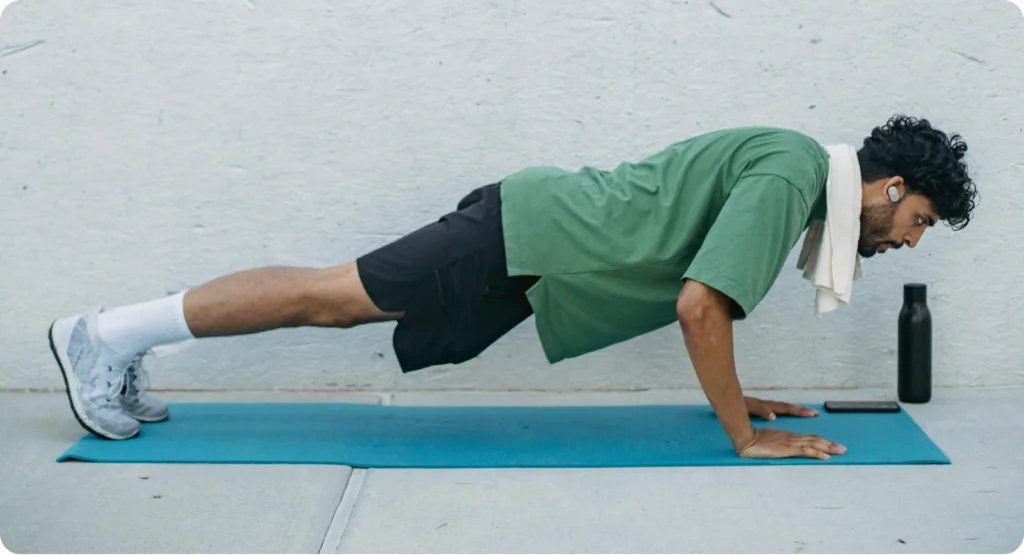
Hands slightly wider than shoulder width, knees on the floor, body in a straight line from head to knees. Lower your chest toward the floor under control, then press back up.
Lie on your back with knees bent, feet flat on the floor, and a dumbbell across your hips. Drive your hips up until your body forms a straight line from shoulders to knees. Hold for two seconds at the top, then lower with control.
Lie on your back, arms extended toward the ceiling, knees bent at 90 degrees. Slowly extend one arm overhead and the opposite leg toward the floor. Return and switch sides.
A brisk walk on rest days. If you only have 30 minutes for your workouts, you probably have 20 for a walk.
Brief stretching focused on hips and shoulders. Five minutes is enough if it is targeted.
Phase 2: More Load, Same Time (Weeks 5-8)
Phase 2 increases all exercises to 4 sets and drops the rep range to 6-8 for heavier loading. Knee push-ups progress to full push-ups. The sessions stay under 30 minutes because rest periods remain at 60 seconds.
One extra set on the first exercise adds roughly 2 to 3 minutes. Tighten rest on the lighter exercises to 60 seconds to keep the total under 30. The constraint is the point of this program. Work within it.
Hold a dumbbell vertically against your chest. Squat down keeping your torso upright, elbows tracking between your knees. Drive through your heels to stand.
Lie flat on a bench or the floor, dumbbells at chest level. Press up to full extension, then lower under control.
Hinge at the hips with a flat back, dumbbells hanging. Row both up to your lower ribs, squeeze your back, then lower with control.
Lie on your back with knees bent, feet flat on the floor. Curl your upper body off the floor by flexing through your abs, pause at the top, then lower with control. No equipment needed.
Hold dumbbells in front of your thighs. Push your hips back, lower along your legs until you feel a hamstring stretch. Drive your hips forward to return.
Seated or standing, dumbbells at shoulder height. Press overhead to full extension, lower with control.
One hand on a bench or chair, row the dumbbell to your hip with the other. Squeeze your back at the top, lower slowly.
Hold dumbbells at your sides. Step back, lower your back knee toward the floor, drive through the front heel to return. All reps on one leg before switching.
Stand with a wide stance, toes pointed outward. Hold one dumbbell vertically in front of you with both hands. Squat down by pushing your knees out over your toes, keeping your torso upright. Drive through your heels to stand.
Full push-ups from the toes. Progression from knee push-ups in Phase 1. If full push-ups are still too hard, alternate between full and knee reps within each set.
Lie on your back with knees bent, feet flat on the floor, and a dumbbell across your hips. Drive your hips up until your body forms a straight line from shoulders to knees. Hold for two seconds at the top, then lower with control.
Lie on your back, arms extended toward the ceiling, knees bent at 90 degrees. Slowly extend one arm overhead and the opposite leg toward the floor. Return and switch sides.
Same as Phase 1. Keep the habit going.
Same as Phase 1. Brief, targeted, effective.
30-Minute Home Workout Plan PDF
A dumbbell and bodyweight program for beginner to early intermediate lifters who can't commit to long sessions.
This is a 3-day full body plan you run for 8 weeks, four exercises per session at 3 sets with 60 seconds rest, finishing in under 30 minutes. Phase 2 moves every lift to 4 sets at 6-8 reps and progresses knee push-ups to full push-ups.
- Four Exercises, Straight Sets, Done No filler and no supersets keeps every session under 30 minutes.
- Full Body Coverage Three Times A Week Each session covers a squat, hinge, push, and pull pattern.
- Push-Ups Replace Knee Push-Ups In Phase 2 Sets move to 4 and reps drop to 6-8 as the loading gets heavier.
Get Your 30-Minute Home Workout Plan
Includes both training phases, the weekly schedule, and exercise cues for all three sessions. Download instantly after you submit the form.
Unsubscribe any time.
Nutrition Guidance
Short training sessions do not mean you can skip nutrition. The work you do in 30 minutes still needs fuel and recovery support. Getting your protein right is the single biggest lever you can pull. If your time is limited for training, it is probably limited for cooking too. Our guide on micro workouts and time-efficient training covers how to get results from short sessions and how to match your nutrition to a time-constrained lifestyle.
The Basics
- Protein: 1.6 to 2.2g per kg of bodyweight daily. This is the most important nutritional variable regardless of how long your sessions are. Our macro-friendly recipes are designed to be quick and protein-rich, just like your sessions.
- Calories: Match your calorie intake to your goal. Maintenance for general fitness, a small surplus for muscle building, a moderate deficit for fat loss. Our macro calculator gives you a number to aim for based on your goal.
- Pre-training: A small meal or snack with protein and carbs 60 to 90 minutes before your session. Even a banana and a protein shake is enough.
- Sleep: Seven to nine hours per night. Recovery happens outside the gym, and short sessions do not reduce your need for sleep.
A 30-minute workout with 8 hours of sleep produces better results than a 90-minute workout with 5 hours of sleep. If you are short on time, protect your sleep first. Our guide on sleep and its impact on your results explains why.