Bodyweight Glute Building Program
Build stronger glutes at home with zero gym equipment. Three sessions per week using your bodyweight, each session focused on the glutes from a different angle. Progressive overload through harder variations, not heavier weights.
Program Overview
This is a structured program built entirely around bodyweight glute exercises you can do at home with nothing more than some floor space. Three sessions per week, each built around a different glute training emphasis: hip extension, abduction, and single-leg stability. The glutes respond to three things: load, stretch, and frequency. Without a gym, load is limited, but stretch and frequency are fully within your control. This program trains the glutes three times per week through different movement patterns and ranges of motion, which is enough stimulus for real growth even without heavy barbells. Phase 1 builds the foundation with standard bodyweight movements. Phase 2 progresses to harder variations that increase the challenge without adding equipment. If you have a resistance band, it can be added to any bridge, squat, or abduction exercise for extra resistance, but it is not required. The three sessions can be done on any nonconsecutive days of the week. Monday, Wednesday, Friday is the default, but Tuesday, Thursday, Saturday or any other arrangement with a rest day between sessions works just as well.
Floor space and something to elevate your feet on (a couch, chair, or sturdy box). That is it. If you have a looped resistance band (hip circle style), it can be added to bridges, squats, and abduction exercises for extra resistance. A band is a useful progression tool but the program works without one.
Who Is This For?
This program is for anyone who wants to build their glutes at home without gym equipment. This plan is right for you if:
- You want to grow your glutes but do not have access to a gym
- You have some floor space and a couch or sturdy chair
- You can commit to three sessions per week for 8 weeks
- You are a beginner or returning to training after a break
- You want a structured plan, not random glute exercises from social media
If you have been training glutes consistently for 6 or more months and bodyweight is no longer challenging, you will need external load to keep progressing. Our Beginner Glute Workout Plan uses gym equipment for heavier loading, or the Glute and Strength Specialization Program is built for advanced lifters.
Weekly Schedule
Phase 1: Build the Foundation (Weeks 1-4)
Three sessions per week. Session A focuses on hip extension (bridges, thrusts). Session B focuses on abduction and outer glute work (lateral patterns). Session C focuses on single-leg stability and stretch (split squats, lunges). All exercises at 3 sets with 60 seconds rest. Once you can complete all prescribed reps with good form, progress by slowing the tempo, adding a pause, or introducing a resistance band.
Bodyweight progression comes from making the movement harder, not adding load. Your tools are: slower tempo (three-second descent), pauses at the hardest position (bottom of a squat, top of a bridge), single-leg variations, and adding a resistance band if you have one. Use these in order. If an exercise feels easy at the prescribed reps, apply the next progression tool before moving to Phase 2.
Lie on your back, knees bent, feet flat on the floor. Drive your hips up until your body forms a straight line from shoulders to knees. Hold for two seconds at the top, lower with control.
Upper back on a couch or sturdy chair. Feet flat on the floor, shoulder width apart. Drive your hips up until your body forms a straight line from shoulders to knees. Hold for two seconds, lower with control.
Lie on your back, soles of your feet together, knees dropped out to the sides. Drive your hips up by squeezing your glutes. Hold briefly at the top, lower with control.
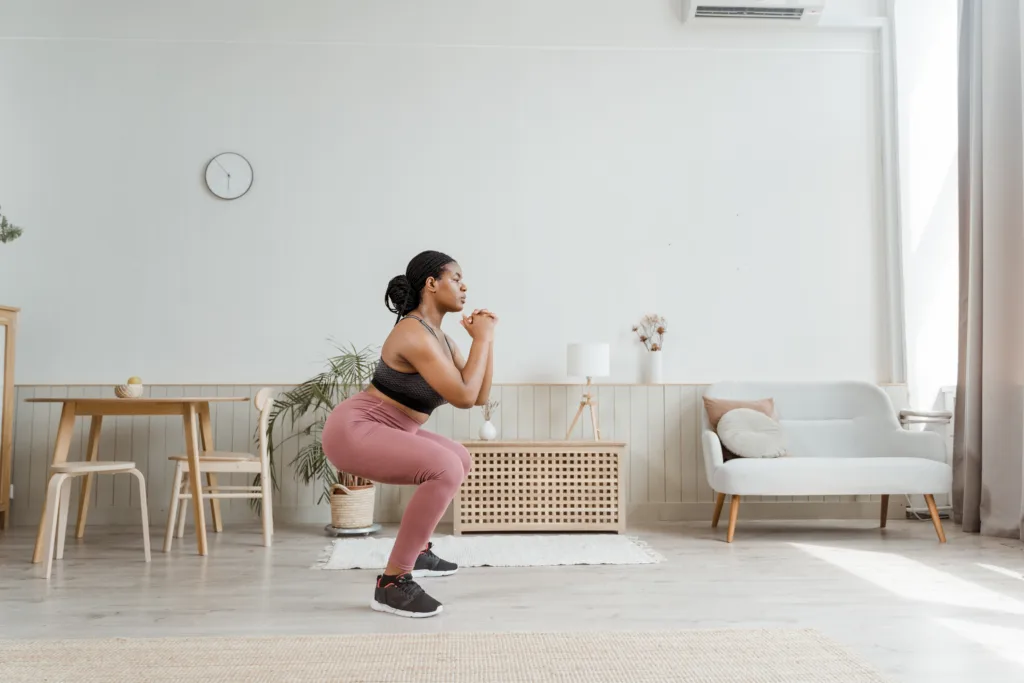
Feet shoulder width, toes slightly out. Sit your hips back and down until your thighs are parallel to the floor. Drive through your heels to stand.
On all fours, extend one arm forward and the opposite leg back until both are parallel to the floor. Hold briefly, return with control, switch sides.
On all fours, lift one knee out to the side while keeping it bent at 90 degrees. Squeeze your outer glute at the top, lower with control. Complete all reps before switching.
Lie on your side, knees bent, feet together. Open your top knee by squeezing your outer glute, keeping your feet in contact. Lower with control. Complete all reps before switching.
Lie on your back, knees bent, feet flat on the floor. Drive your hips up until your body forms a straight line from shoulders to knees. Hold for two seconds at the top, lower with control.
Stand tall. Step one foot behind and across the other leg, lowering into a lunge. Drive through the front heel to return. Complete all reps on one side before switching.
Stand wide. Shift your weight to one side, squatting down on that leg while the other stays straight. Drive through the working heel to return. Complete all reps on one side before switching.
Rear foot on a couch or chair behind you. Lower straight down until your back knee nearly touches the floor. Drive through the front heel to return. Complete all reps on one leg before switching.
Lie on your back, knees bent, feet flat. Lift one foot off the floor and drive your hips up using the working leg only. Hold for two seconds at the top, lower with control. Complete all reps before switching.
Stand with one foot slightly behind the other, back foot on its toes providing light balance support. Squat down through the front leg, driving most of the load through the front heel. Return and complete all reps before switching.
Same as Session A. Pure glute isolation to finish the week.
Lie on your back with knees bent. Curl your upper body off the floor by flexing through your abs, pause at the top, lower with control.
Walking on rest days. The glutes are active during walking, especially uphill. If you have access to hills or stairs, use them.
Hip flexor stretches, 90/90 hip switches, and deep squat holds. The glute program loads your hips from multiple angles and they will tighten up without mobility work.
Phase 2: Harder Variations (Weeks 5-8)
Phase 2 progresses through harder exercise variations, not just more reps. Bridges become feet-elevated. Hip thrusts go single-leg. Squats gain a 1.5-rep pattern. If you have a resistance band, Phase 2 is where it adds the most value. The exercises change because at bodyweight, progression comes from making the movement harder, not adding load.
If you are still finding Phase 1 challenging by Week 4, repeat it for another 2 to 4 weeks before moving to Phase 2. There is no rush. The harder variations in Phase 2 require solid form on the basics first. Moving to single-leg hip thrusts when your two-leg bridge is still shaky will not produce better results.
Same as the banded bridge from Phase 1 but with your feet elevated on a step, couch, or sturdy box. Band stays above the knees. The elevation increases the range of motion and shifts more load onto the glutes.
Same setup as the bodyweight hip thrust from Phase 1 but with one foot off the floor. Drive through the working leg only. Hold for two seconds at the top, lower with control.
Five extra reps from Phase 1. Add a band above your knees for additional resistance if bodyweight alone is no longer challenging.
Squat to full depth, come halfway up, go back to full depth, then stand fully. That entire sequence is one rep. The extra half rep at the bottom doubles the time your glutes spend in the hardest position.
Two extra reps per side with a two-second hold at full extension. The hold makes every rep significantly harder.
Same exercise from Phase 1 with a one-second hold at the top of every rep. Three extra reps per leg. Add a resistance band if you have one for additional outer glute resistance.
Five extra reps per side from Phase 1. Add a two-second hold at the open position on every rep. A resistance band adds meaningful resistance if you have one.
Replaces the flat banded bridge from Phase 1. Band above the knees, feet on a step or low surface. Push knees apart throughout.
Two to three extra reps per leg from Phase 1. Add a band above your knees for additional outer glute resistance during the lunge.
Two extra reps per leg. Your depth should have improved since Phase 1. Go deeper if your mobility allows.
Two to three extra reps per leg from Phase 1. Add a band above your knees for additional glute activation during the squat.
Three extra reps per leg from Phase 1. By now, your hips should stay level throughout. Add a band above your knees on the working leg for extra resistance.
Same staggered stance as a split squat but with your front foot on a small step or plate. The elevation extends the range of motion and increases the glute stretch at the bottom.
Same as Session A Phase 2. Pure glute isolation to finish the week.
Five extra reps from Phase 1. Hold a heavy book or backpack on your chest if bodyweight is too easy.
Same as Phase 1. Incline walking if available.
Same as Phase 1. Hip flexor stretches and deep squat holds.
Bodyweight Glute Building Program PDF
A no-equipment glute program for anyone building their glutes at home without a gym.
This is a 3-day bodyweight plan you run for 8 weeks, no equipment required, with each session hitting a different glute emphasis: hip extension, abduction, and single-leg stability. Phase 2 progresses to feet-elevated bridges, single-leg hip thrusts, and a 1.5-rep squat pattern, with a band adding extra resistance for anyone who has one.
- Three Angles, Three Sessions Hip extension, abduction, and single-leg work each get their own day.
- Progress Comes From Harder Variations No weights needed, just tougher versions of the same movements.
- The 1.5-Rep Squat Doubles The Hard Part Extra time at full depth makes Phase 2 noticeably harder without new equipment.
Get Your Bodyweight Glute Program
Includes both training phases, the weekly schedule, and exercise cues for all three sessions. Download instantly after you submit the form.
Unsubscribe any time.
Nutrition Guidance
Building glutes requires a calorie surplus or at minimum eating at maintenance. If you are in a significant calorie deficit, this program will help you maintain glute strength but will not build noticeable size. The glutes are a large muscle group and they need fuel to grow. Our guide on the top exercises for growing the glutes covers the training principles behind glute growth in more detail.
The Basics
- Calories: Eat at maintenance or in a slight surplus of 200 to 300 calories per day if your goal is glute growth. Our macro calculator can help you find your starting point.
- Protein: 1.6 to 2.2g per kg of bodyweight daily. The glutes recover and grow from protein, especially after three sessions per week. Browse our high protein recipes for practical meal ideas.
- Timing: A meal with protein and carbs within a couple of hours after training supports recovery. Beyond that, hit your daily targets and do not overcomplicate it.
- Sleep: Seven to nine hours per night. The glutes are the largest muscle group in your body and they need recovery time to grow. Sleep is where that happens.
Beginners can build some glute size even in a mild deficit because the stimulus is new and the body responds strongly. But for sustained growth, you need adequate calories. If your primary goal is fat loss and you want to train glutes, this program will maintain and strengthen them while you cut. For actual growth, eat at maintenance or above. Our guide on how to gain muscle explains the nutrition side of muscle building.