Glute and Strength Specialization Program
Three hip thrust sessions per week: heavy, moderate, and volume. An 8-week advanced glute block with targeted isolation work built around one goal, stronger and bigger glutes.
Program Overview
Glute development stalls for most advanced lifters not because they lack effort but because they lack specificity. General programs spread lower body volume across the squat, deadlift, lunge, and hip thrust without giving any single movement enough frequency or loading to drive meaningful progress. This program addresses that gap. The barbell hip thrust is the primary lift. It is trained three times per week: once at low rep ranges with near-maximal loading on Monday, once at moderate loading as part of the Wednesday session, and once at higher rep ranges specifically for volume accumulation on Saturday. Each session has a distinct loading intent, they are not three identical workouts. The Romanian deadlift and Bulgarian split squat support the primary lift by developing the hamstrings and unilateral glute strength that heavy hip thrusting demands. The squat is present as a compound support movement rather than the primary focus. Upper body work is genuine maintenance across a single session per week. The program runs for eight weeks with a strength test in week 8 on the hip thrust and Romanian deadlift.
The distinction between a glute activation program and a glute strength program is loading. This program progresses the hip thrust and Romanian deadlift as primary strength movements, loading them with genuine progressive overload across both phases. Resistance bands, bodyweight circuits, and high-rep isolation work support the heavy compound work but do not replace it.
Who Is This For?
This program is for advanced lifters whose glute development has plateaued on general training and who want to bring their glute strength and size up as the primary goal for a training cycle. This plan is right for you if:
- You have been training consistently for 2 or more years with structured programming
- Your glutes are a weak point relative to your other lower body development
- You can barbell hip thrust and Romanian deadlift with technically sound form under load
- You are comfortable with 4 training sessions per week and can manage the recovery
- You are prepared to accept reduced development of everything else for 8 weeks
If your glutes are still developing on a general program, complete that program first. Browse our advanced programs to find the right general program to run before committing to a specialization block.
Weekly Schedule
Phase 1: Volume Accumulation (Weeks 1-4)
Phase 1 builds work capacity on the primary movements at moderate intensity. The heavy glute session targets RPE 7 to 8 on the hip thrust across all sets. This is controlled enough to sustain across four consecutive weeks of twice-weekly glute sessions. The volume glute session on Saturday is lighter and more accessory-focused.
Choose a starting weight on the barbell hip thrust that feels like RPE 7 in Week 1. Add weight each week when you complete all prescribed reps with a full two-second squeeze at the top on every rep. The Romanian deadlift should be treated with the same seriousness as the hip thrust, both are primary strength movements in this program.nnRPE stands for Rate of Perceived Exertion, a scale from 1 to 10 that measures how hard a set feels. RPE 7 means you could do about 3 more reps. RPE 8 means 2 reps left. RPE 9 means 1 rep left. RPE 10 means you could not do another rep with good form. Using RPE helps you train hard enough to make progress while managing fatigue and reducing injury risk.
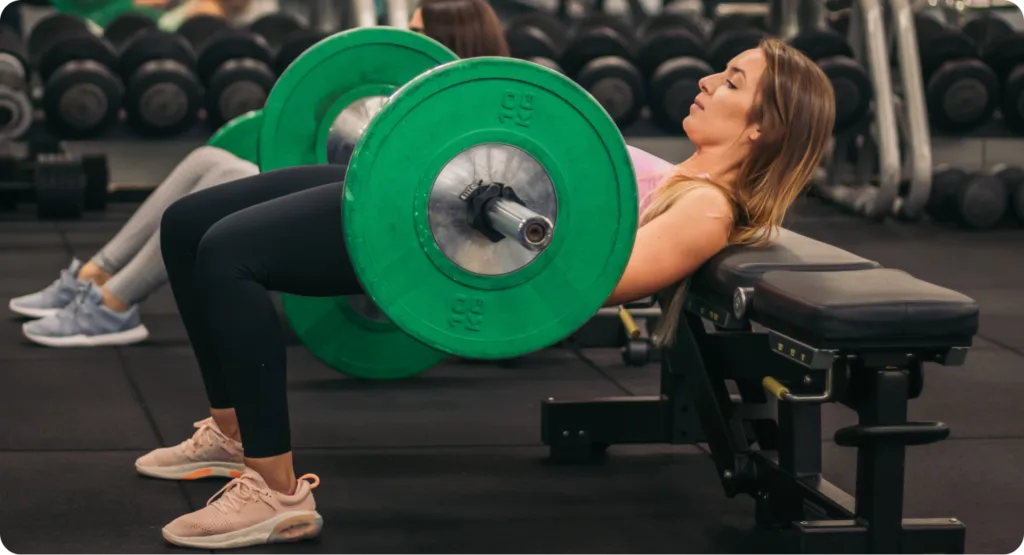
Upper back against a bench, barbell across your hips with a pad. Drive your hips to full extension and hold for two full seconds at the top, squeezing your glutes as hard as possible before lowering. This is the primary lift of the entire program. At advanced level, the hip thrust should be loaded with serious weight, do not treat this as an activation exercise.
Push your hips back and lower the bar along your shins until you feel a strong hamstring stretch, then drive your hips forward to return. The Romanian deadlift is the primary hinge movement of the program and directly develops the hamstring strength that supports hip thrust performance. Lower over 3 to 4 seconds.
Rear foot on a bench, dumbbells at your sides. Lower your back knee toward the floor and drive back up through your front heel. Unilateral glute and quad loading that develops the single-leg strength and stability that heavy hip thrusts and squats demand.
Attach a cable to your ankle at a low pulley. Stand facing the machine and extend your leg back and up, squeezing your glute at the top of the movement. Direct glute isolation in the hip extension range. The cable maintains tension throughout the movement unlike bodyweight versions.
Attach a cable to your ankle at a low pulley. Stand sideways to the machine and raise your leg out to the side against the cable resistance. Targets the gluteus medius, the outer glute, which contributes to hip stability under load and the rounded appearance of the glute from the side.
The squat is a support lift in this program. It develops the compound leg strength and glute drive out of the hole that carries over to hip thrust performance. Keep this at RPE 7 maximum, challenging but not depleting.
Hold dumbbells with one foot slightly behind the other for balance. Hinge at the hips, loading primarily through the front leg. Lower until you feel a strong hamstring stretch, then drive back up. Switch sides. Unilateral hamstring and glute work that addresses imbalances between sides.
Same setup as Session 1 but at a lighter weight and higher rep range. This is volume work to accumulate additional glute stimulus across the week. The two-second hold at the top still applies on every rep.
Kneel at a high cable with the rope attachment. Flex your spine and crunch your rib cage toward your pelvis. Direct core work at the end of a session that already includes squats, unilateral hinging, and hip thrusts, all of which demand strong bracing.
On all fours, extend your right arm and left leg simultaneously until both are parallel to the floor. Hold for two to three seconds, return with control, repeat on the other side. Anti-extension core stability that supports bracing quality across all the primary lifts.
Three sets at a moderate rep range. Maintenance pressing volume to preserve horizontal push strength across the block.
Press from shoulder height straight overhead. Maintenance overhead pressing volume to preserve shoulder strength and stability.
Grip slightly wider than shoulder width. Pull to your upper chest driving your elbows down and back. Control the return to full arm extension. Four sets maintains lat and upper back development across the block.
Pull the handle to your lower chest, pause for one second at full contraction, then lower slowly. Horizontal pull maintenance to balance the pressing volume.
Hinge forward with light dumbbells. Raise both arms out to the sides until parallel to the floor. Rear delt health work to maintain shoulder balance across a block with consistent pressing volume.
High cable with rope attachment. Elbows pinned, push to full extension. Three sets of direct triceps work maintains arm strength alongside the indirect work from pressing.
Third hip thrust session of the week at moderate loading. The volume session accumulates additional glute stimulus at a rep range that drives hypertrophy. Two-second hold at the top on every rep.
Hold dumbbells at your sides and step forward into a lunge. Lower your back knee toward the floor, pause briefly, then push back to standing. Unilateral quad and glute volume with a different loading pattern than the split squat.
Lock your feet into the glute ham raise machine. Lower your torso toward the floor by bending at the knee, then use your hamstrings and glutes to pull yourself back up. One of the highly effective hamstring and glute exercises available, combining knee flexion and hip extension in the same movement.
Standing with a cable attached to your ankle, hinge forward then kick your heel up toward the ceiling, squeezing your glute at the top. A direct glute isolation movement that loads the hip extension range where the glute is most active.
Lie on your back with the soles of your feet pressed together and your knees out to the sides. Drive your hips up by squeezing your glutes, hold briefly at the top, lower with control. A glute-dominant hip extension exercise that minimizes hamstring and quad involvement due to the externally rotated position.
Balls of your feet on an elevated surface. Full stretch at the bottom, pause for one second, drive all the way up. Calf raises are included here as minimal-cost maintenance work, they add no meaningful systemic fatigue at the end of a glute-focused session and keep lower leg strength ticking over across the 8-week block.
Phase 2: Intensification (Weeks 5-8)
Phase 2 increases intensity on the primary hip thrust and Romanian deadlift. The heavy glute session drops to lower rep ranges with heavier loading. The volume glute session gains one set. Upper body maintenance stays consistent. Week 8 is your test week: attempt a new 5-rep max on the barbell hip thrust and a new 5-rep max on the Romanian deadlift.
In Week 8, use Session 1 to test your hip thrust and Romanian deadlift. Warm up thoroughly and work up to a challenging set of 5 on the hip thrust at RPE 9. Rest fully, then repeat on the Romanian deadlift. Compare both to your Week 1 starting weights. A meaningful result is any load increase that still allows technically clean reps with the two-second hold maintained throughout. Even a modest load increase across 8 weeks represents genuine strength progression on movements that advanced lifters find hard to improve.
Fewer sets, lower rep range, heavier loading. Phase 2 hip thrust targets RPE 8 to 9. This should feel like genuine near-maximal effort on the final set. The two-second hold at the top becomes harder to maintain at high loads, if you cannot hold it, the weight is too heavy.
Same sets, lower rep range, heavier loading than Phase 1. The Romanian deadlift at Phase 2 intensity is a genuinely demanding strength exercise. Lower over 3 to 4 seconds on every rep.
One extra set with heavier loading. Add a pause at the bottom of each rep in Phase 2 to increase the training demand without additional weight.
One extra set with more weight on the cable. Direct glute isolation volume increases alongside the heavier compound work in Phase 2.
Same sets, slightly more resistance on the cable. Glute medius work continues at consistent volume through Phase 2.
Same sets, lower rep range, slightly heavier loading than Phase 1. The squat stays at RPE 7 throughout Phase 2. As the hip thrust gets heavier, maintaining the squat at moderate intensity becomes more important for recovery management.
One extra set with heavier loading. Unilateral hamstring and glute development continues to grow across Phase 2.
One extra set at the same rep range with more weight. Volume accumulation on the hip thrust increases in Phase 2 to support the heavier primary session loading.
Same sets, slightly more weight. Core strength work continues at consistent volume through Phase 2.
Same sets. Add a three-second hold at full extension in Phase 2 to increase the anti-rotation demand as primary lift loads approach maximal.
Same sets, slightly heavier loading. Pressing maintenance holds at consistent volume across both phases.
Same sets, slightly heavier loading. Overhead pressing maintenance continues at consistent volume.
Same sets, slightly heavier loading. Lat maintenance holds at four sets through Phase 2.
Same sets, slightly heavier loading. Horizontal pull maintenance holds through Phase 2.
Same sets. Rear delt health work holds consistently throughout Phase 2.
Same sets, slightly more weight. Triceps maintenance continues at consistent volume.
One extra set with more weight. Five sets of volume hip thrusts on Saturday gives substantial total weekly hip thrust volume across all three sessions.
One extra set with heavier dumbbells. Unilateral leg volume increases in Phase 2 to support the heavier primary lift work.
One extra set. By Phase 2 the glute ham raise should be noticeably harder than Week 1 due to accumulated hamstring and glute strength from the program.
Standing with a cable attached to your ankle, hinge forward then kick your heel up toward the ceiling, squeezing your glute at the top. A direct glute isolation movement that loads the hip extension range where the glute is most active.
Same sets. Add a light plate on your hips in Phase 2 to increase the resistance. The glute-dominant position is what makes this effective as a finisher.
Balls of your feet on an elevated surface. Full stretch at the bottom, pause for one second, drive all the way up. Calf raises are included here as minimal-cost maintenance work, they add no meaningful systemic fatigue at the end of a glute-focused session and keep lower leg strength ticking over across the 8-week block.
Glute and Strength Specialization Program PDF
An advanced glute specialization block for lifters whose glute development has plateaued on general training.
This is a 4-day gym program you run for 8 weeks, training the barbell hip thrust three times a week: heavy on Monday, moderate on Wednesday, and high-rep volume on Saturday, with a single upper body maintenance day on Thursday. Phase 1 (weeks 1-4) builds work capacity at RPE 7-8 on the hip thrust while the squat stays capped at RPE 7 as a support lift. Phase 2 (weeks 5-8) drops the heavy session to 3-5 reps at RPE 8-9, adds a set to the volume session, and ends in a week 8 test for a new 5-rep max on the hip thrust and Romanian deadlift.
- The Hip Thrust Trained Three Times A Week Each session has a different loading intent, so the frequency builds real strength instead of just piling on volume.
- A Genuine Strength Test In Week 8 You work up to a new 5-rep max on the hip thrust and Romanian deadlift to measure real progress, not just a pump.
- Everything Else Held To Maintenance A single upper body session and a capped-intensity squat protect recovery so the glute work gets the lion's share of it.
Get Your Glute Specialization Program
Includes both training phases, the weekly schedule, and exercise cues for all four sessions. Download instantly after you submit the form.
Unsubscribe any time.
Nutrition Guidance
Glute and lower body specialization at this intensity creates a genuine caloric and protein demand. The hip thrust and Romanian deadlift at heavy loading are systemically demanding exercises, and twice-weekly sessions at high intensity require nutritional support to drive the adaptation you are training for. For a practical breakdown of the highly effective exercises for glute development and how to load them, our guide on the top five exercises for growing the glutes covers the rationale behind the primary movement choices in this program.
Nutrition for Glute Specialization
- Protein: 1.8 to 2.2g per kg of bodyweight daily. Twice-weekly heavy sessions create real demands on muscle protein synthesis. Sitting at the higher end of this range supports recovery and adaptation more reliably across an 8-week block. Our high protein recipe collection can help you hit your target consistently.
- Calories: Eat at maintenance or a small surplus of 150 to 250 calories. Glute muscle development is significantly harder to achieve in a caloric deficit. If body composition is the goal, address it in a separate training cycle after this block. Our macro calculator can set your targets based on your training volume and goal.
- Carbohydrates: Heavy hip thrusts and Romanian deadlifts run on glycogen. Prioritise carbohydrate intake around Monday and Saturday training sessions.
- Sleep: Seven to nine hours per night. Recovery from twice-weekly heavy glute sessions, particularly the hip thrust, requires adequate sleep to consolidate the strength adaptations that drive week-to-week progress.
Accumulated fatigue from twice-weekly heavy loading becomes significant by Weeks 6 and 7 in Phase 2. If your Monday hip thrust performance is declining rather than holding or improving, take a lighter week before continuing. Our guide on how to deload effectively covers how to structure a lighter week without losing momentum.