The glutes get more attention than any other muscle group, and most of it focuses on how they look. That is fine as a motivation, but it undersells them. Your glutes are the largest muscle in your body and the main engine behind standing up, climbing stairs, and holding your pelvis steady every time you take a step. When they are weak, your lower back and knees end up doing work that was never theirs to do.
Below are the 12 best glute exercises, each with a form video, grouped by the job they do rather than by equipment. Under them you will find a sample glute session and the programming that actually makes the difference. Most of these need nothing more than a dumbbell and a bench.
How to use this guide: Every exercise has a form video, set to the women’s demo by default, with a toggle above it for the men’s version. You do not need all twelve. Pick one from each of the four groups below, get strong at those, and you have a complete glute programme.
Jump to a Topic
What the glutes actually do
To train a muscle well, you need to know what movement it produces, because the best exercises are the ones that load that movement directly.
“Glutes” is really three muscles. The gluteus maximus is the big one, and its main job is hip extension: taking your hips from a bent, hinged position back into line with your torso. That is the motion in a hip thrust, a deadlift, and the drive out of the bottom of a squat. The gluteus medius and minimus sit higher and further round the side, and their job is mostly abduction, moving your leg out away from the midline, plus stabilising your pelvis when you stand on one leg.
That split is why a programme of nothing but squats leaves gaps. Squats load hip extension well at the bottom and poorly at the top, and they barely touch abduction at all. Training all three muscles across their full range is what produces both the strength and the shape people are after.
How to choose your exercises
This list is a starting point rather than a prescription. Body proportions, equipment, and injury history all mean different exercises suit different people. A movement earns a place in your programme if it meets three criteria:
- It loads the muscle you are trying to train.
- You can perform it safely with technique that holds up.
- You can add weight or reps to it over time in a practical way.
That third one is where most people come unstuck. Progressive overload is what drives growth, so getting strong at a handful of well-chosen exercises beats rotating through a long list of movements you never load properly.
Hip Extension: The Main Event
These load the glutes hardest at the top, in the fully shortened position where squats and deadlifts give them the least tension. If you only do one category, make it this one.
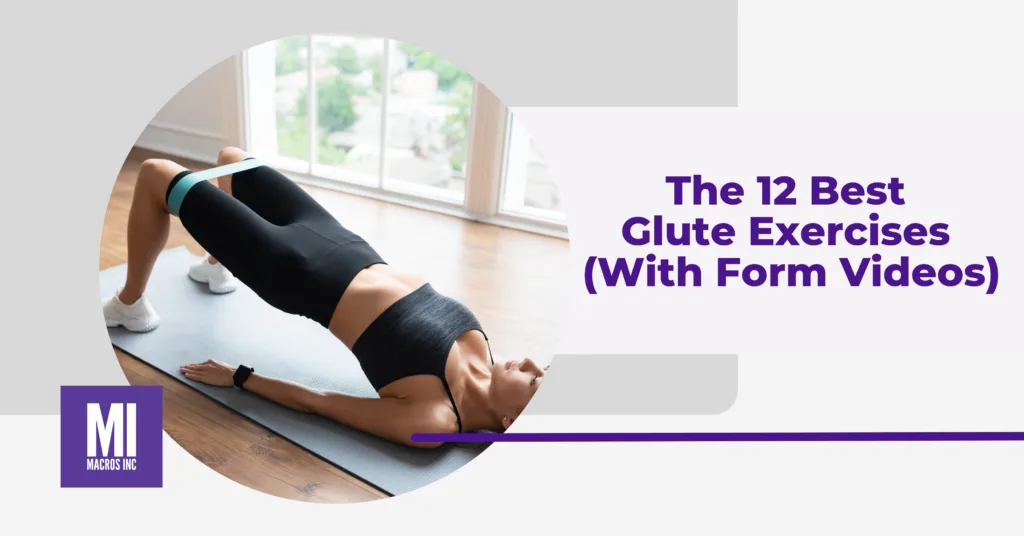
1. Glute Bridge
Lie on your back with your knees bent and feet flat, roughly hip width. Drive through your heels to lift your hips until your body forms a straight line from knees to shoulders, squeeze your glutes hard at the top, then lower under control.
Form tip: Keep your ribs down and your chin gently tucked so the movement comes from your hips rather than your lower back arching. If you feel this mostly in your hamstrings, bring your heels a little closer to your backside.
2. Dumbbell Hip Thrust
Sit with your upper back against a bench or sofa and a dumbbell resting across your hips, cushioned with a folded towel. Plant your feet so your shins end up vertical at the top, drive through your heels, and lift until your body is level from knees to shoulders. Pause for a full second at the top before lowering.
Form tip: The bench should sit just below your shoulder blades so your upper back can pivot on it. Too high and you will find yourself arching rather than hinging.
3. Barbell Hip Thrust
Same setup as the dumbbell version, with a barbell and a thick pad across your hips. Drive up to full lockout, squeeze, and lower under control. The reason this exercise earns its reputation is simple: you can load it heavily and add weight to it for years, which is exactly what drives growth.
Form tip: Stop at level. Pushing past a straight line from knees to shoulders means your lower back is finishing the rep, not your glutes. It looks like more range and is actually less.
4. Cable Pull Through
Set a rope on the lowest cable setting and face away from the machine, rope held between your legs. Push your hips back and let your arms travel between your legs, then drive your hips forward to stand tall and squeeze your glutes at the top.
Form tip: This is not a squat and it is not a row. Your arms are just hooks, your knees stay softly bent, and every bit of the movement comes from your hips travelling back and forward. It is the best exercise on this page for learning what a hip hinge feels like.
A Glute Plan You Can Follow
Our 3-day beginner glute plan builds around the hip thrust with the sets, reps and weekly progression already worked out, so you are not guessing at what to do next.
Hinges: Glutes Under Stretch
Where hip thrusts load the top of the movement, hinges load the bottom, with the glutes and hamstrings under a deep stretch. Research increasingly points to that stretched position as a strong driver of growth, which is why a good programme includes both.
5. Romanian Deadlift
Stand tall with the bar or dumbbells at your thighs. Push your hips back and let the weight travel down the front of your legs, keeping your knees only slightly bent and your back flat, until you feel a strong stretch through your hamstrings. Drive your hips forward to stand and squeeze at the top.
Form tip: Worth distinguishing this from the stiff-legged deadlift, which keeps the legs almost straight and shifts more work onto the lower back. The slight knee bend in an RDL is what keeps the load on your glutes and hamstrings. Your depth is set by your hamstrings, not by the floor, so stop where the stretch is and before your back starts to round.
6. B-Stance Romanian Deadlift
Set up as for a Romanian deadlift, then slide one foot back so only the toes touch the floor, level with the heel of the front foot. Hinge as normal. The back foot is a kickstand for balance only, with around 80 to 90% of the load going through the front leg.
Form tip: Resist the urge to push through the back foot. If you can lift those back toes off the floor at the bottom of the rep without wobbling, you have the weight distribution about right.
Single Leg Work
Training one leg at a time does two things a two-legged exercise cannot. It exposes strength differences between sides that a squat will happily hide, and it forces the gluteus medius to work hard stabilising your pelvis while you balance.
7. Bulgarian Split Squat
Stand a couple of feet in front of a bench and place the top of one foot on it behind you. Lower straight down until your front thigh is roughly parallel with the floor, then drive back up through your front heel.
Form tip: Two adjustments make this a glute exercise rather than a quad exercise: step further forward, and lean your torso slightly over the front leg. Hold a wall or rack with one hand while you find your balance, everyone does at first.
8. Box Step Over
Face a sturdy box or bench and place one whole foot on top. Drive through that leg to stand up on the box, bring the other foot through, then step down under control and alternate.
Form tip: All the work should come from the foot on the box. If you are bouncing off your back leg to get up there, the box is too high. A higher box means more glute involvement, so raise it as you get stronger rather than starting there.
9. Curtsy Lunge
From standing, step one leg behind and across the other, as if curtsying, and lower until your front thigh is close to parallel. Push through the front heel to return to standing.
Form tip: Keep your hips square to the front rather than letting them rotate with the stepping leg. The crossing angle is what shifts work onto the gluteus medius, and squared hips are what keep it there.
Squats and Abduction
Squats are on almost every glute list, and they deserve a place, just not the crown they usually get. Abduction work almost never makes those lists, and it is the piece most often missing.
10. Goblet Squat
Hold one dumbbell vertically against your chest with both hands cupping the top. Feet about shoulder width, toes slightly out. Squat down between your legs with your chest tall and heels planted, going as deep as you can manage, then drive back up.
Form tip: Depth is what decides how much glute work a squat gives you. A squat has two components, knee extension and hip extension, and the knee part goes to your quads. Only by dropping your hips below your knee crease do you fully load the hip extension, which is the glute half. A shallow squat is a quad exercise.
11. Band Fire Hydrant
On all fours with a band around your thighs just above the knees, lift one knee out to the side against the band while keeping it bent. Pause at the top, then lower under control.
Form tip: Keep your hips level and square to the floor. The natural cheat is to roll your hips away from the working leg to get more range, which hands the work to your lower back instead. Less range with square hips beats more range without.
12. Band Side Clam
Lie on your side with a band above your knees, hips and knees bent, feet together. Keeping your feet touching, open your top knee against the band as far as you can without your hips rolling backward, then lower slowly.
Form tip: This is a high-rep exercise. Twenty reps that burn beat ten with a band so heavy your form falls apart. Used at the start of a lower body session, it also makes the glutes noticeably more responsive in the work that follows.
Those twelve cover every job the glutes do, but they are not the only options in the library. If you train in a gym, cable donkey kicks and cable hip extensions are excellent isolation work with an easy-to-adjust load. At home, feet elevated glute bridges and frog pumps add range and variety, and the kettlebell swing is a strong explosive hinge if you have one.
A sample glute session
One exercise from each group, in an order that puts your heaviest work when you are freshest. Run this once or twice a week alongside the rest of your training.
| Exercise | Sets | Reps | Rest |
|---|---|---|---|
| Band Side Clam (warm-up) | 2 | 15 to 20 / side | 30 sec |
| Hip Thrust (dumbbell or barbell) | 4 | 8 to 12 | 2 min |
| Romanian Deadlift | 3 | 8 to 12 | 90 sec |
| Bulgarian Split Squat | 3 | 8 to 10 / leg | 90 sec |
| Goblet Squat | 3 | 10 to 12 | 90 sec |
| Band Fire Hydrant | 2 | 15 to 20 / side | 45 sec |
For something already programmed, our 3-day beginner glute plan builds around the hip thrust across three sessions, and the glute and strength specialization program runs these lifts through a longer progressive structure.
Why this matters more with age
Glute training is usually sold on appearance, but the functional case gets stronger every decade. Hip strength is closely tied to balance and to how well you absorb load through your knees and lower back, and both muscle and bone decline from your thirties onward unless you train to keep them. For women, that decline accelerates through perimenopause and menopause.
A lot of persistent lower back and knee discomfort turns out to be hips that are not pulling their weight. Nothing here is a treatment, and anything painful or long-running is worth a conversation with a physio. But strong glutes take real load off the joints either side of them, and that is worth having whether or not you care how they look.
If you are starting from scratch, our guide to strength training for women over 40 covers the full-body version of this with a two-day-a-week plan.
Training is only part of it
You can train as hard as you like, but if your eating does not match the work, the results will not either. Muscle growth needs three things together: a progressive training stimulus, enough energy to build with, and enough protein to build from.
Practically, that means eating at maintenance or in a slight surplus if growth is the priority, and around 1.6 to 2.2g of protein per kilogram of bodyweight daily. Our free macro calculator sets your numbers, our guide on increasing daily protein covers how to hit them, and these high-protein meals under 500 calories make it considerably easier. If you are wondering about timing around sessions, we cover that in what to eat before and after a workout.
Free Muscle Building Programs
Glute exercises only work when they sit inside a structured plan with progressive overload and proper recovery. Our muscle gain programs run beginner through advanced, with several lower body and glute-focused options.
Frequently asked questions
How often should I train glutes?
Two sessions a week works well for most people. That gives you enough volume to drive growth while leaving time to recover between them. Training them every day sounds productive and mostly just leaves you too sore to train hard when it counts.
Can I build glutes at home without weights?
To a point, and it is a good place to start. Glute bridges, bodyweight hip thrusts, curtsy lunges, step ups and band work will all build strength from a low base. The limit is progression: once bodyweight becomes easy, you need a way to add load. A single adjustable dumbbell and a band covers most of what is on this page.
How long until I see results?
Strength improves within a few weeks. Visible change takes longer, usually three to six months of consistent training with food to match. Muscle is built slowly, and anyone promising otherwise is selling something. Stick with it and six months from now you will be glad you started.
Are squats enough on their own?
No. Squats load the glutes well in the stretched bottom position and poorly at the top, and they do very little for the gluteus medius. Pairing them with a hip thrust and some abduction work covers the ranges they miss, which is why this list is grouped the way it is.
Why can’t I feel my glutes working?
Usually one of three things: your range is too short, your form is letting another muscle take over, or you are simply not used to the movement yet. A few sets of band work before your main lifts helps, as does slowing down and pausing at the top. Feeling a muscle is not required for it to grow, but it is a useful sign you are in the right position.
The glutes are like any other muscle. Load them across their full range, get stronger over time, eat enough to support it, and they will respond. Pick one exercise from each group above, run it for a couple of months, and add weight whenever you can.
If you would rather have a coach handle the training and the nutrition together, our fitness and nutrition coaching puts both into one plan built around you.
No gimmicks. No restrictions.
Start your journey with expert coaching, personalized nutrition, and real results, absolutely free for two weeks.