When new clients tell me their goal, one of the most common answers is some version of “I want to turn my fat into muscle.” It’s an intuitive way to describe what most people are after, and the underlying ambition (lose the soft, add the strong) is one of the most universal fitness goals there is. The wording itself isn’t quite right though, and getting the mechanics straight changes how you go about it.
The short answer is no: fat does not convert into muscle, and muscle does not convert into fat. They’re two different tissues with two different functions and they don’t transform into one another. The good news is that the outcome people imagine when they use that phrase, less body fat and more muscle, is absolutely achievable. It just happens through two separate processes running in parallel rather than one tissue magically becoming the other.
Jump to a Topic
Can You Turn Fat Into Muscle?
The Mechanism: Why Not?
Both muscle gain and fat loss are exchanges of energy. Everything in your body is made of molecular bonds. Those bonds require energy to form and release energy when broken. Your primary source of that energy is the food you eat, which is itself made of molecular bonds that your body breaks down to release usable energy. This is broadly the same logic as the calories-in-calories-out (CICO) model.
Fat Loss
Fat loss happens when your body’s energy needs exceed the calories you’re taking in (a calorie deficit). To make up the gap, your body pulls from its main stored-energy reserves: body fat. When body fat is broken down, it releases energy for your body to use. Because energy is being released and tissue is being broken down, this is called a catabolic process.
Muscle Gain
Muscle gain requires energy in order to build the new tissue. Your body is most efficient at this when you’re in a calorie surplus, because some of the excess energy can be allocated to muscle growth. Energy is being used and tissue is being built, which makes this an anabolic process.
The key point is that catabolic and anabolic processes pull in opposite energetic directions. Fat loss and muscle gain are, at the energy level, opposite processes. This is why doing both simultaneously is harder than doing either one on its own, and it’s also why the “convert fat to muscle” framing doesn’t work. There’s no biochemical pathway that takes fat cells and rebuilds them into muscle fibers.
So What’s Actually Happening?
Your body runs through countless anabolic and catabolic reactions every single day. When we talk about fat loss or muscle gain as goals, we’re talking about the net change over an extended stretch of time, the overall direction the body is moving in. Maximizing muscle growth generally wants a calorie surplus. Maximizing fat loss generally wants a calorie deficit. Doing both at once is technically possible in specific scenarios, but it’s not the default and it’s not efficient outside of those scenarios.
So what’s going on in the two situations people typically describe as fat-to-muscle or muscle-to-fat conversion?
“Muscle Turning Into Fat”
This comes up when someone who used to be lean and strong starts looking softer and less defined. The assumption is that their muscle is converting to fat. What’s really happening is two separate processes running at the same time, driven by two different factors.
The muscle loss is usually tied to a drop in training activity. Muscle tissue adapts to whatever stimulus it’s exposed to. Lifting progressively heavier over time produces growth. Stop lifting (or significantly reduce it) and the body interprets that as the tissue no longer being needed at its current size, so it shrinks accordingly.
The fat gain is tied to both diet changes and the reduced activity level. Lower training expenditure plus the same or higher food intake creates a calorie surplus, and because there’s no longer a strong stimulus telling the body to build muscle, most of that surplus is stored as fat instead.
So muscle doesn’t turn into fat. But yes, you can absolutely lose muscle and gain fat at the same time, which is what produces the visual that people interpret as conversion.
“Fat Turning Into Muscle”
This one usually comes up when a lifter drops weight and suddenly seems to be much more muscular. The trick here is mostly visual. The leaner you get, the easier it is to see the muscle you already have. Less body fat sitting on top of the muscles means more separation, more definition, and a more “muscular” overall appearance, even if the actual amount of muscle hasn’t changed much.
A person at higher body fat can be physically bigger by total weight, but the muscle they’re carrying is obscured. As they lean out, the muscle becomes prominent and creates the illusion of substantial new growth. In reality, they’re not adding huge amounts of muscle. They’re revealing what was already there.
The clearest illustration of this is competitive bodybuilders. In the offseason, they walk around at average to higher body fat percentages while bulking or maintaining. When they diet down for a contest, the muscle they’ve built becomes dramatically more visible (Figure 1).
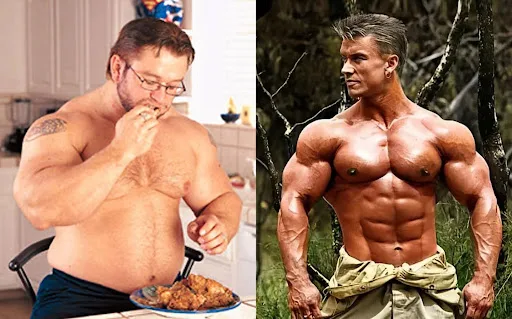
Figure 1: Professional bodybuilder Lee Priest, offseason vs contest shape. His offseason weight was around 270 to 285 pounds (122.7 to 129.5 kg), his contest weight around 200 to 225 pounds (90.9 to 102.3 kg). His height is 5’4″ (162.5 cm). Same person, same muscle, dramatically different visual result.
How to Actually Get the Result You Want
Setting aside the conversion myth, the actual goal (less fat, more muscle) is achievable through two main approaches: body recomposition or alternating bulk and cut phases. Both work. The right one depends on where you’re starting from.
Body Recomposition (Recomp)
Recomp is the act of gaining muscle and losing fat simultaneously while eating around maintenance calories. This works particularly well in two scenarios, and especially when they overlap.
First, people with substantial fat to lose can add lean body mass while at maintenance or even in a small deficit. As long as they’re lifting progressively heavier as they lean out, some muscle growth will accompany the fat loss.
Second, novices new to resistance training can make meaningful strength and muscle gains around maintenance calories, at least for the first 6 to 12 months. Again, the key requirement is challenging the muscles with progressively heavier weight on a structured program. If you’re in that beginner window and don’t already have a routine, our 3-day full-body beginner split is a solid template for getting started.
The ideal recomp candidate is someone who’s both new to weight training and carrying excess body fat. That person can expect real progress on both fronts simultaneously. The catch is that recomp effectiveness sits on a sliding scale. The leaner you get and the more training experience you accumulate, the harder it becomes to add muscle and lose fat at the same time. Eventually, pursuing them as separate phases becomes the more productive path.
Bulking and Cutting
For everyone past the beginner phase, the bulk-and-cut approach tends to be more efficient. It alternates between two distinct phases. The bulk runs a calorie surplus to maximise muscle growth, accepting that some fat gain will come along with it. The cut runs a calorie deficit to lose that fat, with protein and training prioritised to retain the muscle built during the bulk. Over multiple cycles, net muscle accumulates while body fat stays in a controlled range.
If you’re new to the concept, our overview of bulking and who actually benefits from it is a good entry point. For the full mechanics including macro splits, training adjustments, and a worked numerical example, our complete guide to bulking and cutting has the deep technical breakdown. And if you specifically want to keep fat gain to a minimum during the bulk phase, building muscle while minimizing fat gain covers the lean-bulk protocol.
One worthwhile clarification: bulking and cutting is sometimes mistaken for yo-yo dieting. They’re different in two important ways. First, bulking and cutting is done deliberately and sustainably, where yo-yo dieting tends to involve crash diets and unsustainable restrictions. Second, bulking and cutting has a long-term goal of net muscle accumulation, where yo-yo dieting has no goal beyond losing weight. Bulking and cutting is a structured framework. Yo-yoing is a pattern that emerges when there isn’t one.
Free Muscle Building Programs
Whether you’re running a recomp or a structured bulk, progressive resistance training is the lever that moves things. Our muscle gain programs cover the spectrum from beginner-friendly to advanced splits, all free to follow.
Wrap Up
Fat doesn’t convert to muscle and muscle doesn’t convert to fat. What you can do is run two separate processes side by side: lose body fat through a sustained deficit and add muscle through progressive resistance training. Recomp handles both at once when you’re new or starting from higher body fat. Bulking and cutting handles them as alternating phases once you’re past the beginner stage. Either way, consistency over months and years is the actual lever. The biology is settled. The patience is the hard part.
If you’d like a coach to figure out which approach fits your current stage and build the plan around it, talk to one of our coaches.
No gimmicks. No restrictions.
Start your journey with expert coaching, personalized nutrition, and real results, absolutely free for two weeks.