
Bulking and cutting has been a staple of bodybuilding for the better part of a century. It is so ingrained into the sport and culture that it is hard to be a regular gymgoer or spend any time online in fitness circles without coming across the term.
The practice traces back to the late 19th century, referenced by early bodybuilders like Charles Atlas, Bernarr McFadden, Eugen Sandow, and Arthur Saxon. The initial use of the word simply meant putting on body mass. In modern bodybuilding, the definition is more specific: bulking is a phase of eating in a caloric surplus to gain lean body mass, while cutting is the corresponding phase of eating in a caloric deficit to lose fat mass.
This article is the deep technical reference for the cycle. It covers the math, the worked example, the diet and training adjustments per phase, and the considerations most surface-level guides skip. If you’re looking for a faster overview of what bulking is and whether it’s right for you, our piece on bulking and who actually needs to do it is the better entry point. What follows is the comprehensive guide for people who want the full mechanics.
Jump to a Topic
The Complete Guide to Bulking and Cutting
Why Bulk and Cut?
The goal of the bulk and cut cycle is to gain net lean body mass while keeping body fat levels controlled. By separating the two goals into distinct phases, the process tends to be more time-efficient than pursuing both simultaneously. This becomes increasingly true the more advanced a trainee gets. The heavier you lift, the more lean mass you carry, and the more efficiently you train, the harder it becomes to add muscle and lose fat at the same time.
The main alternative is body recomposition, or recomp, where the goal is to gain muscle and lose fat simultaneously. For new trainees, this is a perfectly viable option. The more advanced a trainee gets, the harder it becomes. Recomping also works well for maintenance, or for people who are content with their current physique and want to hold steady between bulking and cutting phases. The broader principles of how to gain muscle apply across all three approaches.
Should I Bulk or Cut First?
This is an individual question with no hard and fast rule. The general principle: start a bulk when you’re relatively lean and start a cut when you have more fat than you’re comfortable carrying. Those goalposts are subjective. A useful gut check is to ask yourself whether you’d be comfortable adding 5 to 15 pounds of fat to your frame over the course of a bulk. If the answer is no, you’re probably not ready to bulk yet.
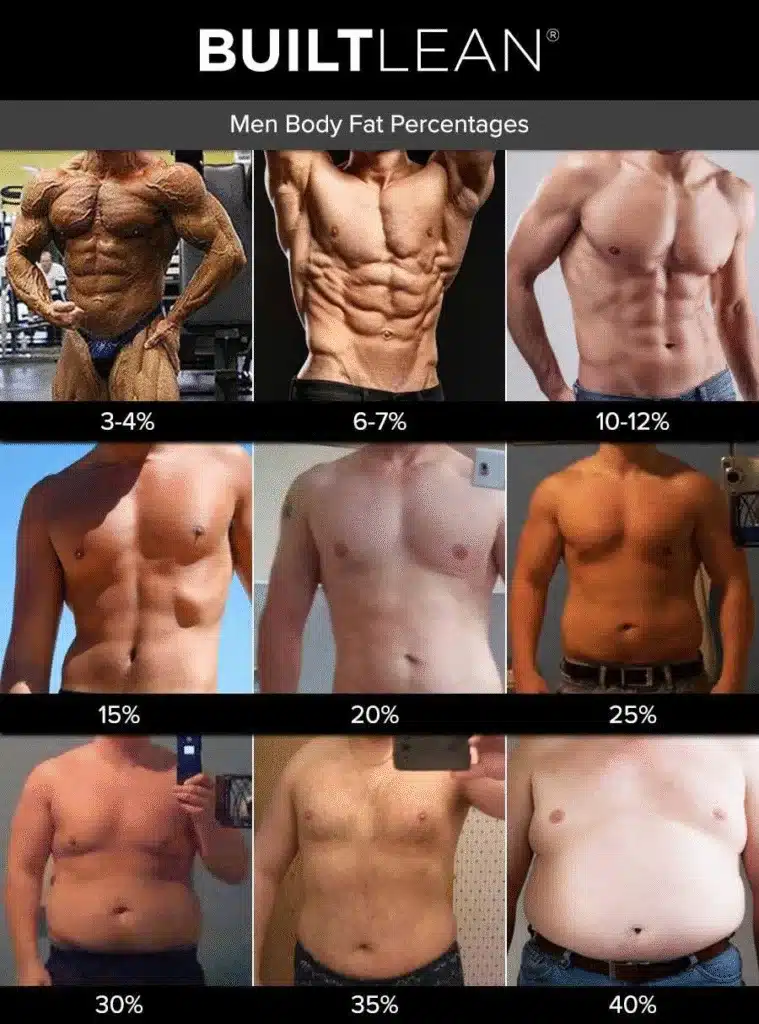
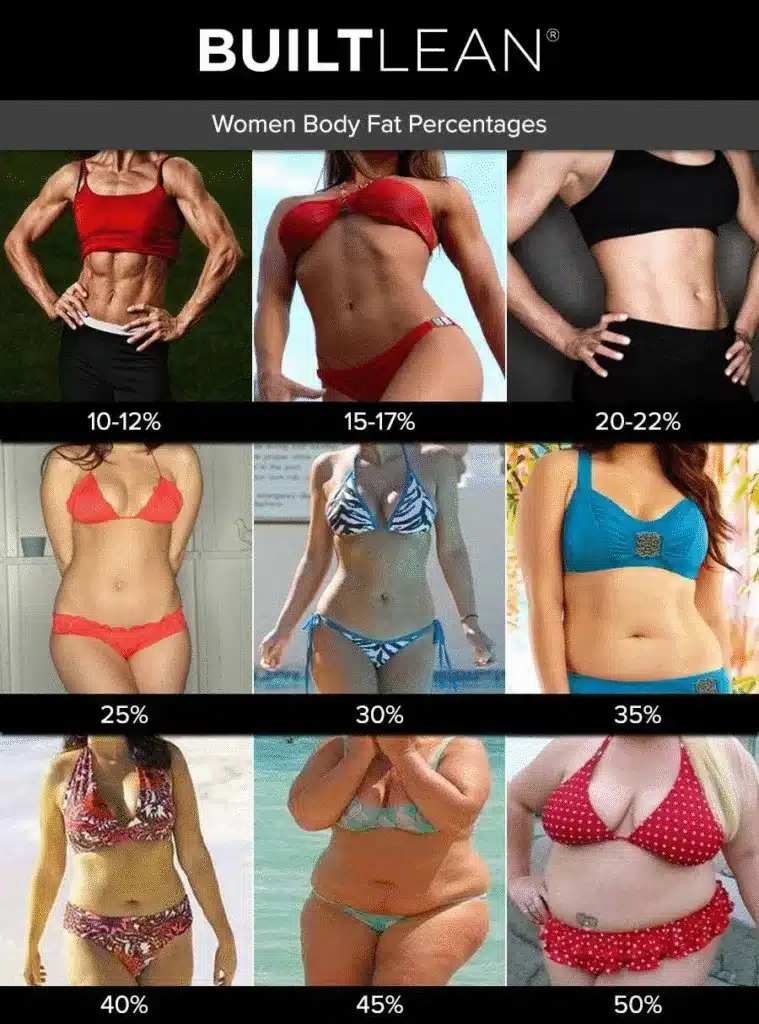
Another approach is to set lower and upper body fat percentage limits for yourself. For most men, that range works out to roughly 10 to 12 percent as a lower limit and around 15 percent as an upper limit. For women, the corresponding range is 15 to 17 percent at the lower end and 20 percent at the upper end, since women naturally carry more body fat than men.
Visual estimates are perfectly fine for gauging body fat percentage. Most men start to show some abdominal definition around 15 percent and have a visible six-pack at rest around 10 percent. For women, those reference points shift to roughly 20 percent and 15 percent respectively (Figures 1 and 2).
There are two reasons to set a sensible upper limit on a bulk. The first is logistical. The higher you end the bulk, the more ground you’ll have to cover on the cut afterwards. You generally want to spend as little time in a calorie deficit as possible since growth is either severely limited or outright stalled while cutting.
The second reason is physiological. In humans, there’s something called the p-ratio that determines how incoming calories get partitioned between lean mass and fat mass. Body fat plays a significant role in hormone signaling, and the higher your body fat percentage climbs, the more this ratio skews toward fat gain instead of muscle gain. Bulking is most efficient at lower body fat percentages.
Note that calorie partitioning is a sliding scale, not a binary. At the very lowest end of body fat percentages, the body preferentially regains body fat as a protective response. There’s no magic upper percentage where things shift to all fat and no muscle either. For deeper reading on the p-ratio specifically, Lyle McDonald’s guide to calorie partitioning covers the topic in detail.
Expected Gains and Losses
For tracking purposes, weigh yourself daily, first thing in the morning, on an empty stomach and bladder. That serves as the most consistent baseline. Use either weekly or preferably monthly trends to gauge where things are headed. Body weight fluctuates significantly from day to day and even week to week, so longer-term trends smooth out the variation and give a clearer picture of actual progress. This is particularly important when accounting for variables like the menstrual cycle.
On a bulk, muscle gain is a slow process and it takes considerable time to accumulate meaningful lean mass. For the average trainee, gaining roughly 1 to 2 percent of body weight per month (0.25 to 0.5 percent per week) is a reasonable target. Of those gains, approximately 50 to 75 percent will partition toward lean mass and the remaining 25 to 50 percent will add as fat. In practical terms, that’s around 2 to 3 pounds of lean mass and 1 to 2 pounds of fat gained per month. This ratio depends on the trainee’s genetics, training experience, age, surplus size, and training quality.
On a cut, fat loss is gradual but considerably faster than muscle gain. For most people, losing somewhere in the range of 2 to 8 percent of body weight per month (0.5 to 2 percent per week) works well. That equates to roughly 1 to 2 pounds of fat loss per week. The main determinant of fat loss rate is the size of the calorie deficit. It’s possible to push faster rates with steeper deficits, but doing so brings its own set of complications in terms of training quality, food selection, and lean mass retention. Improper cutting can erode the lean mass you just spent months building.
Duration of Each Phase
There are no strict rules for how long a bulk or cut should last, but there are sensible defaults based on what each phase needs to accomplish. The single biggest pitfall is transitioning between phases too often, which usually means neither phase lasts long enough to produce visible results. This is the classic “spinning your wheels” scenario: start a bulk, get nervous about adding fat, switch to a cut prematurely, and end up back where you started a few months later with nothing to show for it. When you commit to a bulk or cut, commit to it for long enough to actually accomplish something.
Bulking duration. Effective training is a major part of bulking success. A core principle for muscle growth is progressive overload, which means increasing the amount of work a muscle does over time. Getting good momentum on progressive overload takes considerable time. Given that cutting makes progress much harder, it makes sense to push a bulk as long as possible to milk strength and growth from the program. A useful rule of thumb is to match the duration of a bulk to the training cycle of the program you’re running.
At a bare minimum, a bulk phase should last around 12 weeks. Longer is generally better. If you start a bulk at a low body fat percentage and control your rate of gain, it’s not unusual for bulks to run upwards of a year, especially early in your lifting career. The thought of gaining fat for that long can be unsettling. Remember though: you have to gain fat on a bulk. You do not have to get fat on a bulk.
Cutting duration. The length of a cut depends largely on the results of the previous bulk. The goal is to bring body fat back down to pre-bulk levels while retaining the lean mass you built. On a typical bulk you might expect around 1 to 2 pounds of fat gain per month. Since a typical cut runs at 1 to 2 pounds of fat loss per week, that works out to roughly one month of cutting for every 2 to 4 months spent bulking.
Cuts also don’t have to be done in one continuous stretch. Implementing periodic diet breaks (short returns to maintenance calories) is often beneficial both physiologically and psychologically. Our piece on whether reverse dieting works covers the diet-break approach in more detail. Successful cuts are often run as several shorter stretches with refeeds or diet breaks between them to prevent burnout and keep progress moving.
For situations where you’ve drifted higher than intended mid-bulk, a short mini cut can reset things without ending the bulk phase entirely.
Finally, when transitioning between phases, it’s often useful to spend a couple of weeks at maintenance calories to let the body adjust. Coming out of a bulk, this helps prepare the body for the upcoming deficit. Coming out of a cut, it gives the body time to recover before another surplus. If you’re transitioning straight from a cut into a bulk, our guide on how to lean bulk effectively walks through the reverse-diet ramp-up.
Timing of Phases (Seasonal)
Bulks and cuts can be scheduled at any time of year, but certain times make certain dietary goals easier than others. For trainees just starting out the timing is irrelevant. Their primary goal is usually fat loss regardless of the date. For someone who’s already at their target leanness and choosing between phases, the calendar matters more.
The classic mainstay says to bulk in the winter and cut in the summer. In winter, clothing is bulkier and less form-fitting, so not being at peak leanness is less of a daily mental hurdle. Winter also includes most of the major eating-heavy holidays, so the hearty eating might as well go toward productive surplus calories. Warmer months are when most people want to wear shorts, swimsuits, and lighter clothing, so timing a cut to land before or during summer typically aligns with when leanness is most visible.
Other personal factors play in too. If you know certain stretches of the year are loaded with social events, birthdays, weddings, holidays, or annual trips, those windows are often poor times to start a cut. Plan around them.
That said, people tend to over-stress about timing their cut “just right” to land at peak leanness on a specific date. The instinct is understandable but it can be counterproductive to long-term progress. As long as you’ve set sensible upper limits on your bulk, you’ll never get fluffy enough to really worry about your appearance, and you’re never far enough from your target leanness to need dramatic timing. This is part of why starting from a lean base makes everything easier. You know what you’re working back toward.
A Worked Example of a Bulk/Cut Cycle
Let’s run through a hypothetical example. A male trainee starts at 150 pounds body weight, 135 pounds of lean mass, 15 pounds of fat, and 10 percent body fat. He’s new to weight training and starting a structured progressive overload program.
He runs a nine-month bulking phase, eating in a moderate surplus, gaining approximately 3 pounds per month for a total of 27 pounds. Of those 27 pounds, 15 pounds add as lean mass and 12 pounds add as fat. At the end of the bulk he’s at 177 pounds body weight, 150 pounds of lean mass, 27 pounds of fat, and 15.2 percent body fat.
He then cuts to finish off the cycle, aiming to return to 10 percent body fat. He enters a calorie deficit, loses roughly 4 pounds per month, and after three months sits at 165 pounds body weight, 148 pounds of lean mass, 17 pounds of fat, and 10 percent body fat.
Net result after one year: 15 pounds of net lean mass gained, body fat percentage fluctuating between 10 and 15 percent (Table 1). From here he can either maintain for a while or begin another bulk and cut cycle.
| METRIC | INITIAL STATS | END OF BULK #1 | END OF CUT #1 |
| Body Weight | 150lb (68.2kg) | 177lb (80.5kg) | 165lb (75kg) |
| Lean Body Mass | 135lb (61.4kg) | 150lb (68.2kg) | 148lb (67.3kg) |
| Fat Mass | 15lb (6.8kg) | 27lb (12.3kg) | 17lb (7.7kg) |
| Body Fat Percentage | 10% | 15.2% | 10% |
| Net Change from Initial (Bodyweight) | 0 | +27lb (12.3kg) | +15lb (6.8kg) |
| Net Change from Initial (Lean Body Mass) | 0 | +15lb (6.8kg) | +13lb (5.9kg) |
| Net Change from Initial (Bodyfat Percentage) | 0 | +5.2% | 0 |
The Phases in Detail
The rest of this guide breaks down each of the three phases: bulking, cutting, and recomping. Each section is split into diet and training considerations.
For the diet sections, all calorie estimates use simple bodyweight multipliers. This isn’t a precise approach, but it’s significantly easier than equations like Harris-Benedict, Mifflin-St Jeor, or Katch-McArdle. The multipliers should land you in the right ballpark, and from there you adjust based on actual results. If you want a more dialed-in starting point, you can use our macro calculator to get personalised numbers.
There are two ways to calculate protein needs: by total body weight or by lean body mass (total weight minus fat weight). The lean mass approach is technically more accurate but requires you to know your body fat percentage. Once you have it, the formula is straightforward:
- (Body fat percentage / 100) = body fat percentage in decimals
- Body weight − (body weight × body fat percentage in decimals) = total lean body mass
Going by total body weight is also fine, particularly if the trainee is already relatively lean. The higher your body fat percentage, the more likely that estimating protein needs by total body weight will overshoot the target. That said, there’s nothing inherently wrong with overdoing it on protein. Other tissues besides skeletal muscle have protein requirements, and there are generally no health risks associated with high protein intakes.
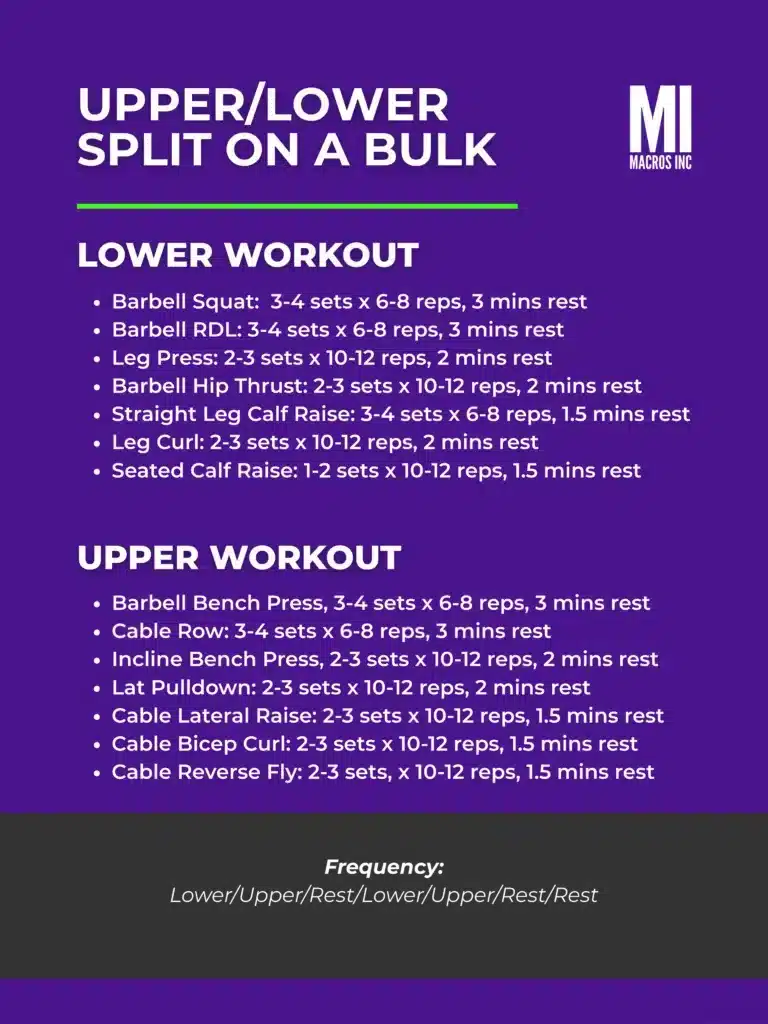
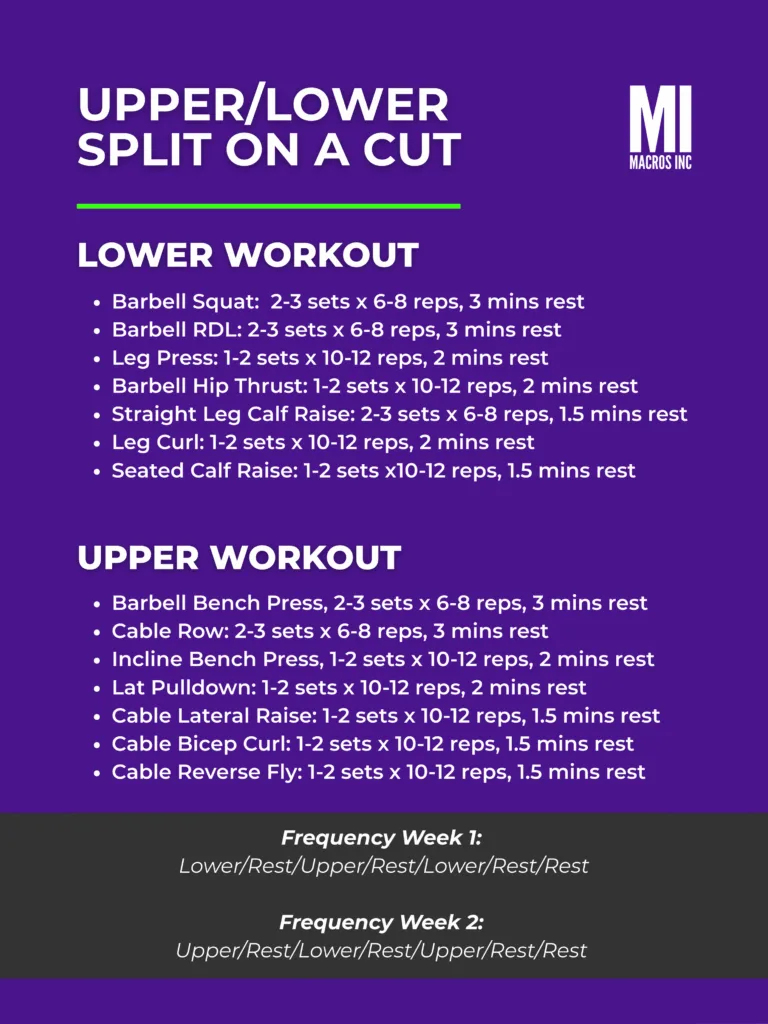
For training, each phase includes a sample upper/lower split. The standard weekly layout for an upper/lower routine is Lower / Upper / Rest / Lower / Upper / Rest / Rest. The exercises in each table are written as:
- (Exercise), (Sets × Reps), (Rest in Minutes)
- Reps = repetitions, how many times to perform the exercise before resting
- Sets = groups of reps, how many groups to do before moving on
- Rest = how long to recover between sets, fully rested, not used for other exercises
This is in the context of bodybuilding. Strength-focused athletes, powerlifters, and advanced lifters typically already have their own routines. The diet recommendations still apply to them, but the training templates here are general bodybuilding setups.
Bulking
Diet
Calories for bulking typically land in the range of 16 to 18 per pound (35.2 to 39.6 per kilogram) of body weight. Alternatively, if you already know your maintenance calories, adding 10 to 20 percent on top should put you in the right zone for a bulk.
For protein, the standard target is 1 gram per pound (2.2 grams per kilogram) of body weight, or more accurately 1 gram per pound of lean body mass. For trainees who are already relatively lean (around 15 percent or less for men, 20 percent or less for women), the two figures will be close enough that either works.
Dietary fat typically sits between 20 and 30 percent of total calories. There’s no strict physiological requirement for fat beyond the essential fatty acids, so total fat intake is largely preference-based (higher fat with lower carbs, or lower fat with higher carbs). A practical lower limit is around 50 grams just to leave some dietary flexibility. For the essential fatty acids specifically, a daily target of about 2 to 3 grams combined EPA and DHA is well-supported.
Carbs make up the remaining calories. Whatever isn’t allocated to protein or fat goes to carbs. These provide the readily available energy that fuels workouts and makes hitting a calorie surplus easier than it would be on a low-carb approach.
Training
Resistance training is what makes the bulk a bulk. Without it, the calories partition toward fat instead of muscle. Muscle tissue requires three things to grow: adequate energy, sufficient amino acids, and a stimulus. The energy comes from the calorie surplus, the amino acids come from dietary protein, and the stimulus comes from resistance training. The resistance training has to introduce progressively higher levels of stimulus over time. This is the principle of progressive overload.
In practice, progressive overload means working incrementally harder over time. There are three variables you can manipulate: intensity, volume, and frequency. Intensity refers to the magnitude of the stimulus itself, most easily increased by adding weight to the bar or cable stack. Volume refers to the number of sets and reps performed for a given muscle group. Frequency is how many times per week a muscle group is trained.
Of these three, intensity is generally the most feasible to keep improving over the long run. Volume has diminishing returns and frequency is capped by recovery capacity. Both are also constrained by feasibility since most people aren’t going to spend hours in the gym every day of the week. Once volume and frequency are set, the main lever you keep pulling is intensity.
For volume and frequency, the research suggests around 6 to 8 sets or 40 to 70 reps per muscle group per workout, performed 2 to 3 times per week, covers most requirements. That leaves significant room to play with how things are arranged.
On a bulk specifically, the main difference compared to other phases is work capacity. Calorie surplus means energy levels are high, recovery is good, and propensity for improvement is at its peak. This is the prime time to push progressive overload aggressively and make as much progress as the program allows. If you don’t already have a structured upper/lower split to follow, our intermediate upper/lower split program is a solid template that aligns directly with the structure below (Table 2).
Free Muscle Building Programs
Our muscle gain programs are built for the kind of structured, progressive-overload training that bulking phases reward. Pick the one that matches your experience and run it for the full cycle.
Cutting
Diet
Calories on a cut typically sit around 10 to 12 per pound (22 to 26.4 per kilogram) of body weight. If you know your maintenance, shaving 10 to 20 percent off that number also lands you in a sensible starting range.
Protein needs on a cut are significantly higher than on a bulk. This is partly due to elevated requirements for lean mass retention, and partly because the body also uses some of the incoming protein as a fuel source when energy is restricted. A target of around 1.5 to 2 grams per pound (3.3 to 4.4 grams per kilogram) of lean body mass covers nearly all needs. This might be slight overkill for novice trainees, but if the priority is preserving muscle, it’s better to err on the high side. Higher protein intakes also promote satiety, which matters when you’re hungry from the deficit.
You can again calculate protein by body weight as an alternative, with the same caveat. The leaner you are, the closer the two estimates will be. For a relatively lean trainee, the lean mass recommendations above equate to roughly 1.3 to 1.7 grams per pound (2.9 to 3.7 grams per kilogram) of body weight.
Dietary fat is more restricted on a cut because total calories are lower. There’s still no strict requirement beyond the essential fatty acids, but extremely low fat intake can lead to hormonal issues over time. Around 30 to 40 percent of total energy intake usually works well, or roughly 30 to 50 grams of total dietary fat. The essential fatty acid target stays the same at 2 to 3 grams combined EPA and DHA.
Training
In theory the same program used for bulking should work on a cut. The main constraint is that work capacity is no longer a given because energy intake is restricted. Making progress on a cut becomes increasingly difficult, and even maintaining current progress can be a challenge. Something usually has to give.
Of the three training variables, the one most closely tied to lean mass retention is intensity. Volume and frequency can both be scaled back to accommodate impaired recovery, but intensity (weight on the bar) should be maintained. In fact, as long as intensity holds, both volume and frequency can be scaled back by up to two-thirds without risking lean mass loss. In practical terms, you can reduce the number of workouts per week and the number of working sets, as long as the weights you’re lifting stay roughly the same. The more aggressive the deficit, the more volume and frequency you should reduce to compensate.
Because intensity needs to stay high on a cut, deloads become trickier to schedule. The best place to insert a deload is during a diet break, where calories return to maintenance for a stretch. That’s the safest window to drop intensity briefly without risking lean mass.
The same upper/lower split from the bulking section can be modified for a cut without much restructuring (Table 3).
Recomping
Diet
Recomping sits between bulking and cutting and is generally simpler to set up than either. Bulking and cutting remain the more efficient strategies for trainees who want faster, more dramatic results. Recomping is better suited to slower, steady progress, and to staying in maintenance windows between dedicated phases. For a more detailed look at the small-surplus end of the spectrum specifically, our piece on building muscle while minimizing fat gain covers the lean-bulk version of this trade-off.
Calories for a recomp typically land around 14 to 16 per pound (30.8 to 35.2 per kilogram) of body weight. Since energy isn’t a limiting factor, protein and fat intakes can stay roughly the same as on a bulk. Carbohydrate intake is reduced compared to a bulk simply because total calories are lower.
Training
Training on a recomp looks similar to training on a bulk. The goal is progressive overload, increasing work over time. The main difference is that work capacity is somewhat lower than on a bulk because there’s no calorie surplus. This is also the main reason progress tends to slow faster on a recomp than on a bulk. The workout structure can stay roughly the same, although it can help to slightly reduce volume or frequency to better support steady progression.
Summary
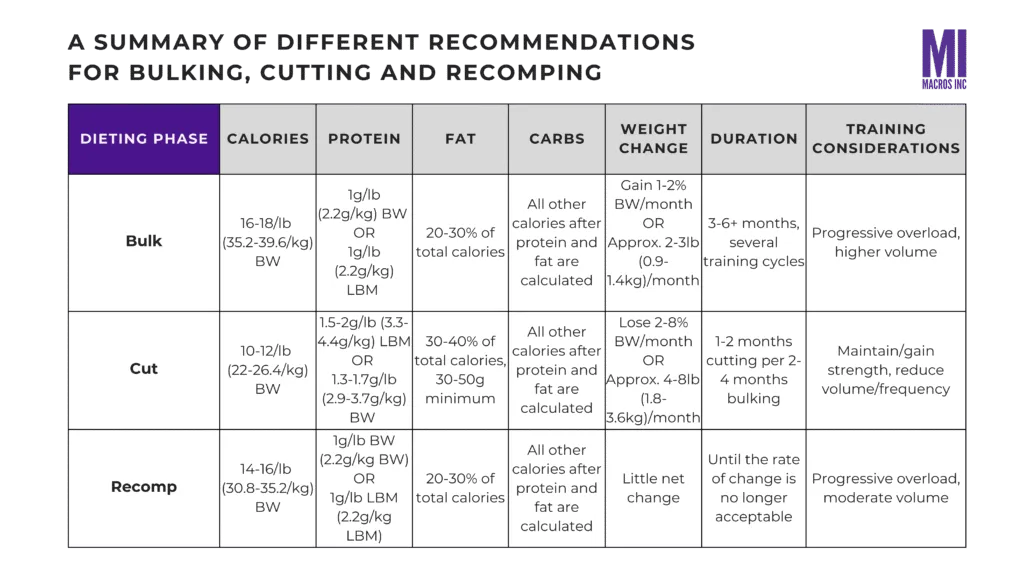
A summary of all the recommendations across the three phases is shown below (Table 4).
Conclusion
The bulking and cutting process can look intimidating at first glance, but broken into its component parts it’s straightforward to execute. Bulking and cutting aren’t strictly required for progress, especially early in your lifting career. For more advanced trainees who want to keep adding lean mass over the long term, though, it remains one of the most efficient dietary frameworks available.
If you’d like a coach to walk you through your starting numbers, set the surplus or deficit correctly, and make adjustments as the phases unfold, one of our coaches can help.
No gimmicks. No restrictions.
Start your journey with expert coaching, personalized nutrition, and real results, absolutely free for two weeks.