
Building muscle isn’t actually mysterious, but it’s surrounded by enough bad advice that it can feel that way. Plenty of people put in years of honest work and see almost nothing in return. Not because muscle gain is hard to figure out, but because they’re working hard against the principles instead of with them.
The real answer is short: train hard enough to force your muscles to adapt, eat enough to fuel that adaptation, and rest enough to let it happen. That’s the whole game. Everything else is detail layered on top.
This article walks through those principles in enough depth that you can actually apply them, then points to the programs that put them into practice.
Jump to a Topic
How Do You Actually Gain Muscle?
Three things have to be in place at the same time. First, a training stimulus that progressively challenges your muscles, applied consistently over weeks and months. Second, a slight calorie surplus with enough protein, typically 0.7 to 1 gram per pound of bodyweight per day. Third, real recovery between sessions, which mostly means sleep and not training the same muscle group every day.
Miss any one of those three and progress stalls. People who plateau usually have one weak link. The training is solid but the food is off, or the food is right but the training has no progression, or both are dialled in but they’re sleeping five hours a night. Fix the weakest link and growth resumes. The rest of this article covers each pillar in turn.
Pillar 1: Train for Growth
Increase volume over time
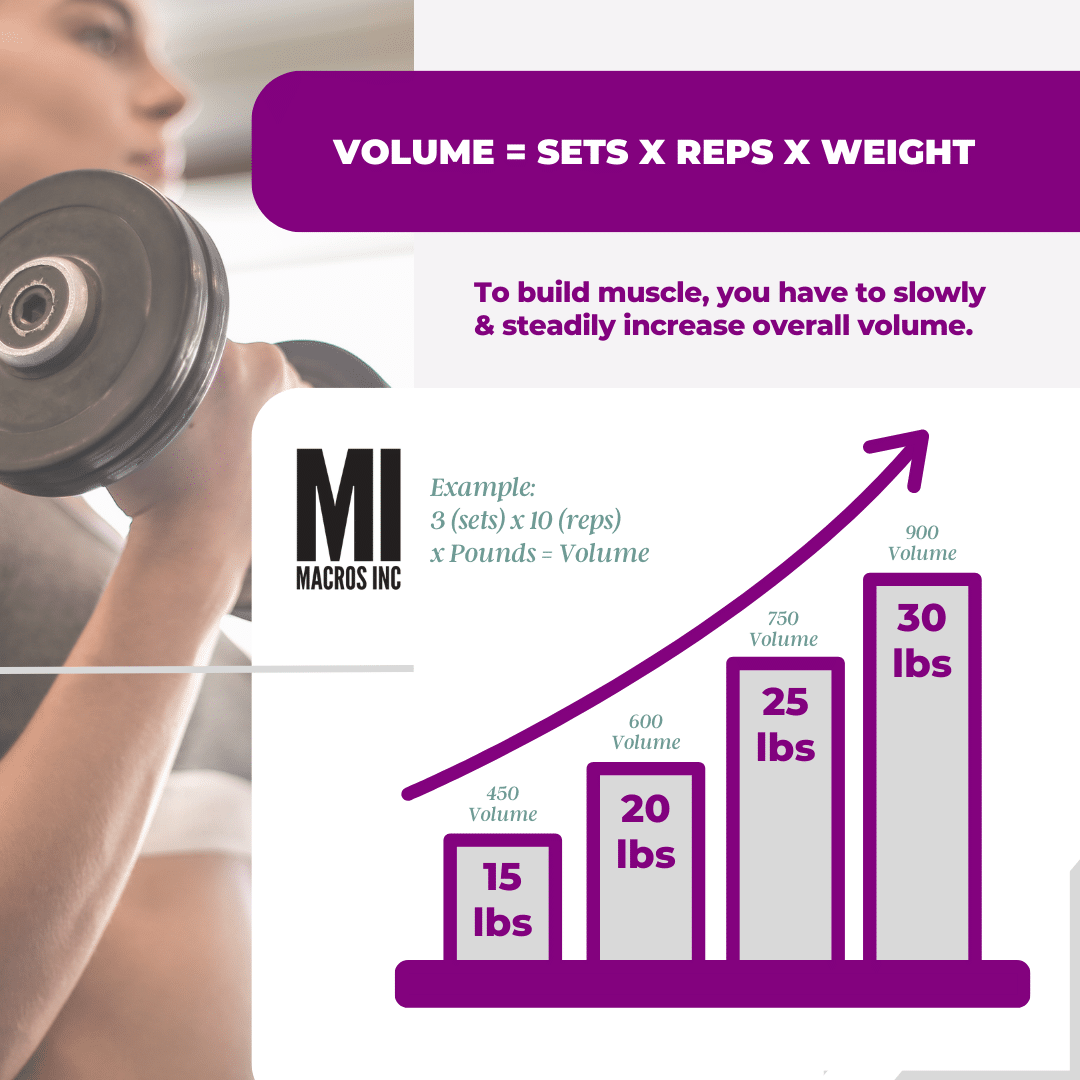
Training volume is the total work you do on a muscle group: sets multiplied by reps multiplied by weight. To build muscle, that number has to gradually go up over time. This is what coaches mean when they talk about progressive overload, and it’s the single most important variable in any muscle-building program.
If you do 3 sets of 10 bicep curls with 30 pounds, that exercise is worth:
3 (sets) x 10 (reps) x 30 (pounds) = 900
Sum that across every exercise you do for a muscle group across a training week. Over a training block of 4 to 8 weeks, that weekly number should be climbing. Not every session. Not every week without exception. But the trend has to be upward, or you’re maintaining at best.
Move the muscle, not the weight
One of the fundamental differences between powerlifting and bodybuilding is what you’re actually training for. Powerlifting is about moving a weight from A to B by any means necessary. Bodybuilding is about putting tension on a specific muscle and holding it there.
This sounds trivial. It’s actually e.v.e.r.y.t.h.i.n.g.
One of the most iconic quotes in bodybuilding came from Kai Greene: “I am not a weightlifter.” The point being that loading up a barbell and grinding through ugly reps does very little to build the target muscle. Muscle growth requires mechanical tension on the muscle, and the greater the tension, the greater the result.
In practice this means caring more about the quality of every rep than the number on the dumbbell. Slow down the lowering phase. Pause briefly in the stretched position. Squeeze at the top. If you can’t feel the target muscle working, drop the weight and try again with better form. Ego lifts don’t build muscle. They just build calluses on your palms and lower-back injuries.
Stop changing your exercises every two weeks
One of the fastest ways to stall muscle growth is “muscle confusion”: changing your exercises constantly to keep things fresh. It’s a fitness industry myth that refuses to die, and it directly contradicts how muscle actually grows.
To build muscle you need a similar stimulus in type, applied at increasing magnitude, over time. Every time you switch exercises, you reset both. You lose the technical efficiency you’ve built up on the movement, and you can’t compare last week’s loads against this week’s. Your nervous system has to relearn the pattern instead of pushing harder on a known one.
The most successful bodybuilders run the same core exercises for months or years before changing them. Be patient with your exercise selection. Pick a small handful of movements, run them for 8 to 16 weeks, and focus on increasing volume on those specific lifts. If you’ve been swapping exercises every other week and wondering why you’re not growing, that’s your answer.
Pillar 2: Eat for Growth
Muscle is built from food. If you’re not eating enough total calories and enough protein, no amount of training will produce visible growth. This is the pillar that catches most people, because everyone wants to add muscle without adding any body fat, and the reality of muscle gain doesn’t work that way.
Eat in a slight calorie surplus
Where fat loss requires a deficit, muscle gain requires a surplus. You need to be eating more calories than your body burns so there’s energy left over for new tissue. Start with a surplus of 200 to 400 calories above your maintenance level. Run our macro calculator if you don’t know roughly what your maintenance is.
Going much higher than that doesn’t build extra muscle faster. It just builds extra fat. The body can only synthesise so much new muscle tissue per week, and excess calories beyond what supports that get stored as fat. For most people, gaining 0.5 to 1 pound per week is the sweet spot. If the scale is climbing faster than that, you’re likely adding more fat than necessary. For a deeper dive on doing this without ballooning, our guide on how to lean bulk effectively is worth a read.
Hit your protein target
Protein is the macronutrient that directly contributes to muscle tissue synthesis. Aim for 0.7 to 1 gram per pound of bodyweight per day, split across 3 to 5 meals. For a 180-pound person, that’s 125 to 180 grams of protein daily.
This is the part most people underestimate. Hitting 80 grams of protein in a day and assuming that’s enough is one of the most common reasons trainees plateau. If you’re struggling to get there, our breakdown on how to increase your daily protein intake covers practical strategies. Once your protein target is consistently hit, fill the rest of your calories with whatever balance of carbs and fats fits your preferences.
Pillar 3: Recover
Training is the stimulus. Food is the raw material. Recovery is when growth actually happens. Skip this pillar and the other two stop working.
The biggest lever here is sleep. Aim for 7 to 9 hours per night, consistently. Muscle protein synthesis spikes during sleep, and the hormonal environment that supports growth (testosterone, growth hormone) is largely set by what your sleep looks like. Sleeping five hours a night and expecting to gain muscle is like trying to charge a phone with the screen on.
The second lever is training frequency per muscle group. Hitting the same muscle group with serious volume on consecutive days doesn’t double your gains. It compromises both sessions. Most muscle groups need 48 to 72 hours between heavy sessions to recover and grow. This is why training splits exist: they let you train hard 4 to 6 days a week without overlapping muscle groups too quickly. For more on why structured rest matters, see our piece on the power of rest.
Use a Structured Program
You can apply everything above as freestyle if you want. Most people who try end up either undertraining, overtraining, or randomly cycling exercises and never building progression on any of them. A structured program solves all three problems by giving you the schedule, the lifts, and a built-in way to track progressive overload.
The specific program matters less than the fact you’re following one consistently for at least 8 to 12 weeks. We’ve got several free muscle gain programs on the site at different experience levels. Two solid starting points:
Our 4-day hypertrophy program is the best fit for most intermediate trainees. Four sessions a week, upper/lower split, designed specifically around volume progression on a small set of compound lifts. The 4-day PHUL workout is similar in shape but blends in lower-rep power work, which suits people who want strength alongside size.
For more advanced trainees with the recovery capacity for higher frequency, our 5-day muscle building program or the 6-day PPL split offer higher weekly volume and more specialised muscle group work.
Free Muscle Building Programs
All our muscle gain programs are free and built around the principles in this article. From 4-day intermediate splits to 6-day advanced powerbuilding, there’s one to match your experience level.
Common Mistakes That Stall Muscle Growth
If you’re doing everything above and still not growing, run through this list. One of these is almost always the culprit.
Eating at maintenance and thinking it’s a surplus. The most common one. People underestimate what they eat by 20 to 30 percent. If the scale isn’t slowly climbing over a 3 to 4 week stretch, you’re not actually in a surplus regardless of what your tracking says.
Training every set to failure. Counterintuitive, but training to failure on every set crushes recovery and limits how much total volume you can accumulate. Most working sets should leave you with 1 to 3 reps in the tank. Save true failure for the last set of an exercise, if at all.
Doing too much cardio. Cardio isn’t bad for muscle building, but excessive cardio competes for the same recovery resources your muscles need. If you’re running 5 days a week and lifting 5 days a week and not growing, the running is part of the reason.
Confusing soreness with growth. Soreness is just a sign you’ve done something your body isn’t used to. It says nothing about whether the session was productive. Plenty of advanced trainees rarely get sore and still grow. Plenty of beginners are sore constantly and grow slowly. Use the scale and the mirror as your feedback loops, not muscle soreness.
Bailing on the program after 3 weeks. Visible muscle growth takes months. The first 3 to 4 weeks of any new program will feel underwhelming because you’re mostly building neural efficiency, not tissue. If you bail at week 4, you never get to the part where you actually grow. Pick a program and ride it for at least 12 weeks before judging.
If you’ve been stuck for longer than that, our guide on breaking through a training plateau goes into how to actually diagnose what’s gone wrong.
Wrap Up
Muscle gain is one of the slowest, most patience-testing pursuits in fitness. There’s no shortcut. But the principles are simple and they’re knowable: progressive overload, a sustainable calorie surplus with enough protein, and real recovery between sessions.
Pick a program, run it for at least 12 weeks, eat in a small surplus, hit your protein, get your sleep, and do this for long enough that the changes become visible. That’s the whole formula. If you’d like a coach to help you put it all together and hold you accountable to the unglamorous parts, our coaching team can help.
No gimmicks. No restrictions.
Start your journey with expert coaching, personalized nutrition, and real results, absolutely free for two weeks.
