Band & Bodyweight Fat Loss Workout Plan
Nothing but your body, a resistance band, and some floor space. Built for travel, home training, gym closures, or anyone who wants to start losing fat without waiting for equipment.
Program Overview
You do not need a gym to start losing fat. You do not even need dumbbells. This program is built entirely around your bodyweight and a single resistance band, and it covers every major movement pattern across three sessions per week. The training is not meant to replace a fully equipped program forever. What it does is give you a structured, progressive plan for the weeks or months where equipment is not available. That might be a work trip, a house move, a gym closure, or simply not being ready to commit to a membership yet. Whatever the reason, this program means you are training with intent rather than guessing.
A bodyweight program cannot load you as heavily as a barbell or dumbbell program. That is a real limitation. What it can do is maintain the muscle you have, build baseline strength and movement quality, and support a calorie deficit. For a beginner or anyone between gym setups, that is more than enough to make meaningful progress.
Who Is This For?
This program is for anyone who wants to start a structured fat loss plan without needing equipment. It works equally well as a first program or as a bridge between gym setups. This plan is right for you if:
- You are new to structured training and want to start losing fat
- You travel frequently and need a program that works in a hotel room
- You are between gym memberships and want to keep training
- You have no equipment beyond a resistance band and a sturdy chair or table
- You want to build the habit of training three days per week before investing in equipment
If you have access to dumbbells or a full gym, our other fat loss programs will give you more loading options and faster progression. This program is designed for when equipment is genuinely not available.
Weekly Schedule
Phase 1: Build the Foundation (Weeks 1-4)
Three sessions per week using bodyweight and a resistance band. Every exercise sits at 3 sets of 10-12 reps with 45-60 second rest periods. Short rest keeps your heart rate elevated. The deficit drives the fat loss. The training preserves lean mass.
Bodyweight training progresses differently to loaded training. Your main tools are: adding reps within the given range, slowing the tempo on the lowering phase, reducing rest periods slightly, and eventually moving to harder variations. If you hit the top of a rep range on every set with clean form, you are ready to progress.
Hands slightly wider than shoulder width, knees on the floor, body in a straight line from head to knees. Lower your chest toward the floor under control, then press back up.
Feet shoulder width, toes slightly out. Sit your hips back and down until your thighs are parallel to the floor. Drive through your heels to stand.
Stand on the middle of a resistance band with feet shoulder width apart. Hinge at the hips, grab each end of the band, and row your hands toward your lower ribs. Squeeze your shoulder blades together at the top, then lower with control.
Lie on your back with knees bent, feet flat on the floor, and a resistance band looped just above your knees. Drive your hips up while pushing your knees out against the band. Hold for two seconds at the top, then lower with control.
On all fours, extend one arm forward and the opposite leg back until both are parallel to the floor. Hold briefly, return with control, then switch sides.
Stand tall. Step one foot back and lower your back knee toward the floor until both knees are at roughly 90 degrees. Drive through the front heel to return. Complete all reps on one side before switching.
Anchor a resistance band at a low point. Hinge slightly at the hips, hold one end with your elbow bent at 90 degrees and pinned to your side. Extend your arm straight back against the band, squeeze your tricep at full extension, then return with control.
Hold a resistance band at arm's length in front of you, hands shoulder width apart. Pull the band apart by squeezing your shoulder blades together until the band touches your chest. Return with control.
Lie on your back with knees bent, feet flat. Lift one foot off the floor and drive your hips up using the working leg only. Hold for two seconds at the top, lower with control. Complete all reps before switching.
Start in a side plank position on your forearm. Lower your hip toward the floor, then drive it back up by squeezing your obliques. Complete all reps on one side before switching.
Stand with a wide stance, toes pointed outward. Squat down by pushing your knees out over your toes, keeping your torso upright. Drive through your heels to stand.
Loop a resistance band behind your upper back, holding one end in each hand at chest level. Press both arms forward until fully extended, then return with control.
Stand on the middle of a resistance band, holding each end with palms forward. Curl both hands up toward your shoulders, squeezing your biceps at the top. Lower with control.
Step forward into a lunge, lower your back knee toward the floor, then drive through the front heel and step forward with the other leg. Continue walking forward, alternating legs.
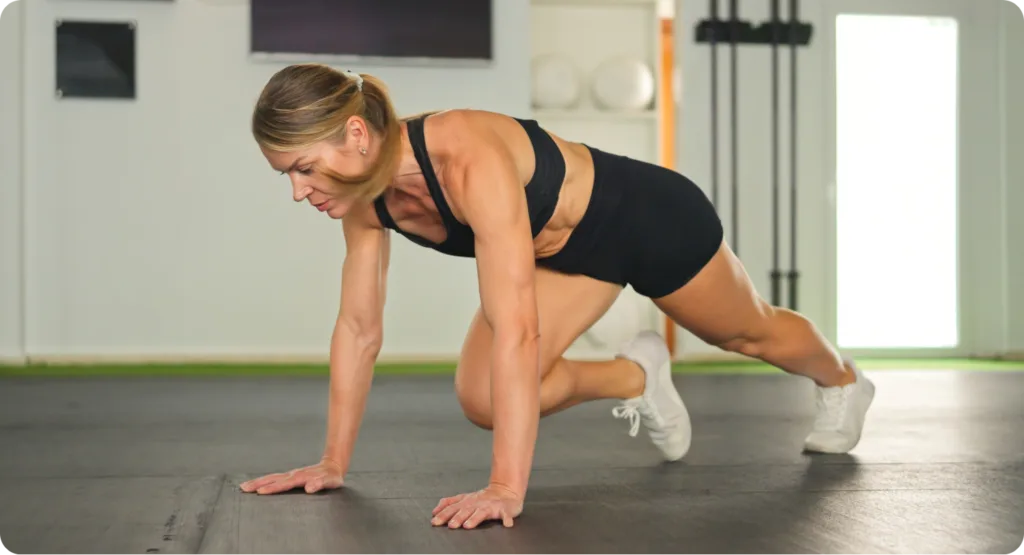
Start in a push-up position. Drive one knee toward your chest, return, then switch sides. Keep your hips level and core braced throughout.
Brisk walking most days of the week. Outdoors, on a treadmill, or just pacing around your neighborhood. The goal is volume and consistency, not speed.
Light stretching and mobility work focused on hips, thoracic spine, and shoulders. Five minutes of hip openers and five minutes of upper body stretching is a good starting point.
Phase 2: Harder Variations (Weeks 5-8)
Phase 2 progresses to harder variations: knee push-ups become full push-ups, banded exercises use heavier bands, and the glute bridge adds foot elevation. Reps drop to 8-12 and rest extends to 60-90 seconds to allow for more effort per set.
Phase 2 variations are options, not requirements. If you are still progressing on the Phase 1 version of an exercise, there is no reason to change it. Progression on a simpler movement always beats poor form on a harder one. Only upgrade when the Phase 1 version no longer challenges you within the given rep range.
Full push-ups from the toes. Hands slightly wider than shoulder width, body straight from head to heels. Lower your chest to the floor, press back up.
Loop a resistance band just above your knees. Squat down keeping your knees pushed out against the band throughout. Drive through your heels to stand.
Same movement as Phase 1 with a heavier band or doubled-up band for more resistance.
Same setup as the banded glute bridge but with your feet elevated on a step or low chair. Band above the knees, push your knees apart as you drive your hips up. Hold for two seconds at the top.
Same exercise from Phase 1 with higher reps and a two-second hold at full extension.
Same movement as Phase 1. Add a loaded backpack or hold a household item for resistance if bodyweight feels easy.
Same movement as Phase 1 with a heavier band.
Same movement as Phase 1 with a heavier band.
Same movement as Phase 1. Focus on controlling the descent and holding the top position.
Lie on your back, legs extended. Keeping your lower back pressed into the floor, lift one leg toward the ceiling until it is vertical, then lower with control. Alternate sides.
Perform a wide-stance sumo squat, stand, then immediately step your feet to shoulder width and perform a standard squat. One wide plus one narrow equals one rep.
Full push-ups from the toes. If you completed Phase 1 with knee push-ups, this is your progression.
Same movement as Phase 1 with a heavier band.
Same movement as Phase 1. Add a loaded backpack for resistance.
Same movement as Phase 1. Higher reps for a conditioning finisher.
Brisk walking most days of the week. This matters even more in a bodyweight program because your training sessions burn less energy than a loaded gym session. Walking fills that gap.
Light stretching and mobility work focused on hips, ankles, and thoracic spine. All three directly affect your squat, lunge, and push-up positions.
Band & Bodyweight Fat Loss Workout Plan PDF
A no-equipment fat loss program for anyone training at home, while traveling, or between gym setups.
This is a 3-day full body plan you run for 8 weeks using just a resistance band and bodyweight. Every exercise runs 3 sets of 10-12 reps at 45-60 seconds rest. Phase 2 progresses knee push-ups to full push-ups, moves to heavier bands, and drops reps to 8-12 with longer rest for more effort per set.
- Zero Equipment Beyond One Band The plan runs on bodyweight and a single resistance band, nothing else.
- Short Rest Keeps The Deficit Working Full body coverage and 45-60 second rest periods keep the training doing its job during a cut.
- Harder Variations Replace Extra Load In Phase 2 Full push-ups and elevated glute bridges pick up where a heavier band leaves off.
Get Your Band & Bodyweight Fat Loss Plan
Includes both training phases, the weekly schedule, and exercise cues for all three sessions. Download instantly after you submit the form.
Unsubscribe any time.
Nutrition Guidance
Fat loss is driven by your calorie deficit, not by how hard you train. That is always true, but it matters even more in a bodyweight program where your sessions burn less energy than loaded gym training. The deficit does the work. The training preserves your muscle. One of the biggest challenges when training at home or traveling is controlling your food environment. Our guide on how to eat out while dieting covers practical strategies for staying on track when your kitchen is not available.
The Basics
- Calorie deficit: A deficit of 300 to 500 calories per day is a sensible starting point. Keep the deficit moderate so you have enough energy to train consistently three times per week. Not sure where to start? Our macro calculator sets your targets in under a minute.
- Protein: 1.6 to 2.2g per kg of bodyweight per day. Protein is the most important nutritional variable for preserving muscle during a cut, regardless of how you train. Need meal ideas? Our high protein recipe collection is a good place to start.
- Meal timing: Try to eat a meal containing protein within two hours of each session. Exact timing matters far less than hitting your daily totals, but it helps recovery.
- Sleep: Seven to nine hours per night. Recovery is harder in a deficit. Sleep is the single best thing you can do for recovery, and it costs nothing.
If you have never tracked your food before, start with one simple habit: hit a protein target. Read our guide on setting realistic fitness goals for a practical approach to building habits that stick before trying to optimize everything at once.