3-Day Beginner Bodyweight Home Workout Plan
Start here if you have never trained before and do not have equipment. Three bodyweight sessions per week that teach the fundamental movement patterns and build the habit of consistent training.
Program Overview
You do not need a gym to start getting fit. You do not even need dumbbells. This program is built entirely around your bodyweight and covers every major movement pattern across three sessions per week. Each session takes 30 to 40 minutes. You train Monday, Wednesday, and Friday with rest days in between. Phase 1 builds the foundation with the simplest version of each exercise. Phase 2 progresses to harder variations and higher reps so your body keeps adapting across the full 8 weeks.
Most people beginning a home workout plan have never followed a structured program before. That is exactly who this is for. Every exercise has a scaling option if the standard version is too difficult, and the rep ranges are designed so you can start wherever your fitness level allows.
Who Is This For?
This program is for anyone who wants to start training at home with zero equipment. This plan is right for you if:
- You have never followed a structured workout program before
- You want to train at home without buying any equipment
- You can commit to three sessions per week for 8 weeks
- You want to build strength, fitness, and the habit of training
- You have floor space and something sturdy to lean against for rows
If you already train consistently and want to add equipment, check our other home programs that use dumbbells for faster progression.
Weekly Schedule
Phase 1: Build the Foundation (Weeks 1-4)
The first four weeks teach the fundamental movement patterns. If any exercise is too difficult, use the scaling option mentioned in the tip. The goal is completing every session with good form, not struggling through reps you cannot control.
Hit the top of the rep range on every set with clean form? You are ready for the next progression. Cannot complete the minimum reps? Use the easier variation until you can. There is no rush. Consistency across 8 weeks matters far more than any individual session.
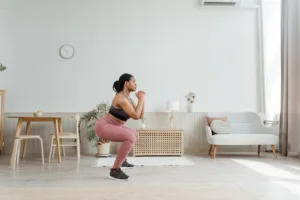
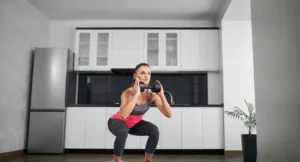
Feet shoulder width, toes slightly out. Sit your hips back and down until your thighs are parallel to the floor. Drive through your heels to stand.
Lie under a sturdy table or low bar. Grip the edge, keep your body straight, and pull your chest up to the surface. Walk your feet further under the table to make it harder.
Lie on your back, knees bent, feet flat. Drive your hips up until your body forms a straight line from shoulders to knees. Hold the top for two seconds, then lower slowly.
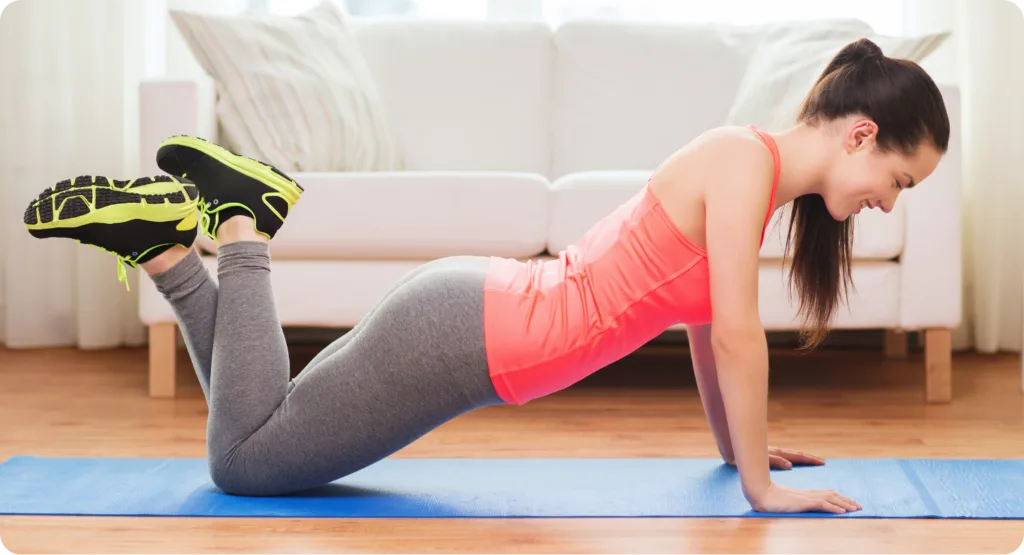
Hands slightly wider than shoulder width, knees on the floor, body in a straight line from head to knees. Lower your chest toward the floor under control, then press back up.
Lie on your back, arms extended toward the ceiling, knees bent at 90 degrees. Slowly extend one arm overhead and the opposite leg toward the floor. Return and switch sides.
Lie on your back with knees bent at 90 degrees, feet off the floor. Curl your hips off the floor by pulling your knees toward your chest using your lower abs. Lower with control.
Stand tall. Step one foot back and lower your back knee toward the floor until both knees are at roughly 90 degrees. Drive through the front heel to return. Complete all reps on one side before switching.
Stand with a wide stance, toes pointed outward. Squat down by pushing your knees out over your toes, keeping your torso upright. Drive through your heels to stand.
Sit on the edge of a sturdy chair. Hands gripping the edge beside your hips. Slide forward, then lower yourself by bending your elbows to roughly 90 degrees. Press back up.
Set up in a standard glute bridge with hips raised. Lift one foot off the floor by driving your knee toward your chest, hold briefly, return, then switch sides. Keep your hips level throughout.
On all fours, extend one arm forward and the opposite leg back until both are parallel to the floor. Hold briefly, return with control, then switch sides.
Lie on your back with hands behind your head. Bring one knee toward your chest while rotating your opposite elbow toward it. Alternate sides in a controlled pedaling motion.
Stand tall. Step one foot behind and across your body, lowering your back knee toward the floor. Drive through the front heel to return. Complete all reps on one side before switching.
Lie under a sturdy table or low bar. Grip the edge, keep your body straight, and pull your chest up to the surface. Walk your feet further under the table to make it harder.
Lie on your back, soles of your feet together, knees dropped out to the sides. Drive your hips up by squeezing your glutes hard. Lower and repeat.
Start in a push-up position with arms fully extended. Lift one hand and tap the opposite shoulder, then return and repeat on the other side. Keep your hips level and core braced throughout.
Lie on your back with knees bent. Curl your upper body off the floor by flexing through your abs, pause at the top, lower with control.
Lie on your back with legs extended straight toward the ceiling. Reach your hands up toward your toes by crunching through your abs. Lower your shoulders back down with control.
A brisk walk on your rest days. Outdoors or around your neighborhood. The goal is movement, not intensity.
Light stretching focused on hips, hamstrings, and shoulders. Five minutes of hip openers and five minutes of upper body stretching.
Phase 2: Harder Variations (Weeks 5-8)
Phase 2 adds one set to the first exercise on each session and introduces harder variations where appropriate. The push-up progresses to a close-grip version. The bodyweight squat upgrades to a jump squat. The glute bridge march becomes a single-leg hip thrust. Stay on the Phase 1 version of any exercise that still challenges you.
Not every Phase 2 variation will suit you yet. If you are still progressing on the Phase 1 version of an exercise, keep it. Moving to a harder variation before you have earned it just means poor form and wasted reps. Upgrade when the Phase 1 version no longer challenges you within the rep range.
Squat down, then drive up explosively and leave the floor. Land softly with bent knees and immediately descend into the next rep.
Higher rep target. Walk your feet further under the table to increase difficulty.
Same setup as the bodyweight hip thrust, but with one foot off the floor. Drive through the working heel, hold for two seconds, lower with control.
Full push-ups from the toes. Progression from knee push-ups in Phase 1. If full push-ups are still too hard, alternate between full and knee reps within each set.
Two extra reps per side with a two-second hold at full extension.
Higher reps than Phase 1. Keep the movement controlled.
One extra set and two extra reps per leg. Wear a loaded backpack if bodyweight feels easy.
Higher reps than Phase 1. Add a backpack for load if bodyweight is no longer challenging.
Higher rep target. Elevate your feet on a second chair to increase difficulty once you hit 20.
Stand wide. Shift your weight to one side and squat down on that leg while the other stays straight. Drive through the working heel to return.
Two extra reps per side with a two-second hold at full extension.
Higher reps than Phase 1. Keep the rotation controlled.
Two extra reps per leg. Add a backpack for load if bodyweight is no longer challenging.
Add a two-second squeeze at the top of every rep to increase difficulty.
Five extra reps. Should burn by rep 20.
Progression from high plank shoulder taps in Phase 1. Start in a push-up position, walk your feet toward your hands so your body forms an inverted V. Lower the top of your head toward the floor, press back up.
More dynamic core work with a conditioning element.
Higher reps than Phase 1. Keep legs vertical and crunch through your abs.
Same as Phase 1. Keep the habit going.
Same as Phase 1. Targeted stretching on areas that feel restricted.
3-Day Beginner Bodyweight Home Workout Plan PDF
A zero-equipment bodyweight program for total beginners building strength and consistency from scratch.
This is a 3-day full body plan you run for 8 weeks with no equipment, each session lasting 30-40 minutes. Phase 2 adds a set to the first exercise each session and swaps in harder variations, like jump squats for bodyweight squats and close-grip push-ups for standard ones.
- Every Movement Pattern, Zero Equipment Squats, rows, presses, and hinges are all covered using just your bodyweight and a sturdy surface.
- Harder Variations Replace More Sets Phase 2 progresses exercises to tougher versions instead of just adding reps.
- Scaling Options On Every Lift Each exercise has an easier variation so no one gets stuck on reps they can't control.
Get Your Beginner Bodyweight Plan
Includes both training phases, the weekly schedule, and exercise cues for all three sessions. Download instantly after you submit the form.
Unsubscribe any time.
Nutrition Guidance
Training at home without equipment is a great starting point, but your results will depend heavily on what you eat. You do not need a complicated diet. You need enough protein and a calorie intake that matches your goal. A common question for home trainers is whether bodyweight workouts are enough to make a difference. Our guide on whether home workouts are effective covers the evidence and sets realistic expectations.
The Basics
- Protein: 1.6 to 2.2g per kg of bodyweight daily. Protein is the most important dietary variable for anyone training, regardless of whether you are at home or in a gym. If you are not sure what to cook, our macro-friendly recipes are a simple place to start.
- Calories: Eat at maintenance if you want to build fitness and slowly improve body composition. Eat in a small surplus of 200 to 300 calories if you want to prioritize muscle gain. Not sure how much to eat? Our macro calculator gives you a starting point in under a minute.
- Meal timing: Try to eat a meal containing protein within two hours of each session. Exact timing matters far less than hitting your daily totals.
- Hydration: Drink enough water throughout the day. Training at home often means less natural movement and fewer reminders to drink.
Getting enough protein is the single biggest nutrition challenge for most home trainers. Read our guide on how to increase your daily protein intake for practical strategies that work without a meal prep obsession.