
“You have to go to the gym if you want to make any progress.”
You’ve likely heard this statement before, along with many others like it questioning the effectiveness of home workouts. But are they true?
Well, like many things fitness and nutrition related, it depends.
The short answer: yes, home workouts can be very effective, especially if your goal is to build muscle, improve body composition, or maintain general fitness. Where they fall short is at the upper end of pure strength training, where adding load consistently matters more than total work done.
Jump to a Topic
Are Home Workouts Effective?
It depends on your goals. If gaining as much strength as possible is your primary aim, you can make progress to a point. But gaining strength requires continually increasing the weight you lift over time.
So if the weights you currently have are a challenge, and you have the ability to add more, you’ll continue to make progress, until you reach a point where the equipment you own no longer challenges you and the load becomes too easy.
But as long as you have the funds and space to facilitate enough weight and equipment, you can absolutely work out effectively at home without ever needing to step foot in a gym. There are different kinds of strength training as well. What I’ve described so far is specifically weight training, and weight training isn’t the only way to get strong.
Effective Ways to Work Out at Home
Calisthenics is another very effective means of training for strength. It requires less equipment, but depending on the baseline strength, conditioning, and level of fitness you’re starting from, it can take longer to see progress. Calisthenics also demands a higher degree of control over your body and technique. Both styles have their pros and cons, but both are very effective.
If shaping your body and achieving a balance of aesthetics, overall health and wellness are your goals, it’s much easier to make progress with fairly little equipment from home. Most of our home workout programmes are built around this exact premise.
Whereas strength requires us to work with heavier loads and increase these loads fairly consistently, building muscle is more a matter of increasing overall training volume over time.
This doesn’t mean you won’t get stronger as you build more muscle. It just means strength will come secondary to muscle size when working with lighter loads and higher volumes.
Volume Training
Training volume is the total amount of work you perform, and it can be manipulated and increased by adding weight, repetitions, sets, or frequency. This is why we can get by with less equipment when the goal is building muscle.
Even with less weight, so long as we increase reps performed with the same weight, whether by increasing how many reps in a set or how many sets we do, we’ll be increasing volume.
We still want to challenge ourselves, and working with lighter loads may mean performing more reps per set to sufficiently do so. Contrary to popular belief, we can build muscle over a very broad range of reps.
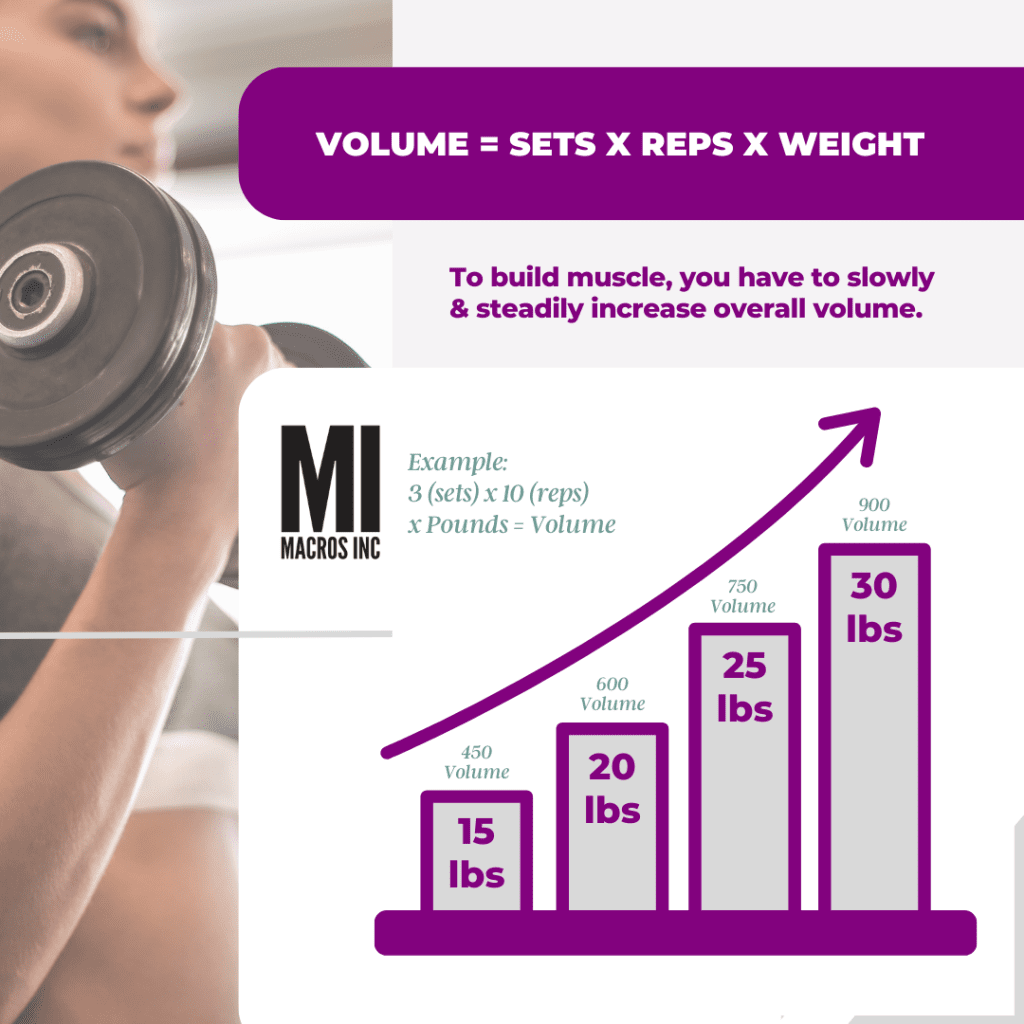
Volume = Sets x Reps x Weight
It used to be believed that we had to work in a range of 8 to 12 reps with a weight that challenged us in that range. But over the past couple of decades, research has shown that we can build muscle using heavy loads and low reps, all the way through to lighter loads and much higher reps.
How we choose to do so will depend on the equipment we have available, secondary goals such as strength or muscular endurance, and practicality. It can be tiresome doing sets of 30 or more reps for multiple sets, and doing so can make for some very long training sessions.
If joint health is poor or we’ve had previous injuries, that’s another consideration for using lower loads with higher volumes and frequency of training.
Working Out at Home with Limited Equipment
Let’s illustrate what progression of volume to build muscle might look like when using limited equipment and weight at home. The following progression principles could be applied to any movement.
Using a flat dumbbell bench press as an example, let’s say you have a set of 20 pound dumbbells you’re using and these are your heaviest dumbbells. You can currently perform 3 sets of 8 repetitions with good technical form.
Without the ability to add weight, you could increase volume and continue to challenge yourself each week by aiming to increase the number of repetitions performed each week, maintaining good form of course.
Adding Reps
Before adding sets, continue to increase reps. On this principle alone, you could continue to challenge yourself for quite some time, depending on how many reps you want to perform as your upper limit.
You could keep adding reps and see progress just fine, but as we said, it can be tiresome performing very long sets. And if you have the attention span of a squirrel like myself, by the time you get to 30 you’ll have lost count.
A couple of months pass, and at this point you can perform 3 sets of 15 reps with good form. It’s enough of a challenge that you could maybe get a few more reps if you pushed hard, but you may miss the last one.
Adding Sets
For the sake of brevity and our attention spans, this is a great time to add a set. Now your aim is 4 sets of 15 reps. Often this extra set, because we’re demanding a bit more from ourselves, means we may even find we’re unable to perform all 15 reps that last set. Once we can, we can either continue to add reps or add another set.
At some point, just as with those high reps, doing many sets per session can become impractical. If this is the case, it may be more feasible to split your training up to increase the frequency you train each body part. You could even drop the number of sets performed per session and, through increased frequency, still increase your overall training volume for the week.
Free Home Workout Programmes
Whether you’ve got a pair of dumbbells, a resistance band, or no equipment at all, we’ve got a free programme to match. Browse our home workouts and pick the one that fits your space and kit.
Increasing Workout Frequency
Say you drop the number of sets back down to 3 sets but perform that exercise 2 times per week instead of once. You’ll increase up to 6 total sets per week for that body part, 2 more sets per week than you were performing previously.
The other benefit is that needing fewer sets per session greatly decreases the amount of time each session takes, making it easier to stay consistent with training because it isn’t as much of a time commitment. If consistency has been a struggle, our 30-minute home workout plan is built around exactly this principle.
Using Exercise Variations
When increasing frequency, you can mix things up by adding different variations of movements to keep it interesting. Rather than doing a flat dumbbell bench press twice per week, you could do a flat bench one session and an incline dumbbell bench press or a dumbbell pec fly the next.
Just as you can add reps and sets, you can keep increasing frequency over time as well. Once you’ve been training for a while, you could move to 3 sessions per body part per week. Our 4-day dumbbell home split is a good example of how to organise this kind of higher-frequency programme without an overflowing equipment list.
There are several ways to structure higher frequency: 3 full body workouts per week, or 6 days per week alternating between an upper and lower workout, with each day a slightly different session, giving you 3 different upper workouts and 3 different lower workouts.
Other Ways to Progress at Home
Reps, sets, and frequency are the most obvious ways to progress, but they aren’t the only tools. A few others worth knowing:
- Tempo: Slowing down the lowering phase of a lift, often called eccentric training, increases time under tension without adding load. A 3-second descent on a push-up or split squat makes a familiar movement noticeably harder.
- Unilateral work: Training one side at a time, like with a Bulgarian split squat or single-arm row, doubles the relative load on the working limb. It’s one of the most effective ways to make a light dumbbell feel heavy.
- Resistance bands: Bands add variable resistance that increases as the band stretches. They’re cheap, portable, and pair well with bodyweight or dumbbell work to extend the range of what you can train at home.
- Reduced rest: Cutting rest periods between sets raises the metabolic demand of a session and is a useful tool for fat loss training in particular.
None of these replace progressive overload, but they extend how long you can keep progressing with the same equipment. If you’re newer to training and want a structured place to start, our beginner 3-day home workout plan uses bodyweight progressions through these principles.
When You Might Outgrow Home Training
To be fair to the original question, there is a point where home training can hit a ceiling. If your goal is to compete in powerlifting or push a 1-rep max barbell squat, you’ll eventually need heavier loads than most home setups can provide. The same goes for advanced strength athletes chasing top-end numbers.
For most people though, that ceiling is a long way off, and getting there is a good problem to have. By the time you’re hitting it, you’ve already built a strong base, and you’ll know exactly what to do next. If you’re curious how to break through a training plateau when progress slows, we’ve written about that separately.
In Summary
So yes, you can definitely work out effectively at home, and with a bit of creativity you can do so for a long time before equipment becomes the limiting factor. This is by no means a comprehensive article on the subject, but hopefully the next time someone brings it up, it’ll equip you to respond with a confident, “I’m doing quite well with what I’ve got at home, but thanks for your concern.” 😉
For more on building an effective home routine, see our guides on the best at-home workouts, working out at home vs the gym, and building your home gym.
No gimmicks. No restrictions.
Start your journey with expert coaching, personalized nutrition, and real results, absolutely free for two weeks.
