
“You’ll never get real results at home.” “If you’re serious, you need a gym membership.” You’ve probably heard versions of both, usually from people who feel strongly that whatever they happen to do is the One True Way.
Honestly, most of it is noise. The home vs gym debate is one of the most overcooked arguments in fitness, because for the vast majority of people chasing fat loss, muscle, or general health, both options work. What actually decides whether you get results has very little to do with your training location and a lot to do with what you’re doing once you’re there, and whether you keep showing up.
That said, the two setups aren’t identical. They have real differences in cost, convenience, equipment, and the kind of psychology that gets you through the door. So let’s look at what each one actually offers, where each one falls short, and how to pick the option that matches your life rather than your Instagram feed.
Jump to a Topic
What Actually Decides Whether You Get Results
Before getting into pros and cons, it’s worth being honest about what does the heavy lifting in any training programme. Results come from three things: a programme that progressively challenges you, effort applied consistently to that programme, and nutrition that supports the goal. None of those three are owned by gyms. None of them are owned by home setups either.
If you don’t have a structured plan, the best-equipped gym in the world won’t save you. If you have a solid plan and you push it hard, you can run it from your spare bedroom with two dumbbells. We’ve watched plenty of people transform their bodies in both environments, and we’ve watched plenty of people stall in both. The setting is the wrapper, not the substance.
So when you’re weighing this up, the right question isn’t “which one is better” in the abstract. It’s “which one am I more likely to actually use, week after week, for the next year.” That’s the variable that swings everything.
The Case for Training at Home
The biggest advantage of home training is friction removal. No commute, no packing a bag, no waiting on someone to finish their fifth set on the squat rack while you stand around. You change, you train, you get on with your day. For anyone with a busy schedule, young kids, awkward shift patterns, or just a low tolerance for faff, this matters more than any equipment list.
It’s also cheaper in the long run. A pair of adjustable dumbbells and a bench will run you a few hundred dollars upfront and then cost you nothing for years. A gym membership at $40 a month is $480 a year, every year. Within 18 months you’ve usually broken even on the kit, and you’re not relying on a business staying open or your circumstances staying the same.
The privacy is underrated too. If you’re new to training, or coming back after a long break, or just don’t want strangers watching you learn a new movement, your living room is a kinder classroom than a crowded gym floor. You can take rest periods as long as you need. You can repeat a warm-up set five times if it doesn’t feel right. Nobody’s eyeballing the squat rack waiting for you to clear out.
What home training does demand is some psychological discipline. When the workout space is also the space where you watch TV and fold laundry, the line between “training time” and “the rest of life” gets blurry. That’s the real downside, and it catches people who assume the convenience alone is going to be enough. It usually isn’t. Most people who succeed long-term at home build a small ritual around it: a set time, a specific corner of the house, headphones on, phone face-down. The structure has to come from you instead of the building.
For more on whether home setups can actually take you somewhere serious, our breakdown on whether home workouts are effective goes into the progression mechanics. The short version: yes, for a long time, but the heavier you want to lift, the more equipment you’ll eventually need.
A Personal Note on Home Training
In the “before” photo on the left, I was a few months postpartum and hadn’t had a real workout routine for ages. Don’t judge the crazy post-workout hair, OK?!
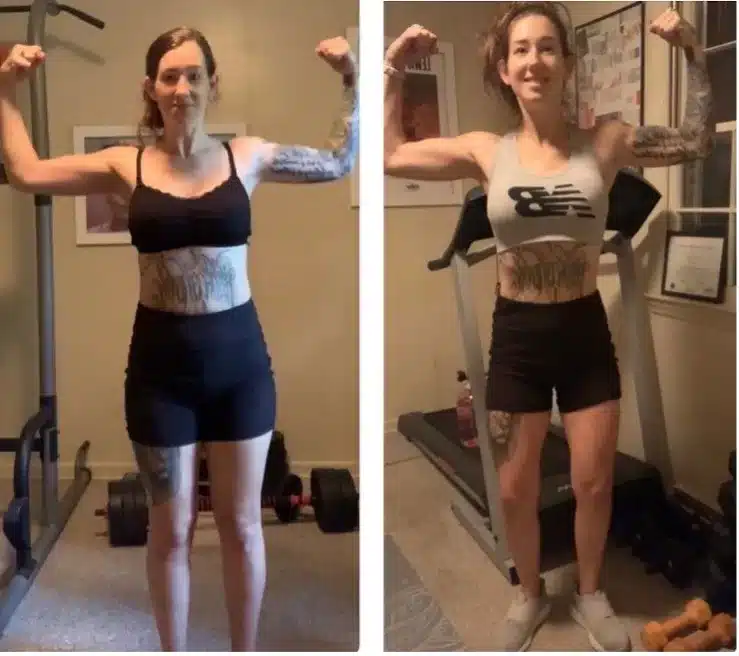
I committed to six full weeks of home workouts only, using just bodyweight and some dumbbells, and I tracked my macros the whole way through. At the end of those six weeks I felt completely different, and the results came from a guest room with a yoga mat in it.
I’m not telling that story to flex. I’m telling it because there’s nothing magic about it. Six weeks, basic kit, a programme I stuck to, food I kept honest. That’s the formula whether you’re in a guest room or in a fully kitted commercial gym. 😊
Free Home Workout Programmes
From bodyweight-only sessions to full dumbbell splits, our home workout programmes give you a real structure to follow. Pick the one that matches your space and equipment.
The Case for Training at the Gym
The gym’s biggest advantage isn’t really the equipment, although that’s the headline. It’s the way the building does some of the psychological work for you. You drove there. You’re standing in front of a barbell. The decision to train has already been made by the time you walk through the door. For a lot of people, that physical separation between “home life” and “training life” is the single thing that keeps them consistent. If your home space leaks distractions, this is a real benefit, not a soft one.
The equipment matters too, of course. A well-kitted gym gives you barbells you can actually load heavy, cable stacks that let you pick angles and resistance curves you can’t replicate with dumbbells, fixed machines that take stability out of the equation when you want to push a working muscle harder, and specialist kit like belt squats or hack squat machines that are genuinely useful at higher levels. None of that is essential to start. Plenty of it becomes useful as you progress.
There’s also a social piece that cuts both ways. Being around other people training can be motivating. If you’re someone who feeds off energy, the gym floor on a Monday evening is a useful environment. If you’re someone who finds crowded spaces draining, that same Monday evening is exactly why you’ll start skipping sessions. Know which one you are before you sign a contract.
The honest downsides are cost, time, and the cap on when you can actually go. A commute that’s 20 minutes each way is 40 minutes a day, three hours a week, 150 hours a year. That’s not nothing. Peak hours can mean waiting for equipment, which throws off the rhythm of a session. And if you’re new, gyms can feel intimidating until they don’t, which usually takes about three weeks of just turning up.
If a gym is the right environment for you, our complete beginner’s workout plan is built around standard gym equipment and walks you through everything you need for your first few months. For something slightly more structured, the 3-day full body strength programme is a strong intermediate next step.
When Home Training Hits a Ceiling
To be fair to the gym side of this argument, there is a point where home training stops being enough. If you’re chasing top-end strength numbers (1RM squats, deadlifts, bench), you’ll outgrow a dumbbell setup eventually. The same applies if you want to specialise in barbell sports, get into powerlifting, or train movements like a heavy back squat or a loaded chin-up with serious progression.
For most people, that ceiling is years away. By the time you hit it, you’ve already built a strong base, you understand programming, and the decision to upgrade is obvious. It’s a good problem to have. Hitting it early is usually a sign your home setup was too minimal for your goals, in which case building out your home gym a bit further often solves the problem cheaper than a long-term membership.
The Hybrid Approach Most People Ignore
Here’s the option that doesn’t get discussed enough: do both. Train at home most weeks, hit a gym occasionally for the lifts where load matters. Or be a gym person who keeps a pair of dumbbells at home for the weeks when life makes a session impossible to drive to. The two setups aren’t actually in competition, they complement each other once you stop treating it as a tribal choice.
A realistic hybrid for a lot of people looks like this: gym sessions on the weekends when you have time and energy, and short home sessions during the week when you don’t. Or a full home setup for general training and a $15 day pass at a commercial gym once a fortnight to do the heavy compounds. You don’t have to pick a side.
This matters because the worst version of the home vs gym argument is the one where someone cancels their membership because they “should be able to train at home” and then doesn’t train at all, or someone refuses to invest in a single dumbbell because they “have a gym” and then misses three weeks because of travel, kids, or a heatwave. The location is supposed to serve the training, not the other way around.
Which One Fits Your Life
If your weeks are unpredictable, your evenings get hijacked by other people’s schedules, or you’re a parent of young kids, home almost always wins. Saving the commute alone usually buys you the two or three sessions a week that make the difference between progress and just maintaining.
If you struggle to switch into focus mode at home, get distracted easily, or live somewhere too cramped to make a workout space work, the gym usually wins. Pay for the environment that pulls you into training rather than fighting your home one.
If your goals are pure aesthetics, fat loss, or general health, the location genuinely doesn’t matter and you should just pick whichever you’ll use more. If your goals are competitive strength, gym is the answer eventually. If you’re somewhere in between, a hybrid setup is probably the smartest move.
The deeper question, whichever way you go, is whether you’re following a programme that’s actually built for your goal. If you’re not sure, our guide on how to choose the right workout plan walks through it. And for inspiration on what a basic home setup can actually deliver, the best at-home workouts rounds up our favourites.
Wrap Up
The honest answer to home vs gym is that the question matters far less than the people debating it want it to. What matters is whether you have a real programme, whether you put real effort into it, and whether your nutrition is in the ballpark of your goal. Get those three things right and almost any location works. Get them wrong and no amount of fancy equipment will save you.
Pick the option that fits the life you actually have, not the life you’re imagining you might have when things calm down. Things rarely calm down. The best training location is the one you’ll still be using in twelve months.
If you’d like a hand pulling all of this together, our coaches build personalised training and nutrition plans around your equipment, schedule, and goals, whether you train at home, in a gym, or somewhere in between. Find out more about coaching here if that sounds useful.
No gimmicks. No restrictions.
Start your journey with expert coaching, personalized nutrition, and real results, absolutely free for two weeks.
