
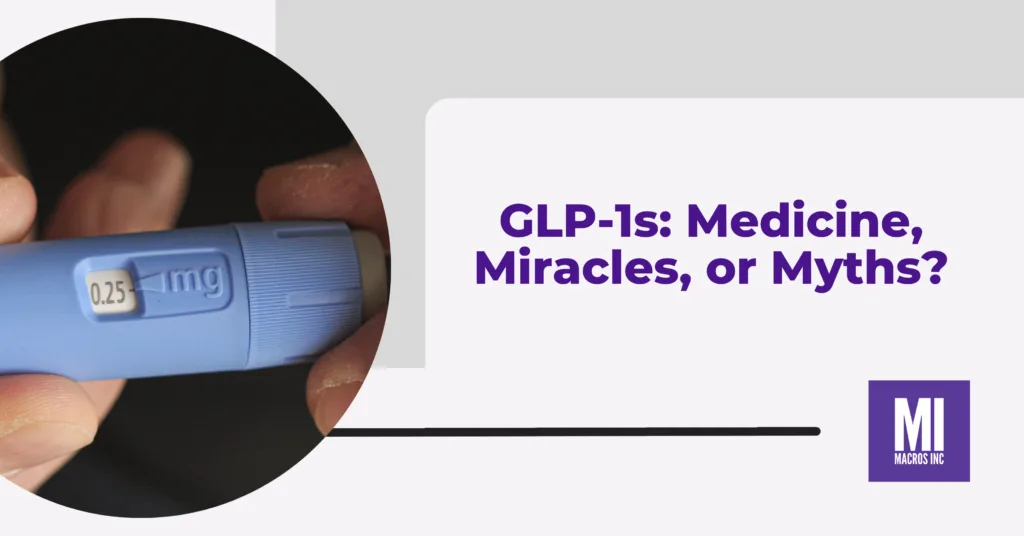
There are a new class of drugs that are taking the fitness world by storm. They’ve become pervasive enough that they’re even a common topic in the media. Celebrities use them to great success, diabetics claim it’s meant for treating diabetes, some tout them as magic, others as dangerous. It’s a lot to unpack, and since these drugs are not going anywhere, let’s try to parse out the fact from the fiction.
Let’s talk GLP-1s.
Jump to a Topic
GLP-1s: Medicine, Miracles, or Myths?
What Are GLP-1(RA)s?
Although the media refers to these drugs as GLP-1s, that is not technically correct. GLP-1 is short for “Glucagon-Like Peptide-1.” It is a naturally produced substance from the intestines and brainstem. It is secreted around meal ingestion and plays a role in food digestion.
The drugs themselves are called “GLP-1 receptor agonists” or “GLP-1RAs.” These are medications that mimic and are functionally similar to GLP-1. They are injected into fatty tissues of the body, independent of meal timing.
One major difference is that GLP-1RAs have a much longer half-life than GLP-1 does. The former can remain active for days to weeks after injection, while the latter is broken down again about two minutes after secretion. Essentially, GLP-1 is only produced around eating, while GLP-1RAs can remain in constant circulation in the body. This allows GLP-1RAs to continue their effects for extended periods of time.
What Do GLP-1s Do?
Both GLP-1 and GLP-1RAs have various functions in virtually all parts of the human body, from the kidneys to the bones. For our intents and purposes, though, I’ll focus on their effects on two different organs: The pancreas and stomach.
Pancreas
In the pancreas, GLP-1 plays a large role in maintaining blood sugar levels. To better explain, we need to look at three different components that drive the whole balance: glucose, insulin, and glucagon. Glucose is the simplest form of sugar, and the type that is generally transported throughout the body. Your body wants to keep the amount of circulating glucose moderated closely, so it primarily uses the two hormones insulin and glucagon to regulate its levels.
Insulin is secreted from the pancreas. Special pancreatic cells, called beta cells, are sensitive to levels of circulating blood glucose. When they detect blood sugar levels are high, they produce insulin in response. Insulin itself can be thought of as a storage hormone. It assists with nutrient uptake into the body’s cells, including glucose. As the body cells absorb the circulating glucose, overall levels of it in the blood go down.
Glucagon is also secreted from the pancreas, this time from alpha cells. These cells are also sensitive to blood glucose levels but respond to low levels of it. When this state is detected, the cells secrete glucagon. One of glucagon’s main roles is interaction with the liver. The liver carries a very large amount of stored glucose. When signaled by glucagon, the liver releases some of its stored glucose, raising blood sugar levels back up.
Thus, your body is in a constant cycle of balance regarding blood glucose. High levels trigger insulin and suppress glucagon, while low levels increase glucagon and suppress insulin. This is also how the body adapts to things like large meals or extended fasts without heavily disrupting the body’s long-term balance.
Now for how GLP-1 fits into all of this. GLP-1 acts upon the pancreatic cells, providing additional influence in the blood glucose balancing act. In beta cells, GLP-1 boosts the cells’ efficacy at producing insulin, as well as their ability to grow and divide. Conversely, GLP-1 also suppresses the secretion of glucagon when the body is fed. Critically, though, GLP-1 does not suppress glucagon during periods of low blood sugar (hypoglycemia). This means that GLP-1 inhibits extra glucose release from the liver when food is available but still allows it in a state of low blood sugar.
In summary, GLP-1 enhances performance of insulin secreting cells, and ensures glucagon is released only during hypoglycemia, not simply during fasting. These factors are part of what make GLP-1RAs so effective and less risky in treating type II diabetes, especially when compared to other treatments. For example, insulin injections lower blood glucose levels directly but also carry a risk of hypoglycemia if not dosed correctly. GLP-1RAs instead strengthen the pre-existing systems in the body, increasing insulin production without introducing exogenous insulin. If you’ve heard that these drugs were initially intended to treat diabetics, this is why.
Stomach
The stomach and digestive tract play a significant role in their own regulation, as expected. While there’s many different hormones that regulate appetite, digestion, etc., our focus here will be how GLP-1 interacts with a hormone called ghrelin.
Ghrelin is secreted by the stomach and serves as a “hunger” hormone. It sends signals to the specific parts of the brain, increasing appetite. Ghrelin fluctuates around food intake, with its highest levels in the body before a meal, and lowest after. If you’ve ever felt a growling stomach or an intense desire for food, ghrelin is one of the key contributors to it.
Conversely, GLP-1 stimulates satiety. This occurs through slowing digestion and the emptying of the stomach. The longer something takes to digest and pass on through the digestive tract, the longer someone tends to stay feeling full. This is similar to how eating a high fiber, protein-rich diet can slow digestion and keep hunger at bay longer.
Finally, both ghrelin and GLP-1 work inversely with each other. When ghrelin levels are high, GLP-1 levels drop, and vice versa. As such, GLP-1RAs can somewhat suppress ghrelin levels, which drives hunger even further down. The net result is typically an overall decrease in food intake, which in turn helps drive fat loss.
How They Do (And Don’t) Work
Unfortunately, the media is a little more focused on the results of these GLP-1s than to really talk about how it is they work. This ultimately comes across as “you inject this stuff, fat magically disappears.” Worse still, some people seem to believe that GLP-1RAs are some sort of cheat, that they somehow allow for people to eat as much as they want while losing fat.
In reality, GLP-1RAs have no impact on how your body digests calories. A thousand calories of pizza is a thousand calories of pizza, regardless of whether someone is on GLP-1RAs or not. The benefits instead mainly come from their impact on satiety. If you’re full longer, and your appetite is lowered, you’re likely to take in less calories overall. The subsequent decrease in caloric intake is what drives fat loss, not necessarily any direct action by the drug itself.
This is also why GLP-1RAs have limited efficacy if you don’t change your dietary practices with it. These drugs make it harder to overeat, but it is absolutely possible to still do so. A high enough calorie diet with quick-digesting, calorie-dense sources can still cause fat gain. If net caloric intake doesn’t decrease while using the drug, results will be minimized, if not absent entirely.
So no, you can’t just eat as much food as you want on GLP-1RAs and still lose weight. Sorry!
Potential Side Effects of GLP-1s
Unfortunately, all drugs come with potential side effects, and GLP-1RAs are no exception. Fortunately, it seems that most of the side effects are generally manageable. I’m no doctor, though, and I don’t want to speak outside of my area of expertise, so ultimately talk to a physician if you have specific concerns regarding specific side effects. The two common side effects I can talk about, though, are nausea and muscle loss.
Nausea
A commonly reported side effect is nausea or an upset stomach. This generally stems from the stomach emptying slower, and the overall decrease in appetite. This can be somewhat mitigated by decreasing meal size and eating more slowly. There’s a bit of delay between the stomach stretching and signaling satiety to the brain, so eating too much too quickly can be discomforting when everything does catch up to speed. Doubly so if your stomach then takes a long time to empty itself.
Muscle Loss
Another common concern is the loss of muscle while losing weight on GLP-1RAs. While some evidence demonstrates loss of lean mass in patients, there’s a little more going on than at first glance. When most people lose weight, it tends to come from a combination of both fat and lean body mass.
There are certain factors that can skew the ratio of muscle: fat loss, including how fast the weight is lost, diet, and activity. Rapid fat loss carries a higher risk of muscle loss than more gradual rates, which is part of what’s being observed here. However, you can favor the ratio toward fat loss with a combination of high protein intake and resistance training. This has been true in almost all cases of conventional weight loss, and GLP-1RA-aided diets also apply.
GLP-1s and Long-Term Results
One of the biggest difficulties with fat loss is not just getting the weight off but keeping it off. The failure of most dietary approaches tends to be longevity, i.e. the methods used to get the weight off fail to transfer over to long-term sustainable habits. This is why it’s crucial that sustainable, feasible changes to the diet drive progress. GLP-1RAs can assist with this by making hunger and appetite less of a pressing factor. They cannot fully drive or keep the weight off by themselves. The drugs are intended to complement the dietary changes, not the other way around.
Conclusion
GLP-1RAs are one of the biggest advances in fat loss aids ever created. Unfortunately, there has been a lot of misinformation regarding what they are, how they work, and what they can do. When used in conjunction with proper diet and training, they can be an excellent tool for assisting with both initial fat loss as well as keeping it off.
Try our nutrition coaching, for free!
Be the next success story. Over 30,000 have trusted Macros Inc to transform their health.
Simply fill out the form below to start your 14-day risk-free journey. Let's achieve your goals together!
