

Welcome back to the menopause series! I’m back with a new piece for you to digest on (see what I did there?). Before we really get into the menopause side, though, let’s discuss metabolism first.
Jump to a Topic
Menopause Cluster Part 6: Menopause and Metabolism
What is “Metabolism”?
Metabolism is a term we colloquially use quite often. “I have a fast/slow metabolism.” “My metabolism is genetic.” “I need to eat to jump start my metabolism.” “My metabolism makes me burn calories or gain fat.” There are many more examples, but you get the idea.
But what exactly is metabolism? Well, it’s all about energy. At the risk of making your eyes gloss over, we need to talk a bit of chemistry. I promise I’ll keep it painless. Mostly.
It all starts on the smallest scale. Everything in existence is made of atoms. If you break things down far enough, we’re all made of the same basic materials: carbon, oxygen, hydrogen, nitrogen…all that good stuff.
Now, atoms can join together through chemical reactions. This process occurs through one of several kinds of chemical bonds. These bonds require energy to form, but once they do, the connection is relatively stable. These groups of atoms are called molecules. From there, molecules join to make bigger molecules, connect in special ways, and form special structures. Ultimately, these structures include every tissue and organ in your body, your food and drink, and everything that surrounds you.
However, let’s rewind back to those chemical bonds. As stated, they take energy to form. That effectively “stores” the energy between the two atoms. Therefore, if that bond is broken, that energy is released once more. This means that the energy of one bond breaking (catabolism) can be used to form another one (anabolism). That exchange is the basis for all metabolism. It’s important to note that this is phenomenon is always occurring in you: eating, sleeping, exercising, talking, thinking…you name it, your body is metabolizing things within itself.
Finally, our body must get that energy from somewhere to get the ball rolling. Since we are heterotrophs, we get our energy from our food. The bonds in protein, fat, and carbohydrate can be broken down for energy. That energy then fuels the chemical processes in our bodies. But how much total energy does our body require, exactly?
TDEE and Its Four Pillars
Total Daily Energy Expenditure (TDEE) is the approximate energy requirements your body needs to maintain itself exactly as is for one day. It encompasses all possible energy needs that arise during that period. The requirements can be divided into resting vs. non-resting energy expenditure, then further into the sources of said energy drain (Figure 1).
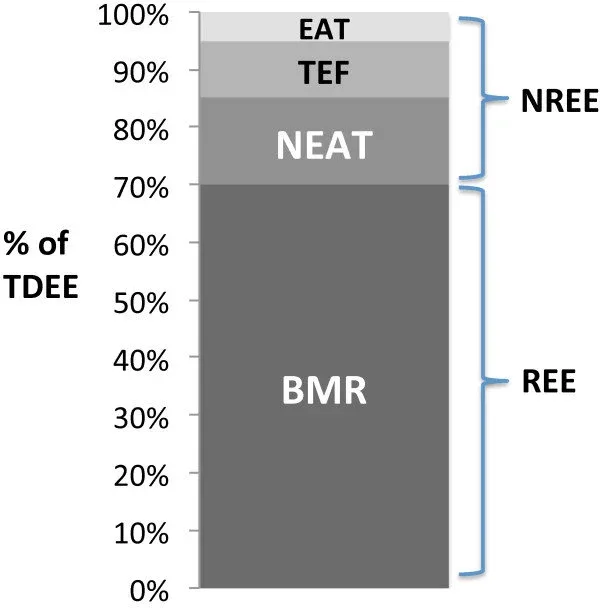
There’s a whole alphabet soup of acronyms here, but I’ll try to keep the memorization to a minimum. Try to focus more on what each requirement consists of rather than the exact name itself. The latter makes the concepts easier(ish) to understand.
Basal Metabolic Rate (BMR)
BMR is comprised of the core essentials your body needs for its baseline processes. The closest approximation to true BMR would be a comatose person. The normal additional energy demands for things such as movement are almost completely removed. Instead, the demands stem from core bodily functions, e.g. creating new cells, brain activity, blood circulation, and breathing. All of the things we talked about in the metabolism section apply here.
BMR is the largest demand of all the energy requirements, consisting of approximately 70% of TDEE. However, since metabolism is generally constant, it isn’t really something we can manipulate. This is also part of why BMR is the only component that is classified as resting energy expenditure (REE). All the others are labeled as non resting energy expenditure (NREE). These require some sort of activity and can thus be manipulated by our own efforts.
Non Exercise Activity Thermogenesis (NEAT)
NEAT is a broad category, consisting of the calories burned from daily activities unrelated to dedicated exercise. If you’re moving around for any other reason, it’s counted as NEAT. Walking around, doing chores, the physical demands of a job, etc. are all common examples. NEAT also accounts for even the tiniest minutia. Squirming around in your seat, tapping your foot, pacing, and other innocuous behaviors also count here.
Aside from BMR, NEAT has the highest impact on TDEE. On average, it represents approximately 15% of total calorie burn. However, it is worth noting that NEAT is also the most variable part of TDEE, with potentially huge differences from person to person. Two individuals of similar size and body composition can have significantly different TDEE values. This inequality is often blamed on differences in metabolism, but the key factor is usually due to differing NEAT levels This inequality usually comes down to lifestyle differences.
Occupations can have a huge effect on NEAT. Someone working a very physically demanding job like a manual laborer will likely have a higher NEAT than an office worker. Additionally, this is where the minutia I mentioned earlier really begin to make a difference. While things like shuffling around or pacing are tiny additions to calorie burn, they can add up to become surprisingly large contributors to extra NEAT over a long period of time.
An effective way to standardize and manipulate your NEAT is by tracking it. Step counters are a popular tool for measuring general movement and are found on most smartphones and watches. This helps ensure you keep a constant target for your movement. By meeting a specific daily step target, you ensure you maintain a daily baseline for your activity levels.
Thermic Effect of Food (TEF)
The thermic effect of food (TEF) is the energy cost to break our food down. Traditionally, we usually think of food as an energy source, not a drain. However, remember how we talked about breaking bonds for energy? That’s where the cost of TEF comes into play. We use energy to break the bonds in the incoming carbohydrates, fat, and protein, and then use the released energy to meet our body’s needs. Our system spends a little to get a lot more back.
All three of the macronutrients can provide energy. Not every macro is built the same in terms of fueling our needs, though. Where they differ are how much energy it takes to break each down, the amount of energy each can provide, and how well it stores in our bodies when not being used right away.
Carbohydrates are generally a great source of dietary energy, providing 4 calories per gram of carb while costing relatively little to break down. The body can also store a limited amount of these carbs in the form of muscle and liver glycogen. The amount of energy needed to break down a carb source depends on the source itself and its complexity. Overall, though, their TEF tends on the lower side at approximately 5-10% of their caloric value.
Dietary fat can be seen as a bit of an opposite to carbs regarding its energy mechanics and how it’s stored. In terms of calories, fat is an excellent source of energy, providing 9 calories per gram of fat digested. It is also readily stored in the body in large amounts, requiring few physical changes between consumption and storage. Regarding TEF, fats have a very low value, ranging around 0-3%. This is again due to requiring minimal processing upon entering the body. This doesn’t necessarily mean that eating fat makes you fat. It is simply a macronutrient that serves a different yet important role in your body.
Last but not least is protein. While protein can be used as an energy source, it can also be digested into amino acids, which can then be used to make other proteins necessary for the body to function. This is why they’re considered sort of the “building blocks” of your diet. Proteins/amino acids cannot be stored in large quantities in the body, so they cannot be “saved” like carbs and fat can. In terms of TEF, proteins cost the most energy to digest by far, ranging around 20-30% of their total caloric value.
So in practical terms, what does this all mean? Well, first, it’s not something to completely stress over. Remember that the net effect of TEF on an average person’s TDEE is only about 10%. Pounding down more protein isn’t necessarily going to make pounds just fall off. On the other extreme, this also doesn’t mean you should cut all carbs and fats for the sake of protein. The latter have specific uses in the body as well and are always part of a well-rounded diet.
All that said, there is a significant difference between going from a low protein diet to a high protein approach. Someone eating at the RDA of 0.8g/kg will see substantial increases in TEF by moving up to around 2.2g/kg. Couple this with the other benefits protein has on health and muscle growth, and it’s overall a wise idea to keep your target high.
Exercise Activity Thermogenesis (EAT)
The final part of TDEE is known as exercise activity thermogenesis (EAT). Yes, it’s ironic that this last section has nothing to do with actual eating. I don’t make the rules, sorry!
Anyway, EAT focuses solely on physical activity. The main difference between it and NEAT is that EAT only focuses on activities that are seen as dedicated exercise or training. It can include virtually anything depending on the person and personal preferences. Some common examples include weight training, running, swimming, biking, pilates…the list can stretch on for quite a while. All that matters is that the activity in question is sustainable and enjoyable.
Now for the unfortunate truth. In terms of actual calorie expenditure, EAT is almost always the smallest factor, and is usually in the range of 5% or so. Given how hard you can push yourself during a workout, why is that the case? Well, it’s not necessarily because of laziness or lack of effort on your part. It’s simply the nature of your life in total.
For example, let’s say that you go for a mile run. The calories burned per run will depend on the person, but it usually roughly averages out to about 100 calories or so per mile. If you have a TDEE of about 2000 calories, your run will have contributed only 5% to it.
If you want to exercise more to increase your calorie burn throughout the week, that’s certainly an option, albeit with two caveats. One is logistics. Many folks already have trouble finding time for dedicated exercises throughout the week, so adding more isn’t always feasible. The other factor is recovery. The body can only recover so fast, and pushing too hard too fast or too frequently can do more harm than good. This is particularly true if you’re also in a calorie deficit. While exercise is mandatory for optimal health, more isn’t always better.
In fact, the practical limitations of EAT are part of why NEAT is such an effective part of fat loss. While exercising for an hour or so a day is great for health, you also want to be aware of what you’re doing during the other 23 hours a day. It is entirely possible for someone to burn more calories with a more active lifestyle and less dedicated exercise compared to the opposite. You can run a mile daily as hard as possible, but if your job has you sitting at a desk all day, your TDEE is still going to be eclipsed by someone like a construction worker. It’s always about the big picture.
This is also why we recommend that your diet do the work for fat loss, not your exercise. Going back to the 100 calorie run, you could simply skip drinking a can of soda to save the same number of calories, if not more. It’s simply easier to not eat your caloric deficit in the first place than to try to create it solely through activity. Again, this isn’t to say that exercise and training are useless. They have their place. You just want to make sure you ‘re focusing on the right tool for the long-term job.
Menopause and Metabolism: Same Rules, Harder Difficulty
Now that we’ve generally covered metabolism as a whole, let’s focus our scope a bit. We can now discuss how menopause affects metabolism and weight loss efforts, both physiologically and practically.
In menopause, the metabolic changes are almost all entirely tied to hormonal shifts. Estrogen is one of the major hormones causing this, specifically the loss of it. In Menopause Cluster Part 2, I talked about changes in estrogen and how it affects other key metabolic hormones such as insulin, leptin, and cortisol. The net changes result in increased appetite, decreased insulin sensitivity, decreased satiety post-meal, and so on.
Additionally, menopausal women tend to experience both a drop in BMR and a decrease in lean body mass. The BMR decrease is usually relatively modest in the range of about 10%, but still significant enough to be worth mentioning. The age-related decrease in muscle mass is called sarcopenia and is often caused both by falling estrogen levels as well as less overall activity as we age.
Your body essentially decides to turn the difficulty dial up to 11 on your diet and efforts. Seems kind of rude after you’ve taken care of it all this time, doesn’t it? The one bright side is that while your system is changing, the fundamentals don’t. They simply become more important than ever.
Aside from hormone replacement therapy, there is no immediate solution to estrogen-based changes during menopause, so we have to focus on what’s possible from our end. That’s where understanding metabolism is important. You want to maximize your calorie expenditure where and when you can without making too radical of shifts to your diet. For each general symptom of menopause, there’s usually some sort of dietary or training intervention that can help soften its impact (Table 1).
| Symptom | Cause | Intervention |
| Lowered basal metabolic rate (BMR) | Decrease in estrogen, changes in downstream hormones, less lean body mass | Slightly steeper calorie deficit, more activity (NEAT/EAT), higher protein intake (TEF) |
| Loss of muscle mass (sarcopenia) | Decrease in estrogen negatively affects muscle protein synthesis | High protein intake, routine exercise/activity, especially resistance training |
| Increased appetite | Altered leptin levels | Higher volume diet, less calorie dense foods, increased protein intake |
| Insulin resistance | Drop in estrogen, increase in bodyfat negatively affect insulin sensitivity | Routine exercise/activity (EAT/NEAT), lowered bodyfat levels |
Conclusion
TDEE and its parts are important aspects to keep in mind as you continue along your journey. They help frame and contextualize just how much (or little) certain actions or activities will contribute to your overall efforts. In particular, it’s good to remember the understated importance of NEAT, and the overemphasis many people place on EAT instead. Both are key for health, but the former covers more of your day, is less taxing, and usually more sustainable. Coupled with a balanced, high protein diet, you’ve got the key for starting to progress.
It may seem a bit anticlimactic for all of this to boil down to “eat less and move more.” Alas, that’s almost always the case for any of us. We all have unique factors and considerations, so no two of us will have the same experiences. On a fundamental level, though, we’re all human. We all operate on the same biological systems and principles, and we aren’t machines. Our bodies experience wear and tear over time, and become less efficient. The proverbial car isn’t getting as many miles per gallon as it did when it was brand new.
Dieting through menopause requires a lot of hard work, patience, and a focus on ones’ self-journey. It’s usually a bad idea to try to compare your progress with that of others, but that’s especially true here. Take it one day at a time, focus on the principles, and enjoy life. The fact that you’ve made it this far is in of itself an achievement, and you still have all the time in the world to keep going!
No gimmicks. No restrictions.
Start your journey with expert coaching, personalized nutrition, and real results, absolutely free for two weeks.