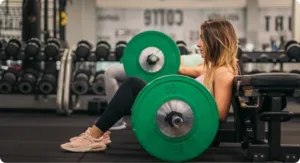
The Fat Loss Workout Plan Built for Women
Three strength-led sessions a week that protect the shape you want while the calorie deficit does the losing, built around how women actually train.
Program Overview
Fat loss for women is sold as endless cardio and tiny pink dumbbells, and both waste your time. Fat is lost in the kitchen through a calorie deficit; training's job is deciding what your body keeps, and strength work is what tells it to keep the muscle that gives you shape. This plan runs three sessions a week for eight weeks, strength first and a short kettlebell and step finisher after, so you leave each session having lifted properly and moved hard. Every exercise includes a form video demonstrated by a female coach.
Not focused on fat loss? The complete workout plan for women is the general version. Prefer working from home? Our 30-minute home dumbbell fat loss plan needs only a pair of dumbbells.
Who Is This For?
This plan suits you if:
- You are in, or starting, a calorie deficit and want to keep your shape
- You would rather lift than live on a treadmill
- You have access to dumbbells, cables, and a kettlebell or two
- You have three 40-minute slots a week
Every plan built for a deficit lives on our fat loss programs page.
Weekly Schedule
Phase 1: Lift First, Finish Fast (Weeks 1-4)
Each session is four strength movements at honest loads, then a five-minute finisher of kettlebell swings and step overs that spends energy without stealing recovery. The strength work is the priority: if anything gets cut short on a low-energy day, it is the finisher, never the lifting.
The deficit will try to talk you into lighter weights. Do not negotiate: matching last week's loads while losing weight is winning.
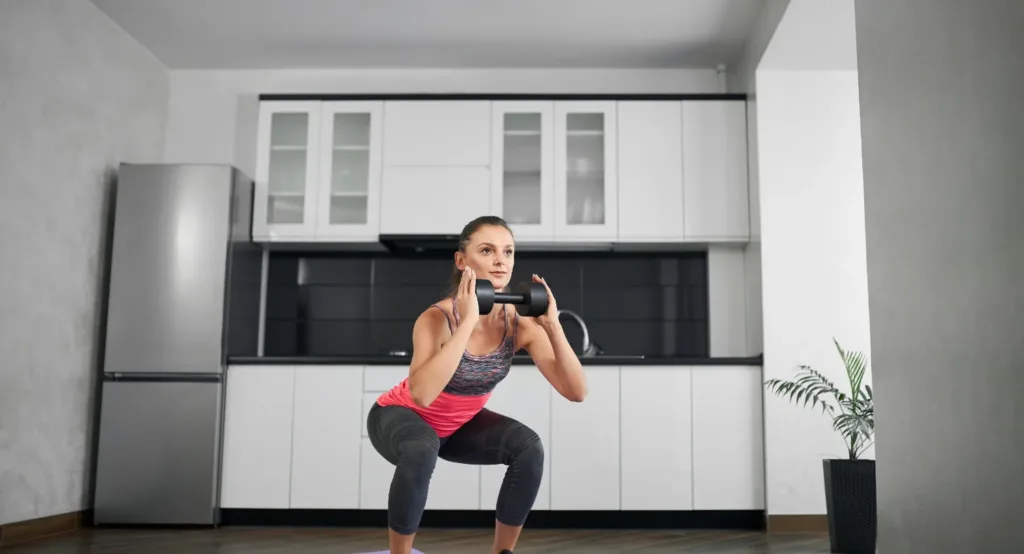
Hold one dumbbell at chest height and squat between your knees.
Press two dumbbells from chest level to lockout above your chest.
Pull the handle to your midsection, keeping the torso upright.
Upper back on a bench, drive the hips up to a full squeeze.
Hinge and snap the hips forward to swing the bell to chest height.
Hinge and lift two dumbbells from the floor by driving your hips forward.
Press two dumbbells from shoulder height to lockout overhead.
Pull the bar down to your upper chest by driving the elbows down and back.
Holding dumbbells, step forward into a lunge and push back to standing. Alternate legs.
Step up onto a box and over to the other side, driving through the working leg.
Squat with one foot slightly behind as a kickstand, loading the front leg. Work both sides.
Press dumbbells from an inclined bench, lowering to upper chest level.
Row a single handle to your side, allowing a longer range through the torso. Work both sides.
With your feet on a bench, bridge your hips up and squeeze the glutes.
Hinge and snap the hips forward to swing the bell to chest height.
A brisk walk on your rest days to aid recovery and keep you active.
Light stretching and mobility for anything that felt tight in your last session.
Phase 2: Hold the Muscle, Raise the Pace (Weeks 5-8)
The strength work drops slightly in volume as the deficit deepens, exactly as it should, while the finishers grow by a round. Weigh weekly, average it, and judge the month: half a percent of bodyweight a week is the sweet spot, and the tape measure will move before the mirror admits anything.
Strength holding steady while the scale drops means muscle stays and fat goes. That is the entire scoreboard.
Hold one dumbbell at chest height and squat between your knees.
Press two dumbbells from chest level to lockout above your chest.
Pull the handle to your midsection, keeping the torso upright.
Upper back on a bench, drive the hips up to a full squeeze.
Hinge and snap the hips forward to swing the bell to chest height.
Stagger the feet with most weight on the front leg and hinge at the hip. Work both sides.
Press two dumbbells from shoulder height to lockout overhead.
Underhand grip on the assisted machine, pull your chin over the bar.
With your rear foot elevated on a bench, lower into a split squat and drive up. Work both sides.
Step up onto a box and over to the other side, driving through the working leg.
Squat with one foot slightly behind as a kickstand, loading the front leg. Work both sides.
Press dumbbells from an inclined bench, lowering to upper chest level.
Row a single handle to your side, allowing a longer range through the torso. Work both sides.
With your feet on a bench, bridge your hips up and squeeze the glutes.
Hinge and snap the hips forward to swing the bell to chest height.
Twenty to thirty minutes of easy walking, outdoors if you can manage it.
Five to ten minutes on hips, ankles, and the upper back.
Fat Loss Workout Plan for Women PDF
Strength-first fat loss: three sessions a week that keep your shape while the deficit does the losing.
This is a 3-day plan you run for 8 weeks alongside a calorie deficit, with dumbbells, cables, and a kettlebell. Each session runs four strength movements at honest loads, covering a squat or hinge, a push, a pull, and direct glute work, then a five-minute kettlebell swing or step finisher. Phase 1 (weeks 1-4) sets the loads. Phase 2 (weeks 5-8) trims strength volume slightly as the deficit deepens while the finishers grow a round, with the scoreboard spelled out: strength held, weight down, shape kept.
- Strength First, Sweat Second The lifting protects your muscle and shape through the deficit; the finisher spends extra energy. The order is the strategy.
- Glutes Guarded Through The Cut Direct hip thrust and bridge work twice a week, because the most common casualty of cardio-only fat loss is exactly the shape most women are trying to keep.
- A Scoreboard That Is Not The Scale The PDF tracks strength alongside weekly weight averages, so you can see muscle staying while fat leaves, which no bathroom scale can show.
Get Your Fat Loss Plan
Includes both training phases, the weekly schedule, and exercise cues for all three sessions. Download instantly after you submit the form.
Unsubscribe any time.
Nutrition Guidance
The deficit does the losing and it has to be set deliberately, not felt out. Our macro calculator sets it and our recipes keep it livable. For more depth, read why you are always hungry on a diet and what post-vacation weight gain really is.
What Actually Matters Here
- Calories: A deficit of 300 to 500 a day. Larger deficits feel virtuous and cost the muscle this training exists to protect.
- Protein: The top of the 1.6 to 2.2g per kg range while dieting. It protects muscle and it is the most filling thing you can eat, which matters more every week.
- The scale lies weekly, tells the truth monthly. Water, cycle, and salt swing daily weight by more than any real change. Average it and judge the trend.
If hunger is unmanageable by week three, raise calories by 100 to 150 and continue. A slower cut you finish beats a fast one you abandon.