Strength Training for Runners
Two short strength sessions a week built around single leg work, designed to make you a faster, more durable runner without stealing recovery from your mileage.
Program Overview
The evidence on strength training for runners is unusually clear: it improves running economy, protects against the overuse injuries that end training blocks, and costs nothing in endurance when the dose is right. The dose is the whole trick. This plan is two 35-minute sessions a week, built on single leg strength because running is a single leg sport, with hinging for the hamstrings that decelerate every stride and calf work for the tissue that takes the most pounding. It slots around your running week rather than competing with it. Every exercise includes a form video.
For more lower body volume in an off-season, our lower body focus program goes deeper. If hamstrings are your recurring injury, pair one of these sessions with our hamstring workout instead.
Who Is This For?
This plan suits you if:
- You run regularly and want to get faster or stop breaking down
- You can give strength work two short sessions a week
- You have a pair of dumbbells and a bench or sturdy step
- You want strength that serves the running, not a second sport
Every strength option lives on our intermediate programs page.
Weekly Schedule
Phase 1: Build the Base (Weeks 1-4)
Two sessions built on the squat, hinge, and step patterns, almost all of it single leg. Place them on easy run days or rest days, never the day before your hardest session or long run. Expect leg soreness in week one and plan your running accordingly; it is gone by week two and does not return.
Two reps in reserve on everything. The strength work exists to serve the running, so it never gets to empty the tank.
Hold one dumbbell at chest height and squat between your knees.
Stagger the feet with most weight on the front leg and hinge at the hip. Work both sides.
Elevate the front foot on a plate and lower into a split squat for extra range. Work both sides.
Rise onto the balls of your feet and lower for a full stretch.
On all fours, extend the opposite arm and leg while keeping the torso still. Alternate sides.
Hinge and lift two dumbbells from the floor by driving your hips forward.
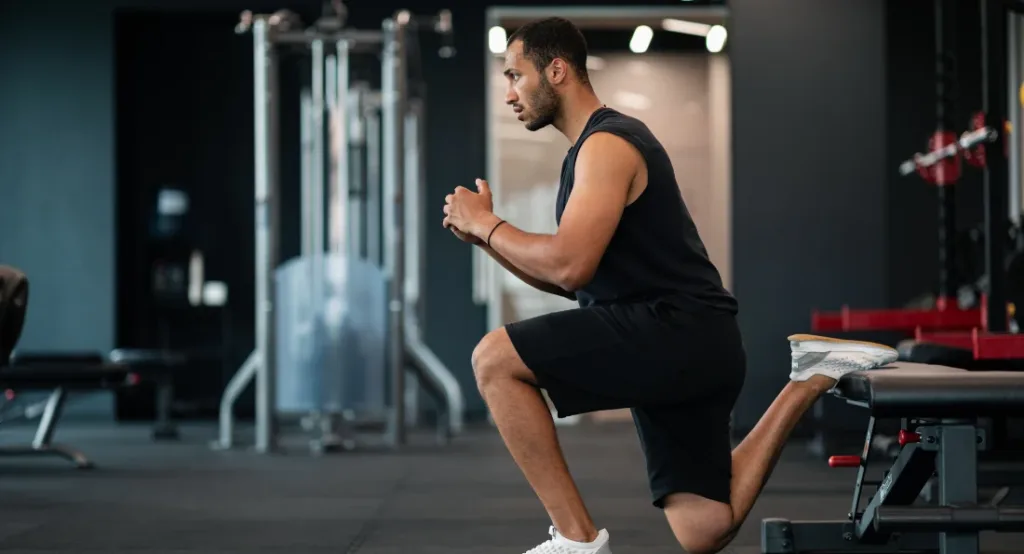
With your rear foot elevated on a bench, lower into a split squat and drive up. Work both sides.
Step up onto a box and over to the other side, driving through the working leg.
Rise onto the balls of your feet and lower for a full stretch.
Lying on your back, curl your shoulders off the floor by flexing the abs.
A relaxed walk on your off days. It adds up more than people expect over a training block.
A short mobility circuit for the hips and thoracic spine.
Phase 2: Add Load and Spring (Weeks 5-8)
The loads climb into genuinely heavy territory for the rep ranges, which is where the running economy research points, and a small dose of jump work arrives to train the stiffness that turns strength into stride. Six quality jump squats are worth more than twenty tired ones, so the volume stays deliberately tiny.
Heavy but crisp. If a set slows to a grind or a jump lands loud, the session is done growing and so are you for the day.
Hold one dumbbell at chest height and squat between your knees.
Stagger the feet with most weight on the front leg and hinge at the hip. Work both sides.
Squat down and jump explosively, landing softly back into the squat.
Rise onto the balls of your feet and lower for a full stretch.
On all fours, extend the opposite arm and leg while keeping the torso still. Alternate sides.
Hinge and lift two dumbbells from the floor by driving your hips forward.
With your rear foot elevated on a bench, lower into a split squat and drive up. Work both sides.
Step up onto a box and over to the other side, driving through the working leg.
Rise onto the balls of your feet and lower for a full stretch.
Lying on your back, alternate small kicks with straight legs and your lower back pressed down.
A brisk walk on your rest days to aid recovery and keep you active.
Light stretching and mobility for anything that felt tight in your last session.
Strength Training for Runners PDF
Two 35-minute sessions a week that build the single leg strength running actually uses.
This is a 2-day strength plan you run for 8 weeks alongside your normal running, with dumbbells and a bench. Phase 1 (weeks 1-4) builds the base with single leg squats, hinges, and step work at two reps in reserve, placed on easy run days so nothing collides with your key sessions. Phase 2 (weeks 5-8) takes the main lifts heavy for sets of 6 to 8, where the running economy research points, and adds a small, sharp dose of jump work to turn the strength into stride.
- Single Leg, Because Running Is Bulgarians, B-stance deadlifts, and step overs load one leg at a time, which is how every stride you will ever take works.
- Heavy Beats High Rep For Runners The economy improvements in the research come from genuinely heavy, low rep work, not circuits with light weights. Phase 2 delivers that dose.
- Scheduled Around Your Running The PDF includes the placement rules: which run days to lift on, what never to do before a long run, and how to handle week one soreness.
Get Your Runner's Strength Plan
Includes both training phases, the weekly schedule, and exercise cues for both sessions. Download instantly after you submit the form.
Unsubscribe any time.
Nutrition Guidance
Runners chronically under-eat for the combined load of mileage plus lifting, and the strength work is usually what gets blamed. Our macro calculator accounts for your activity and our recipes keep the fueling practical. For more depth, read why you are always hungry on a diet and how to tell if your training is working.
What Actually Matters Here
- Calories: Mileage plus lifting is a bigger bill than either alone. If both feel flat in the same week, eat more before you train less.
- Protein: 1.6 to 2.2g per kg daily. Endurance athletes need as much as lifters, and most get half.
- Around the double days: On days you run and lift, put carbs before whichever session matters more and protein after both.
Strength work did not make you slow; the missing 400 calories did. Runners hear this late and improve fast once they do.