Workout Plan for Over 60
Twelve weeks of strength, balance and confidence for people past sixty, starting from wherever you are today and building something that keeps you independent.
Program Overview
Past sixty, strength training stops being about how you look and starts being about what you can still do at eighty. Muscle and bone decline with age unless something argues with them, balance and the ability to produce force quickly fade first, and all three respond to resistance training at any age the research has ever tested. This plan is three sessions a week for twelve weeks, built on movements you can load safely and scale endlessly: sit-to-stand squats, supported presses and rows, hip bridges, and step work that doubles as balance practice. Nothing jumps, nothing requires getting down to the floor and back up at speed, and every movement has an easier version. Every exercise includes a form video.
In your fifties? Our over 40 plans and the over 50 programs are tuned a decade or two earlier. If joints rather than age are the limiting factor, our low impact workout plan is the gentler on-ramp.
Who Is This For?
This plan suits you if:
- You are past sixty and want strength that shows up in daily life
- You want to stay steady on your feet and independent for decades
- You can give three short sessions a week for twelve weeks
- You want a plan that scales down as readily as it scales up
Every plan at this level lives on our beginner programs page.
Weekly Schedule
Phase 1: Build the Base (Weeks 1-6)
Two alternating sessions run A, B, A each week. Loads are light enough that every rep looks identical and you finish each set knowing you had three more. That is deliberate: the first six weeks are about tissue tolerance, confidence and turning up, and tendons adapt slower than muscles do. The bird dog and step work are balance training disguised as accessory exercises, and they matter as much as the pressing.
Three reps left in the tank on everything. If a movement hurts rather than works, use the lighter version listed with it. Nothing here is worth training through pain.
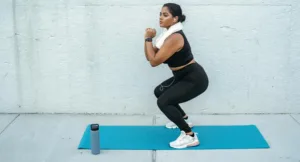
Hold one dumbbell at chest height and squat between your knees.
Press two dumbbells from chest level to lockout above your chest.
Pull the handle to your midsection, keeping the torso upright.
Lying on your back with knees bent, drive the hips up and squeeze the glutes.
On all fours, extend the opposite arm and leg while keeping the torso still. Alternate sides.
Hinge and lift two dumbbells from the floor by driving your hips forward.
Press a single dumbbell overhead while bracing against the offset load. Work both sides.
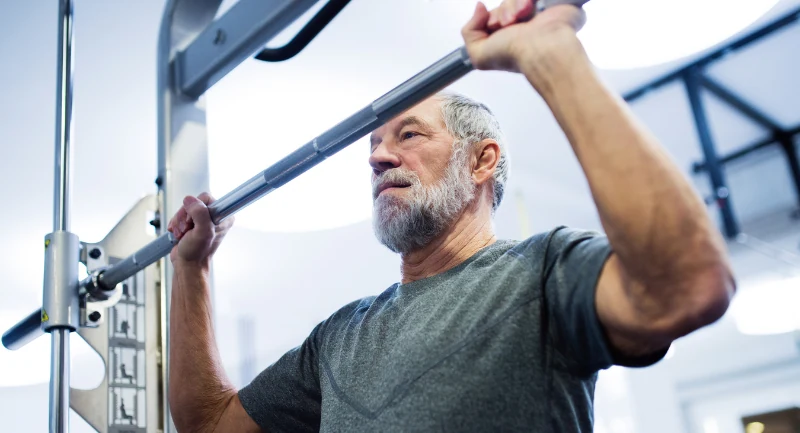
Pull the bar down to your upper chest by driving the elbows down and back.
Step up onto a box and over to the other side, driving through the working leg.
Hinged at the hips, open the arms wide and squeeze the shoulder blades together.
A relaxed walk on your off days. It adds up more than people expect over a training block.
A short mobility circuit for the hips and thoracic spine.
Phase 2: Add Load and Steadiness (Weeks 7-12)
The weights climb into genuinely useful territory, because bone and muscle respond to meaningful load rather than to repetition, and the single leg work arrives to train the balance that protects you from falls. Expect to use heavier dumbbells than you imagined in week one. Every movement keeps its Phase 1 version for any week that needs one.
Add the smallest weight available whenever every set reaches the top of the range with clean form. Strength gained after sixty is exactly as real as strength gained at thirty.
Hold one dumbbell at chest height and squat between your knees.
Press dumbbells from an inclined bench, lowering to upper chest level.
Row a single handle to your side, allowing a longer range through the torso. Work both sides.
With your feet on a bench, bridge your hips up and squeeze the glutes.
Rise onto the balls of your feet and lower for a full stretch.
Stagger the feet with most weight on the front leg and hinge at the hip. Work both sides.
Press a single dumbbell overhead while bracing against the offset load. Work both sides.
Pull the bar down to your upper chest by driving the elbows down and back.
Squat with one foot slightly behind as a kickstand, loading the front leg. Work both sides.
Pull the dumbbells toward your face with high elbows, squeezing the rear delts.
A brisk walk on your rest days to aid recovery and keep you active.
Light stretching and mobility for anything that felt tight in your last session.
Workout Plan for Over 60 PDF
Twelve weeks of strength, balance and independence, starting from wherever you are today.
This is a 3-day full body plan you run for 12 weeks with basic gym equipment, two alternating sessions of around 45 minutes. Phase 1 (weeks 1-6) builds tissue tolerance with light, controlled loads on supported presses, rows, hip bridges and step work, with three reps always left in reserve. Phase 2 (weeks 7-12) raises the loads into the range that meaningfully supports bone and muscle, and adds single leg work for the balance that protects against falls. Every movement lists an easier version.
- Balance Trained On Purpose Step overs, bird dogs and single leg work are in every week, because the ability to catch yourself fades earlier than strength does and responds just as well to practice.
- Loads That Actually Matter Six weeks of preparation, then real weight. Bone answers to meaningful load, and gentle-forever programs are why so many people over sixty see no change.
- Scales Both Ways Every exercise has a lighter version written beside it, so a stiff week bends the plan instead of ending it.
Get Your Over 60 Plan
Includes both training phases, the weekly schedule, scaling options, and exercise cues for both sessions. Download instantly after you submit the form.
Unsubscribe any time.
Nutrition Guidance
Older muscle needs a louder protein signal to respond, and appetite usually moves the other way. Our macro calculator sets honest targets and our recipes make them easy to reach. For more depth, read why it is never too late to get in shape and why your tracking might be off.
What Actually Matters Here
- Protein: Aim for the top of the 1.6 to 2.2g per kg range, split across three or four meals. A larger dose per meal is needed after sixty than before it.
- Calories: Maintenance. Weight loss at this age costs muscle and bone unless the training and protein are firmly in place first.
- Hydration and vitamin D: Thirst signals weaken with age and low vitamin D undercuts both bone and muscle. Both are worth a conversation with your doctor.
Most people over sixty eating normally land near half the protein this plan needs. A fortnight of honest tracking usually settles that argument.