
Here’s something that comes up constantly with clients: they know their macros. They can tell you their macros and protein targets without thinking. They log every day. By every account, they’re doing everything right.
And yet the scale doesn’t move.
Jump to a Topic
Your Macros Are Right. Your Tracking Probably Isn’t.
The Real Problem Isn’t the Numbers
Most of the time, the issue isn’t the plan. It’s the gap between what gets logged and what actually gets eaten. And that gap is sneaky, because it doesn’t feel like a gap at all.
Research consistently shows that people underestimate their calorie intake by anywhere from 20 to 50%. Even registered dietitians underestimate restaurant meals by 200 to 300 calories. This isn’t about carelessness. It’s about how the brain perceives portions, and the perception is almost always skewed in one direction: under.
Your body is the most reliable tracker you have. If the scale isn’t moving, you’re not in a deficit, no matter what the app says. The work from here is figuring out where the gap actually is.
The Three Tracking Gaps That Show Up Most Often
1. Logging Only Part of the Day
This is the most common one. Breakfast gets logged with perfect detail. The rest of the day goes unrecorded.
The app shows 300 calories. The actual day looks nothing like that.
A partial log doesn’t earn partial credit. A day with one meal logged isn’t a day where you ate one meal — it’s a day with missing data. Your body logged everything that happened. You just can’t see it, which means you can’t learn from it.
You don’t need a perfect log. You need a complete one. A rough estimate of dinner is worth infinitely more than no dinner logged at all. Tracking isn’t a test. It’s a data collection tool, and incomplete data can’t tell you anything useful.
2. Logging Food But Not Weighing It
Eyeballing portions feels reasonable, and it consistently leads to sneaky calories.
A tablespoon of peanut butter eyeballed is almost always closer to two tablespoons. A serving of chips estimated “by feel” is often 1.5 servings. Olive oil poured straight into a pan rarely gets measured, and it runs about 120 calories per tablespoon.
This isn’t about being obsessive. It’s about recognizing that portion perception is reliably inaccurate, in the same direction, every time. Ten seconds with a food scale shows you where the sneaky calories are actually coming from.
3. Treating Snacks as Invisible
A handful of chips while making dinner. A few bites of your kid’s leftovers. Creamer in three cups of coffee.
Individually, these feel too small to matter. Collectively, they’re often 300 to 500 unlogged calories a day.
Nothing is too small to count. That’s not about making eating stressful — it’s about making the data honest. Your body is tracking it whether you log it or not.
Accuracy Doesn’t Mean Perfect
It means consistent and complete.
A day where everything gets logged imperfectly is more useful than a day where breakfast is logged flawlessly and nothing else makes it in. Consistent, slightly imperfect tracking will always outperform perfect tracking done sporadically. The goal isn’t a beautiful log. It’s a truthful one.
When Perfect Tracking Isn’t Possible
Some weeks are harder than others. Travel, social events, celebrations — life doesn’t happen in a controlled environment. A few strategies keep your data useful even then.
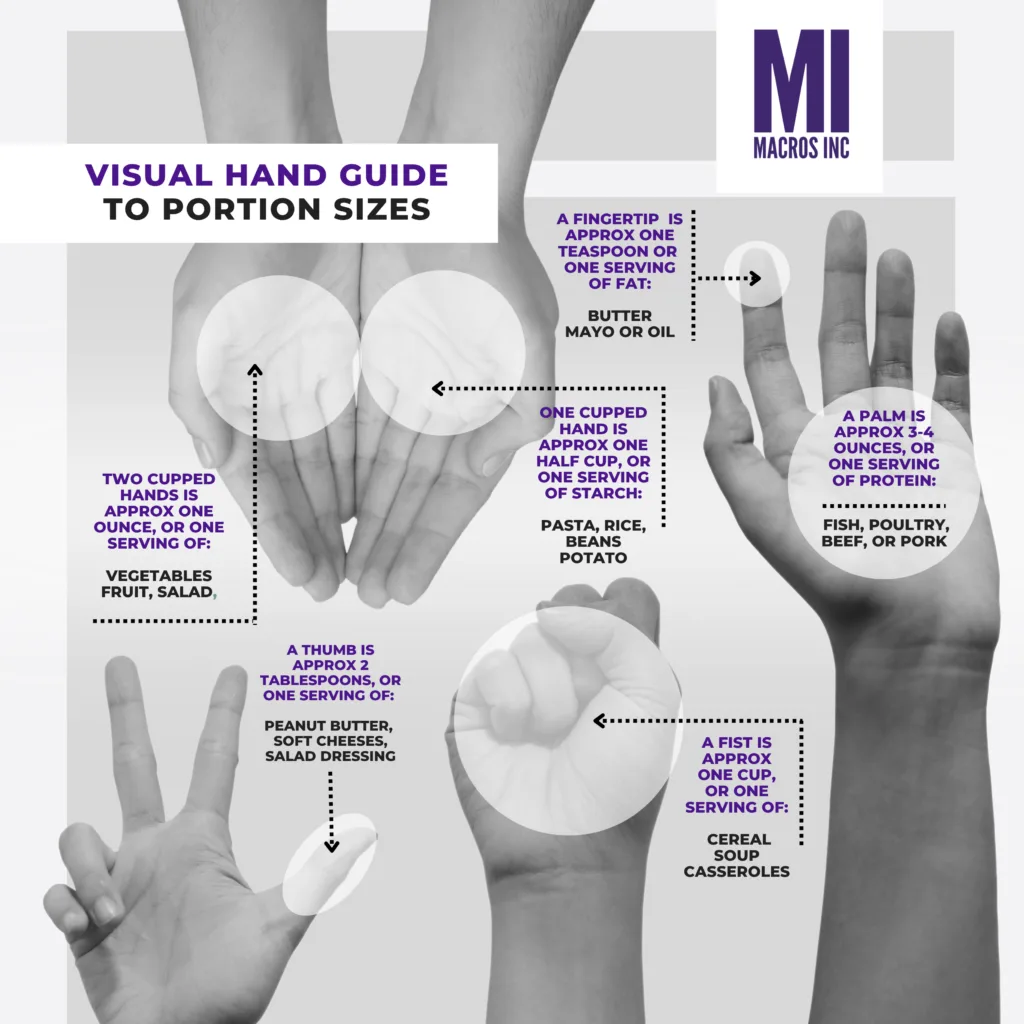
Use the hand method when you can’t weigh food. Your palm roughly equals a protein serving. Your fist roughly equals a carb serving. Your thumb roughly equals a fat serving.
Design your plate intentionally. Half protein and vegetables, one quarter carbs, as a default structure when precision isn’t available.
Estimate high, not low. When in doubt, log the higher-calorie version of what you think you ate. Overestimating by 30% gets you much closer to the truth than underestimating ever does.
Track your habits when you can’t track your food. Did you hit your protein? Did you eat mindfully? Did you stop when you were satisfied rather than full? Those notes give you useful information to reflect on at the end of the week, even without exact numbers.
The Bottom Line
Your macro targets exist for a reason. Your macros were built around your body, your goals, and your activity level. But a target only works if you’re actually shooting at it.
Almost every time a client feels stuck and the data gets pulled apart, the answer is the same. The plan isn’t wrong. The data behind it doesn’t reflect what’s actually being eaten.
You don’t need to be perfect. You need to be honest. Log everything, weigh what you can, and choose complete over correct, every time.
Frequently Asked Questions
Why am I not losing weight even though I’m hitting my macros?
The most common reason is a gap between what’s logged and what’s actually eaten, not an error in the macro targets themselves. Partial logging, eyeballed portions, and unlogged snacks can add up to hundreds of unaccounted calories a day, which is often enough to erase a deficit entirely.
How accurate is calorie tracking, really?
Research shows most people underestimate their intake by 20 to 50%, including trained professionals like registered dietitians. The inaccuracy isn’t due to carelessness — it reflects how unreliable human portion perception is in general, almost always in the direction of underestimating.
Do I need to weigh all my food to track accurately?
Not necessarily, but weighing food periodically helps recalibrate your sense of true portion sizes. Many people find that even a few weeks of weighing food changes how they eyeball portions going forward, improving accuracy even when they go back to estimating.
What’s more important: perfect tracking or consistent tracking?
Consistent tracking, even with some imperfection, produces better results than sporadic perfect tracking. A day with everything logged roughly is more useful than a day with one meal logged flawlessly and the rest missing entirely.
How do I track accurately when I’m traveling or at a social event?
Use the hand-portion method as a rough guide, build plates with a protein-and-vegetables-first structure, and round estimates up rather than down. Tracking habits, like whether you hit your protein or ate mindfully, also gives you useful data even when exact numbers aren’t possible.
If your tracking looks right on paper but your results say otherwise, your coach can help you find the real gap. At Macros Inc, that’s exactly what weekly check-ins are for. Start your free 14-day trial.
No gimmicks. No restrictions.
Start your journey with expert coaching, personalized nutrition, and real results, absolutely free for two weeks.