Workout Plan for Women Over 40
A twelve-week strength program built for women over forty, three sessions a week that protect muscle, bone, and strength through the years when they matter most.
Program Overview
From your forties onward, muscle and bone density decline unless you train to keep them, and resistance training is the single most effective tool for both. That matters double through perimenopause and menopause, when falling estrogen accelerates both losses. This program runs three full body sessions a week for twelve weeks using the equipment every gym has. Phase 1 builds tissue tolerance with moderate loads; Phase 2 loads the squat, hinge, and press patterns properly, because lifting heavy, with good technique, is precisely what your bones respond to. Every exercise includes a form video.
New to the gym entirely? Start with our beginner gym workout plan for women. There is also a men over 40 version of this program with the same principles.
Who Is This For?
This plan suits you if:
- You are over forty and want to keep or rebuild strength and muscle
- You want training that supports bone density through perimenopause and beyond
- You can commit to three sessions a week for twelve weeks
- You want a plan that takes recovery seriously rather than punishing you
Browse everything at this level on our intermediate programs page.
Weekly Schedule
Phase 1: Build the Base (Weeks 1-6)
Six weeks of moderate loads and controlled reps to build tissue tolerance before the weights climb. Stop every set two reps short of failure, and treat the warm up as part of the session: five minutes of brisk walking plus a light set of the first movement.
Two reps in reserve on everything. Consistency across six weeks beats intensity in any single session.
Hold one dumbbell at chest height and squat between your knees.
Press two dumbbells from chest level to lockout above your chest.
Pull the bar down to your upper chest by driving the elbows down and back.
Lying on your back with knees bent, drive your hips up and squeeze the glutes.
On all fours, extend the opposite arm and leg while keeping the torso still. Alternate sides.
Hinge and lift two dumbbells from the floor by driving your hips forward.
Press two dumbbells from shoulder height to lockout overhead.
Pull the handle to your midsection, keeping the torso upright.
Holding dumbbells, step forward into a lunge and push back to standing. Alternate legs.
Lying on your back, curl your shoulders off the floor by flexing the abs.
Sit with your upper back on a bench and a bar across your hips, then drive your hips up.
Press dumbbells from an inclined bench, lowering to upper chest level.
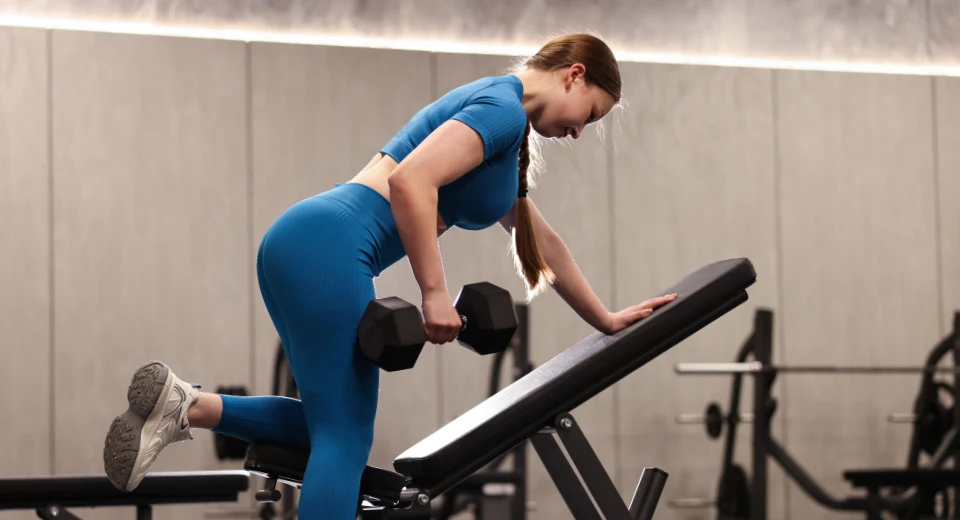
Row a single handle to your side, allowing a longer range through the torso. Work both sides.
Squat with one foot slightly behind as a kickstand, loading the front leg. Work both sides.
Hold a band at shoulder height and pull it apart until your arms are wide.
Twenty to thirty minutes of easy walking, outdoors if you can manage it.
Five to ten minutes on hips, ankles, and the upper back.
Phase 2: Load the Patterns (Weeks 7-12)
The barbell comes in and the loads become meaningful, because bone responds to load, not to repetition. Reps drop on the main movements while the single leg and upper back work stays higher. If a movement flares anything up, swap back to its Phase 1 version and keep moving.
Add weight only when every set hits the top of the rep range with clean technique. Strength after forty is built exactly the way it always was, just with recovery respected.
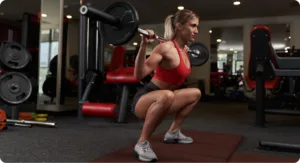
Place the barbell on your upper traps, squat down until thighs are at least parallel, then drive up.
Press two dumbbells from chest level to lockout above your chest.
Pull the bar down to your upper chest by driving the elbows down and back.
Sit with your upper back on a bench and a bar across your hips, then drive your hips up.
Kneeling at a high pulley, crunch down by flexing the spine, not the hips.
Hold the barbell at hip height, push your hips back and lower until you feel a hamstring stretch.
Start with palms facing you and rotate the hands outward as you press overhead.
Hinge forward and row both dumbbells to your lower ribs.
With your rear foot elevated on a bench, lower into a split squat and drive up. Work both sides.
Rotate and pull the cable diagonally across your body from high to low. Work both sides.
With your feet on a bench, bridge your hips up and squeeze the glutes.
Press dumbbells from an inclined bench, lowering to upper chest level.
Pull the handle to your midsection, keeping the torso upright.
Elevate the front foot on a plate and lower into a split squat for extra range. Work both sides.
Rise onto the balls of your feet and lower for a full stretch.
An easy walk to move blood through the muscles you trained without adding fatigue.
Gentle mobility for whichever joints felt stiff getting into position last session.
Workout Plan for Women Over 40 PDF
A twelve-week strength program that protects muscle and bone through your forties, fifties, and beyond.
This is a 3-day full body plan you run for 12 weeks with basic gym equipment. Phase 1 (weeks 1-6) runs three sessions of 5 exercises each at moderate loads with two reps in reserve, building tissue tolerance around the squat, hinge, press, and pull. Phase 2 (weeks 7-12) brings in the barbell and drops the reps on the main lifts, because bone density responds to meaningful load, while the single leg and upper back work stays higher rep. Every session fits inside an hour.
- Built For The Hormonal Reality Falling estrogen accelerates muscle and bone loss. Heavy, well-recovered strength work is the intervention with the strongest evidence behind it, and that is what this is.
- Three Sessions, Full Recovery A day between every session and two at the weekend, because recovery is what changes most with age, not your ability to get stronger.
- The Barbell, Introduced Properly Six weeks of preparation before the bar goes on your back, so the loading in Phase 2 lands on tissue that is ready for it.
Get Your Over 40 Workout Plan
Includes both training phases, the weekly schedule, and exercise cues for all three sessions. Download instantly after you submit the form.
Unsubscribe any time.
Nutrition Guidance
Training after forty works when the food behind it does, and protein needs rise exactly when appetite and habit often push intake down. Our macro calculator sets your targets and our recipes help you hit them. For more depth, read protein needs during menopause and training for menopause weight loss.
What Actually Matters Here
- Protein: Aim for the top of the 1.6 to 2.2g per kg range. Anabolic resistance means the same muscle now needs a stronger protein signal to respond.
- Calories: Maintenance or a small deficit if fat loss is a goal. Aggressive dieting on top of this training costs muscle and bone, the two things the program exists to protect.
- Calcium and vitamin D: The bone side of the equation. Cover them through food where you can and speak to your doctor about supplementation if intake is low.
Track for two honest weeks before changing anything. Most women over forty eating intuitively are under target on protein, not over on calories.