
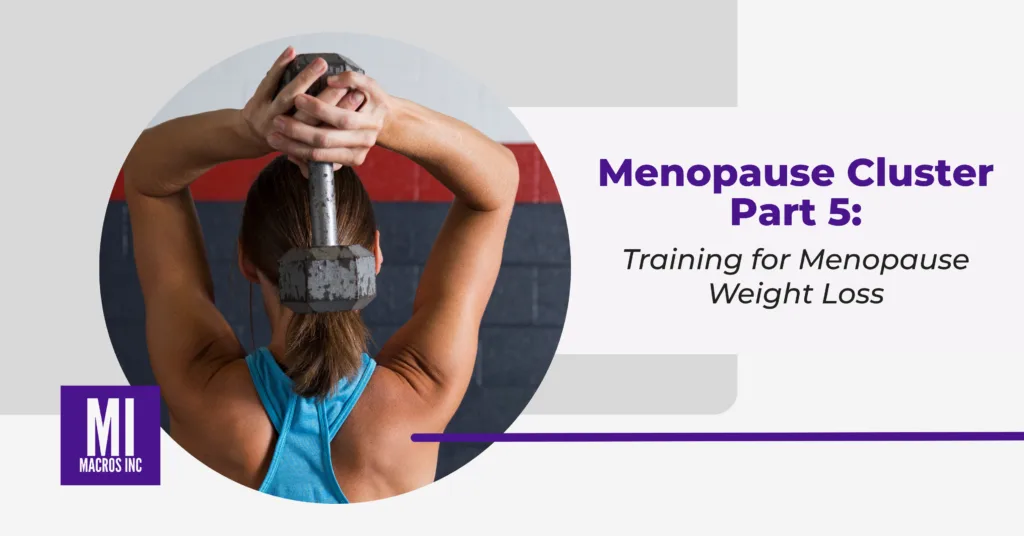
So far, we’ve gone over the different effects dietary choices have on menopause and fat loss. Now, it’s time to look at the other side of the equation: What activities can you do to make fat loss easier during menopause? Luckily, the answers aren’t too terribly complex. As always, it comes down to lifting stuff and moving yourself around. Or, if you want to make it sound fancier, we can call it “training.”
Jump to a Topic
Menopause Cluster Part 5 – Training for Menopause Weight Loss
Exercise vs. Training
Before we delve into the types of training, I think it’s important to differentiate between exercise and training, and why the latter is more effective for our means. The two are often used interchangeably, but there is a distinction between them that matters significantly in the long run.
Exercise is some sort of intentional activity that causes the body to expend energy. This is a very broad, all-encompassing label, and intentionally so. Exercise can include things such as running, swimming, hiking, biking, weightlifting, and virtually anything else you can think of. The magnitude of that effort can vary depending on personal preference, anywhere from virtually no challenge to absolutely grueling.
As for training, you can think of it as exercise with a long-term plan and purpose. Rather than aiming to simply exhaust you, training instead builds you up from session to session. As your body experiences the gradual increase in demand, it adapts to it accordingly. These include muscle growth, more efficient force output, increased cardiovascular efficiency, and other adaptations of your body systems. The act of forcing the body to adapt to increasing stress is known as progressive overload.
The reason training supersedes exercise is that exercise alone doesn’t always drive progress. A devastatingly hard exercise session may actually be poor training if it negatively affects the following workouts. Conversely, A solid training session can seem to be poor exercise since it may not push you as hard as you can go. However, development and growth do not require pushing to failure, so not every session is going to be taxing. Furthermore, fatigue management is a vital part of training, and periodically cycling back the intensity allows the body to recover.
With training, there should always be specific goals that you’re working toward. Whether that’s increases in strength, more endurance, or anything in between, it’s important to know where things are headed, and the steps you’re taking to get there. For today, we’re going to talk about training with the goal of fat loss in mind, particularly in the context of menopause. To understand those, though, we need to talk about what training does for your body.
Types of Training
As with exercise, training can be done in a variety of different forms. Virtually any exercise can be adapted to proper training. For the sake of simplicity, we’ll group the different activities into two broad categories: resistance training and cardio. It’s important to note that many activities actively dip into or benefit from both. For our purposes here, though, we’ll examine them separately.
Resistance Training
Resistance training makes your muscles exert force against an external opposing force. Your muscles do so by contracting and moving the bones they attach to. As these muscles are trained over time, they adapt to the forces exerted upon them. They grow larger to exert more force, become more efficient at responding to the brain’s commands (rate coding), and fatigue less quickly.
While any external force can be used for resistance training, the most common form through lifting weights. Here, the opposing force is created by gravity. The larger the weight, the more force required to move it through the same range of motion. Thus, progressive overload is achieved by gradually increasing the weight, and thus resistance, that your muscles must overcome. There are other ways to increase the demand on your muscles, but the amount of weight lifted tends to be the simplest and easiest to gauge metric for progress.
In the context of fat loss, resistance training is actually a poor source of calorie burn. Thankfully, the true value in resistance training lies with what it makes the body keep, not what it loses. When in a calorie deficit, the body will focus on self preservation. Since all living tissues have an energy requirement, your system will remove anything that it deems unnecessary. Your muscle mass somewhat falls in the “expendable” category: You likely need muscle, but not all of it. Therefore, if your body is trying to preserve itself, it’s perfectly happy with dropping that extra lean mass.
However, if you’re actively using those muscles, the body is going to maintain them since they’re still useful. This is why resistance training during a diet is crucial. It makes the body retain its muscle adaptations even with a lack of energy. Not only does this preserve muscle mass, it ensures that your body primarily focuses on its fat stores instead. By skewing tissue loss toward your fat stores instead, this indirectly increases the amount of fat lost with the same efforts.
Cardio
Cardiovascular training, or cardio for short, consists of activities that increase the exertion of your respiratory and circulatory systems. Cardio increases oxygen intake and quickens heart rate due to the increased demands of the body. Due to the broad definition, virtually any extended activity can be used as cardio. Walking, running, biking, swimming, dancing…if it gets your heart rate up, it’ll do the job.
As with resistance training, the goal with cardio is to get your body to adapt to increasing levels of stress via progressive overload. This can be achieved through doing cardio more often (frequency), increasing the exertion (intensity), or the duration (volume). Using running as an example, you can progress via running more often, faster, or longer. As long as there is an increase in the stimulus, your body will adapt to it.
It is also true that cardio burns more calories than resistance training does. The exact amount depends on the activity and intensity, but nonetheless contributes to the “calories out” part of the energy equation. However, it’s important to remember that the calorie burn is relatively modest compared to the effort put in. This is why it’s usually a good idea to focus on your diet as the main source of a deficit, not cardio alone. It is usually much easier to skip eating 500 calories daily than to burn the equivalent through hours of daily cardio. This isn’t to say that cardio is useless for fat loss; it simply should complement your efforts, not be the brunt of it.
As a final note, while resistance training can also leave you panting, it is not the same as dedicated cardio. Weight training is usually an anaerobic exercise, i.e. it doesn’t depend on oxygen as much in the middle of exertion. By contrast, cardio is usually longer in duration, forcing the body to maintain an elevated heart rate to supply it. Both types of training are important, but they aren’t substitutes for one another.
Menopause Makes Training a Priority
While both resistance and cardio training are important for anyone’s efforts, that need is greatly amplified in the context of menopause. This is true both in terms of fat loss as well as overall health. Both tools are crucial for offsetting some of the changes that arise. Essentially, menopause stacks the deck against you. Effective training helps even the playing field a bit.
With fat loss, things such as altered insulin sensitivity and lowered estrogen make your body less efficient at using its fat stores. Both kinds of training help offset this. Resistance training keeps muscle mass retention a priority, allowing for more focus on your fat stores alone. Additionally, cardio has beneficial effects on insulin sensitivity, increasing the efficiency with which your body mobilizes your fat for energy.
Fat loss aside, the benefits of training are vital for offsetting other troubles as well. In particular, there are at least two particular health concerns that menopause brings. These consist of sarcopenia and osteoporosis.
Sarcopenia is the tendency to lose muscle mass as we age. This happens for a variety of factors including inactivity, altered hormone levels, and impaired recovery. Muscle loss and weakening not only interferes with day-to-day activities, but makes individuals more prone to injury and skews body composition negatively toward higher bodyfat percentages. The risk of lean mass loss can be further exacerbated by a caloric deficit. However, both these risks can be reduced with habitual resistance training.
Osteoporosis is the result of bone density loss over time. As we age, our body’s ability to build bone is outpaced by the pace that it breaks down. This causes bones to become more brittle and less resilient, greatly increasing the risk of fractures. The hormonal changes during menopause amplify this process further. While we’ve mostly talked about the muscular benefits of weight training, there are also positive effects on the skeletal system as well. As you lift over time, one of the stress adaptations your body creates is increasing bone density. Therefore, regular resistance training can help minimize the risk of complications from osteoporosis,
Conclusion
While everyone has their preferences for what they like to do for lifting or cardio, it’s almost always a good idea to incorporate both into your lifestyle. That recommendation only becomes stronger as you enter menopause. When combined with a proper diet, effective training goes a long way toward maintaining health and aiding with fat loss efforts, regardless of what your hormones want to throw your way.
No gimmicks. No restrictions.
Start your journey with expert coaching, personalized nutrition, and real results, absolutely free for two weeks.