

Quick answer: Often a little, in the first few weeks. It’s water stored in your muscles, not fat. Creatine has no calories, so it can’t add fat on its own. Judge it by your weekly trend, your lifts, and how your clothes fit, not one morning on the scale.
Monday you start creatine. Thursday the scale is up. You ate the way you planned and trained the way you planned.
It feels like the plan quit on you. It didn’t. That number is mostly water, and it’s water in the right place.
Jump to a Topic
Why the scale goes up on creatine
Creatine pulls water into your muscle cells. That’s part of how it works: more stored fuel for hard sets, and water comes along with it.
The bump shows up early, then levels off. It isn’t fat, and it isn’t something you did wrong.
What to watch instead:
- Your weekly average weight, not a single weigh-in.
- Whether your lifts are moving up.
- Your waist, and how your clothes fit.
If those hold steady or improve, the plan is working.
Does creatine help with weight loss?
Not directly. Creatine doesn’t burn fat.
What it can do is help you keep training hard while you eat less. When you eat less, keeping muscle is the hard part. Hard sets are how you keep it.
The new Texas A&M study tested this. People who lifted, did cardio, and ate in a modest deficit while taking creatine kept more lean tissue and lost more body fat percentage than people on the same program with a placebo.
Creatine helped the plan. It didn’t replace it.
What the new Texas A&M study found
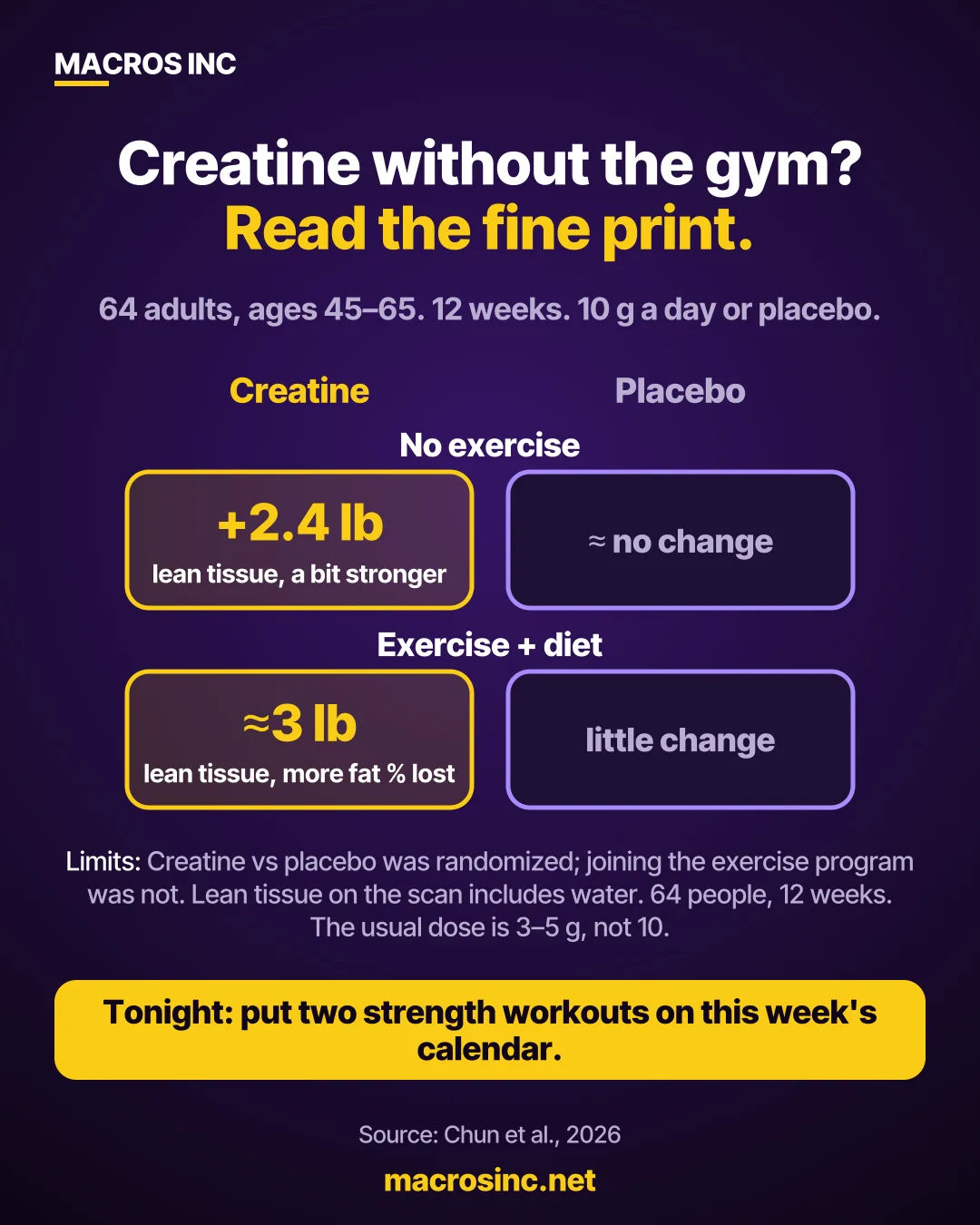
The study in 60 seconds: Creatine can help a little even if you don’t exercise. It works best with lifting and enough protein. Researchers at Texas A&M followed 64 adults, ages 45 to 65, for 12 weeks. Each person chose whether to join an exercise and diet program. Inside each group, some took 10 grams of creatine a day and the rest took a look-alike powder. Without exercise, the creatine group gained about 2.4 pounds of lean tissue and got a bit stronger. With exercise and eating a little less, the creatine group gained nearly 3 pounds of lean tissue and had a bigger drop in body fat percentage. Creatine versus placebo was randomized. Joining the exercise program was not. The scan counts water as lean tissue, it was 64 people for 12 weeks, and the usual dose is 3 to 5 grams, not 10. Tonight: before you buy the tub, put two strength workouts on this week’s calendar.
The headlines say creatine builds muscle without exercise. Here’s what the study actually did.
Who: 64 healthy adults, ages 45 to 65, who weren’t exercising regularly. Forty were women and 24 were men.
How: Each person chose a group: no exercise, or 12 weeks of strength and cardio three times a week with a modest calorie deficit. Inside each group, people were randomly assigned to 10 grams of creatine a day or a placebo. Neither they nor the researchers knew who got which.
What happened:
- No exercise: The creatine group gained about 2.4 pounds of lean tissue and got stronger on the bench press and leg press. The placebo group barely changed.
- Exercise and diet: The creatine group gained nearly 3 pounds of lean tissue and lost more body fat percentage than the placebo group, whose lean tissue barely moved.
- Cardio fitness: Creatine didn’t improve it in either group.
Where the headlines overreach
The study is real. “Skip the gym” is not the takeaway.
People chose whether to join the exercise program. Creatine versus placebo was randomized inside each group. Exercise versus no exercise was not, so differences between those two groups may partly reflect who signed up.
Lean tissue includes water. The body scan counts the water creatine holds in muscle as lean tissue. Some of that 2.4 pounds is likely water.
It was small and short. 64 people for 12 weeks. A good study, not the final word.
The dose was high. 10 grams a day was the study protocol. The usual recommended dose is 3 to 5.
Who paid for it. The study was funded by a gift from the WoodNext Foundation through the Texas A&M Foundation. The creatine itself was supplied by AlzChem, a creatine manufacturer, and the senior author chairs that company’s scientific advisory board. The authors state the sponsors had no role in collecting, analyzing, or interpreting the data. Read the result with that in mind.
The fair read: creatine made people who didn’t exercise a little stronger. The best results came from creatine plus training plus eating well.
Is creatine good for women and adults over 40?
Same rules, same dose. Most people in this study were women, and all of them were 45 to 65.
Creatine isn’t a women’s supplement or a men’s supplement. The real question is whether you’re lifting and eating enough protein. If you are, creatine is a reasonable tool to add. If you aren’t, start there first.
How much creatine should you take?
- Type: Creatine monohydrate. It’s the most studied form.
- Amount: 3 to 5 grams a day.
- Timing: Whenever you’ll remember. Taking it every day matters more than when.
- Loading: Optional. A daily dose fills your muscles within about four weeks.
- Calories and macros: None. Creatine doesn’t count toward your calories, protein, carbs, or fat.
Pair it with enough protein. Drink water like you normally would.
What if you’re on a GLP-1 medication?
There’s no finished study yet of creatine in people taking a GLP-1 medication.
What holds either way: keeping muscle while you lose weight comes from lifting and eating enough protein. Creatine may help you train harder, but it doesn’t replace either one. Ask your prescriber before you add it.
Check with your doctor first if
- You have kidney disease.
- You’re pregnant or breastfeeding.
- You have bloodwork coming up. Creatine can raise creatinine, a kidney marker, so tell your doctor you take it.
The powder is not the plan
Creatine is a tool. It works best for people who are already lifting, eating enough protein, and sticking with it on the messy weeks.
The messy weeks are where most plans quit. A work trip. Short sleep. Then a morning weigh-in that’s up again, and it looks like the plan stopped working.
A coach tells you it’s water before you quit. Then they adjust the week and keep your training moving.
Sources
Chun J, Liu Y, Kibler GL, et al., Kreider RB. Effects of creatine supplementation with and without exercise and diet intervention on body composition, cognitive function, and markers of health in middle-aged and older adults. Journal of the International Society of Sports Nutrition, 2026. doi.org/10.1080/15502783.2026.2716273. Trial registration ISRCTN83081058.
Kreider RB, et al. International Society of Sports Nutrition position stand: safety and efficacy of creatine supplementation in exercise, sport, and medicine. Journal of the International Society of Sports Nutrition, 2017. doi.org/10.1186/s12970-017-0173-z
Antonio J, et al. Common questions and misconceptions about creatine supplementation: what does the scientific evidence really show? Journal of the International Society of Sports Nutrition, 2021. doi.org/10.1186/s12970-021-00412-w
Antonio J, et al. Part II. Common questions and misconceptions about creatine supplementation: what does the scientific evidence really show? Journal of the International Society of Sports Nutrition, 2024. doi.org/10.1080/15502783.2024.2441760
No gimmicks. No restrictions.
Start your journey with expert coaching, personalized nutrition, and real results, absolutely free for two weeks.
