
The quick version
Do the same workout twice. That is how you know you are getting stronger.
To get stronger, a workout has to get a little harder over time, and you have to repeat it to see that happening.
Picture someone who has done home workout videos four days a week for two years. She never skips. But every video is different, so she cannot tell whether her squat is stronger than it was last spring.
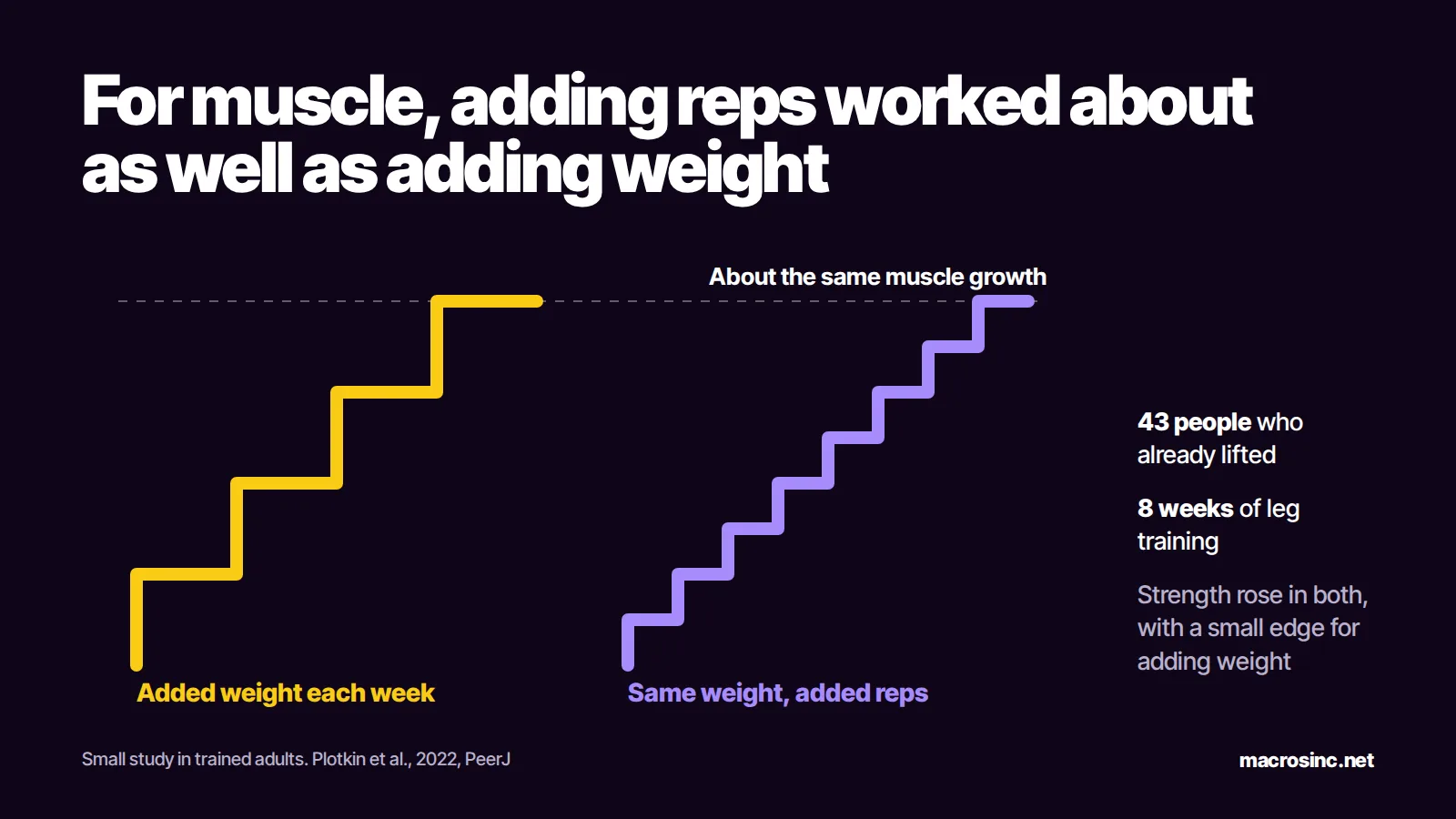
One study looked at two ways to make a workout harder. Forty-three people who already lifted trained their legs for eight weeks. One group added weight each week. The other kept the same weight and added reps. Both groups built about the same amount of muscle. Strength went up in both, with a small edge for the group that added weight.
The limit: it was a small study, only eight weeks long, in people who already trained. It is a good sign that adding reps works, not a promise for every body.
What to do tonight: pick one exercise. Write down the weight and how many reps you did. Next time, try to beat it by one rep.
Source: Plotkin and colleagues, 2022. doi.org/10.7717/peerj.14142
If you have done the same style of workout videos for a year or two, you have probably wondered whether you are still getting stronger or just getting good at the videos. Fair question. The answer is progressive overload, and you do not need a new program to use it. You need a way to see your numbers and a simple rule for when to change one.
Jump to a Topic
What is progressive overload?
Progressive overload is making a workout a little harder over time, so your body has a reason to keep adapting. You add reps, weight, sets, or a harder version of a move, one small step at a time. When the workout stops getting harder, progress slows down.
It does not mean adding weight every workout. It does not mean training until you collapse. It means the demand goes up slowly, and you can see it go up on paper.
Why follow-along workouts can stall
Video workouts are good at getting you moving and keeping you consistent. Where they get tricky is measurement. Each video uses different moves, different rep counts, and different timing. After two years you have done hundreds of workouts, and it is still hard to answer one simple question: is your lunge stronger than it was in March?
You can only see “more” if you do the same thing twice. So repeating the same week of workouts for several weeks is not lazy. It is how overload works. Some video programs are already built in progressive phases. If yours is, follow it in order and log it. If yours is a rotating library, the rest of this article is for you.
Six ways to make a workout harder
- Reps. Same weight, one or two more reps.
- Load. Heavier dumbbells, a heavier kettlebell, or a band with more tension.
- Sets. One more set of the same exercise.
- Tempo and pauses. Take three seconds to lower the weight, or pause at the bottom. The same dumbbell feels heavier.
- Range of motion. A deeper squat, or a split squat with your front foot on a step.
- A harder variation. Incline push-up to floor push-up. Two-leg squat to split squat to rear-foot-elevated split squat.
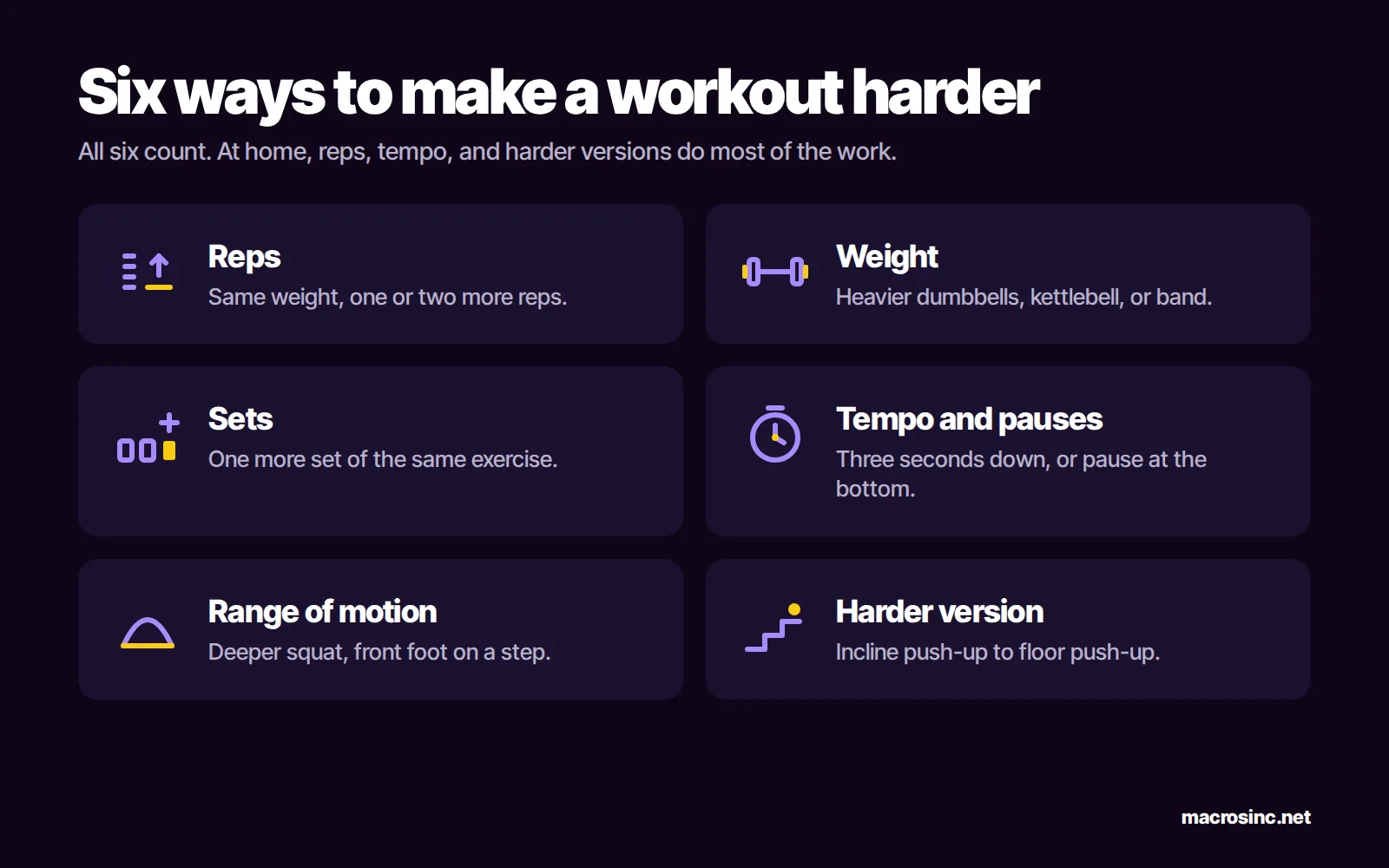
Most people training at home lean on reps, tempo, and variations, because the dumbbell rack is small. That is fine. All six count. Our beginner dumbbell-only workout and 4-day dumbbell home split are built for exactly that setup.
The simplest method: double progression
Double progression is the easiest system to run on your own. You progress reps first, then weight.
- Pick a rep range for each exercise. 8 to 12 works for most lifts.
- Start with a weight you can lift for 8 good reps, stopping with 1 to 3 reps left in the tank.
- Each week, try to add a rep or two to your sets.
- When you hit the top of the range on every set with good form, go up in weight (or to a harder variation) and drop back to the bottom of the range.
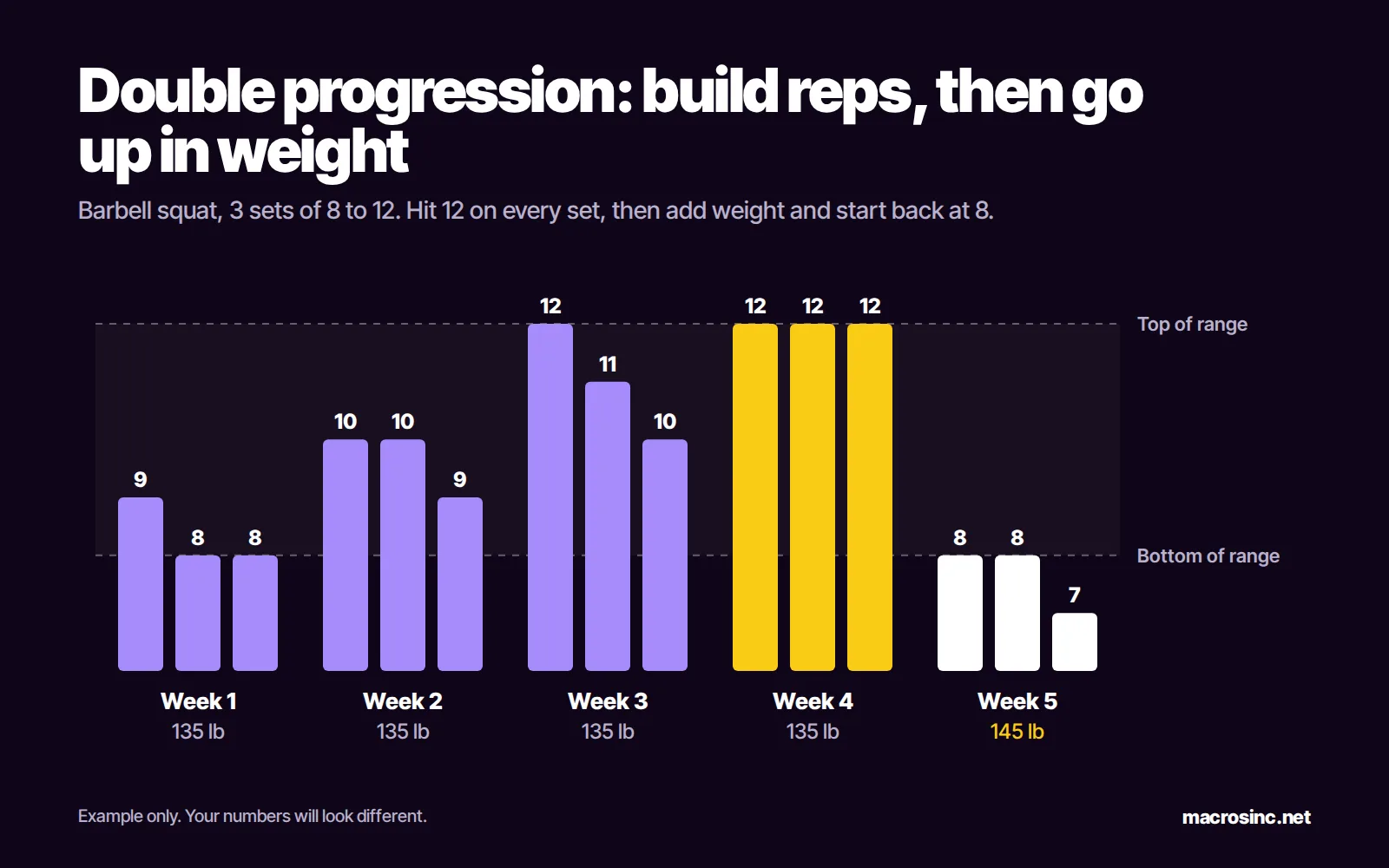
Here is what that looks like for a barbell squat, 3 sets of 8 to 12:
| Week | Weight | Reps (set 1 / 2 / 3) | Next step |
|---|---|---|---|
| 1 | 135 lb | 9 / 8 / 8 | Same weight, chase reps |
| 2 | 135 lb | 10 / 10 / 9 | Same weight, chase reps |
| 3 | 135 lb | 12 / 11 / 10 | Same weight, chase reps |
| 4 | 135 lb | 12 / 12 / 12 | Top of range on every set: go up |
| 5 | 145 lb | 8 / 8 / 7 | Back to the bottom, build again |
Some weeks the reps will not move. That is normal. A late meeting, a bad night of sleep, a sick kid: the plan still works, it just pauses for a week.
Already at the heaviest dumbbell you own? Switch levers. Slow the lowering to three seconds, add a pause, or move to a single-leg or single-arm version. A harder setup can make a light dumbbell do a heavier dumbbell’s job.
How hard each set should feel
End most sets with about 1 to 3 good reps left. You should feel like you could do a couple more, not ten more.
This is why lighter home weights can still build muscle. A 2021 review found that muscle growth happened across a wide range of loads when sets were taken close to failure. The limit: maximum strength still improved more with heavier loads, and most of that research is short-term and done in young adults. Treat it as a principle, not a promise for your body.
Adding reps also counts as overload. A 2022 study compared adding weight each week to adding reps each week, and both groups built muscle and strength about the same. The limit: it was a small, eight-week study in people who already trained.
What to track
A notebook or a notes app is enough. For each workout, write down:
- The exercise
- The weight
- The reps for each set
- One short note (“left knee cranky,” “easy,” “slept 5 hours”)
Before each workout, look at what you did last time. That one glance is what turns a workout into progressive overload.
A sample 4-week home plan
Three days a week, two workouts. Alternate them: A, B, A one week, then B, A, B the next. You need a few pairs of dumbbells and a bench, step, or sturdy chair.
| Workout | Exercise | Sets x reps |
|---|---|---|
| A | Goblet squat | 3 x 8 to 12 |
| A | One-arm dumbbell row | 3 x 8 to 12 each side |
| A | Push-up (incline if needed) | 3 x 6 to 12 |
| A | Dumbbell Romanian deadlift | 3 x 8 to 12 |
| A | Plank | 3 x 20 to 40 seconds |
| B | Split squat | 3 x 8 to 12 each side |
| B | Dumbbell floor press | 3 x 8 to 12 |
| B | Hip thrust or glute bridge | 3 x 10 to 15 |
| B | One-arm overhead press | 3 x 8 to 12 each side |
| B | Dead bug | 3 x 8 each side |
Run it with double progression. Keep the same exercises for at least four weeks, and up to eight if you are still making progress. Brand new to lifting? The 3-day full body beginner split or the complete beginner’s workout plan are good places to start.
Want to keep your videos? You can. Pick two or three that use the same equipment. Do them on repeat for six weeks. Log the weight and reps on the main lifts in each one. Keep one new video a week as your fun day.
When to change something
- Reps and weights are going up: change nothing. Being bored is not a reason to switch programs.
- Stuck for two to three weeks on most lifts: check sleep, food, and stress first. Then take an easier week with one fewer set per exercise, and build back up.
- Joint pain, not muscle soreness: swap the exercise instead of pushing through. If it sticks around, see a medical professional.
- Six to eight weeks of steady progress: swap one or two exercises for close cousins (goblet squat to split squat, floor press to push-up) and start a new block. Ready for four days and more equipment? The intermediate upper/lower split is a good next block.
Food is part of the plan
If you eat well below what your body needs for months, strength stalls no matter how good the plan is. Get protein at each meal and eat enough on training days. When your log stops moving, look at the food before you look for a new program.
If you are trying to lose fat at the same time, expect strength to climb more slowly. Holding your numbers steady while the scale moves is still progress.
Doing it yourself, or with a coach
Everything above works on your own. The method is not the hard part. The hard part is looking at your numbers every week and making a calm call when the week went sideways.
That is the work a Macros Inc coach does: reviews what you actually did, then adjusts food and training to the week you actually had. A real coach who stays with you until the plan is yours. See how coaching works.
Sources
- Schoenfeld, Grgic, Van Every, and Plotkin, 2021. Sports. doi.org/10.3390/sports9020032
- Plotkin and colleagues, 2022. PeerJ. doi.org/10.7717/peerj.14142
No gimmicks. No restrictions.
Start your journey with expert coaching, personalized nutrition, and real results, absolutely free for two weeks.
