Working out at home can be a great substitute for going to the gym. Sure, you won’t have access to the same range of machines and weights, but this doesn’t mean you can’t still get a solid workout including both cardio and strength training.
Some of the best home workouts are bodyweight exercises that use your own weight as resistance. You can mix these up with different routines and formats to keep things challenging. Here are 10 of our top at-home exercises, including recommendations from some of our coaches.
Jump to a Topic
The Top 10 at Home Workouts
1. Pushups
Never underestimate the humble pushup. It works your chest, triceps, core, and anterior deltoids, and there are dozens of variations that shift the emphasis: wide hand, diamond, pike, sphinx, and one-arm pushups all target different areas. No equipment needed, scalable to any skill level, and one of the best upper body exercises you can do at home.
2. Dancing
A hidden gem for at-home cardio. It doesn’t matter what moves you do, the point is to throw some shapes and work up a sweat. You can burn 150 calories or more with a 30-minute dance, making it a genuinely effective cardio option that doesn’t feel like a workout.
3. Squats
A bodyweight squat works your core, glutes, quads, hamstrings, adductors, hip flexors, and calves. Low-impact, no equipment, suitable for everyone. Once you’ve mastered the basic squat, variations like overhead squats (holding a weight above your head) and jump squats (adding a small jump at the top) increase the difficulty without needing any new equipment.
If you want a full program built around bodyweight lower body and glute work, our Bodyweight Glute Building Program uses squats, hip thrusts, and single-leg work across three sessions per week.
4. Jumping Rope
Great cardio that can be adapted for intensity, speed drills, or incorporated into circuits. The equipment is literally a piece of rope (or you can air jump without one). Be aware that frequent jumping can stress your knees, hips, and ankles, so wear supportive shoes and build up gradually.
5. Yoga
Worth considering for both flexibility and strength. Many yoga poses use bodyweight resistance, and it makes a great warm-up or active recovery session. Good starting poses include cat-cow, triangle, bridge, child’s pose, cobra, and warrior. Check out some beginner videos, build your own routine, and add more advanced moves as your flexibility improves.
6. Planks
Planks are great for your core, arms, and legs. Beginners should start around 10 seconds and work up to 60. Once you’ve mastered the basic hold, adding a leg lift or arm lift increases the difficulty. The key is maintaining good form: keep your back flat and avoid letting your hips sag.
7. Burpees
A full-body cardio exercise that doesn’t need any equipment. Higher impact due to the jumping component, so make sure you’re comfortable with that. Best done in a room with a high ceiling, or take them outside.
8. Dead Bug
A great beginner core exercise. Unlike crunches or sit-ups, dead bugs work your deep core muscles and spinal erectors without flexing or rotating your spine, which means better stability and posture. Keep your back pressed to the floor throughout. If the full movement is too challenging, work one limb at a time until your core is strong enough to maintain the position.
9. Stair Runs
If your home has stairs, running up and down them is free cardio. Set a timer and repeat. Simple, effective, and harder than it sounds after the first few rounds.
10. High Knees
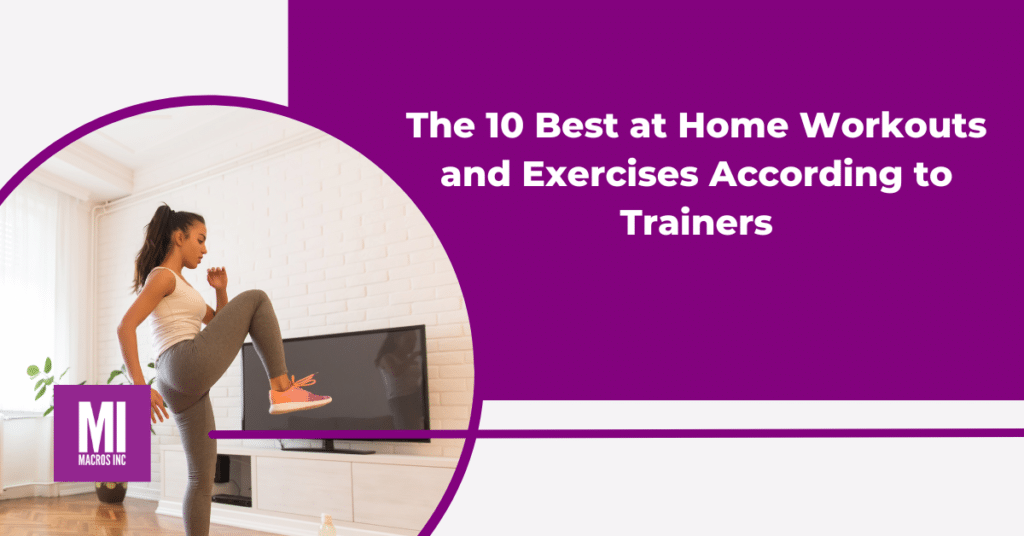
A low-impact cardio exercise where you raise each leg to hip height, bent at the knee. Works your hip flexors, core, calves, and quads. You can go at a running pace for intensity or keep it slow and controlled. Adaptations include stepping onto a higher surface or performing them with your back against a wall.
Free Home Workout Programs
Want a structured plan that puts these exercises into a real program with progression? Our home workout plans are built for bodyweight, bands, and dumbbells at every level.
Do You Need Equipment for a Home Workout?
For beginner level workouts at home, no. There are plenty of bodyweight exercises that build strength and improve flexibility without any equipment at all. Our Beginner Home Workout Plan uses zero equipment and covers a full 8-week progression.
However, if you want to take things further, a few inexpensive additions open up a lot more programming options: a set of adjustable dumbbells, a resistance band, a pull-up bar, a jump rope, or a kettlebell. None of this is professional gym equipment. It’s stuff that doesn’t cost much and adds meaningful resistance to your sessions.
Dumbbells and a bench in particular unlock the most options. With just those two, you can follow a full 3-Day Dumbbell Home Workout Plan or a 4-Day Dumbbell Home Split with enough volume and variety to build real strength over time.
Building Routines for Home Workouts
So, you’ve got an idea of the kind of exercises you can do at home. Now what? The next step is to build some routines to keep things interesting. Here are some tips from our coaches.
AMRAP
AMRAP stands for As Many Reps As Possible, and here’s what Macros Inc. Coach Regina Havalova has to say:
“Pick some exercises. My favorites are lower body split squats, pushups, dead bugs and planks. Do AMRAP for 15 minutes, starting with 20 of each exercise. Decrease by 2 reps each round, so the second round is 18, the third, 16, and so on. Carry on until the 15 minutes are up.”
Luck of the Draw Reps
Alternatively, one of our Lead Fitness & Nutrition coaches Braden Ripley highlights one of his favorite rep games:
“One of the best home workouts is to pick 2-5 exercises and grab a deck of cards. Draw one, and whatever number is shown, do that many reps. Face cards are worth 10, and aces can be 1 or 11 depending on how brave you feel. Record how long it takes you and try to beat that next time. My go-tos for this game are pushups and bodyweight squats.”
Room-Based Reps
This one is great for days off or if you work from home. Lead Coach Melody Schoenfeld recommends:
“Put a piece of equipment in different rooms. Alternatively, assign a bodyweight exercise to each room. Every time you pass through the room, do a set on that equipment or bang out 10 reps of your bodyweight movement. You can do it with daily events too: send an email, do 10 squats.”
This approach is similar to the idea behind NEAT (non-exercise activity thermogenesis): accumulating movement throughout the day adds up to meaningful calorie burn without requiring a dedicated gym session.
Want a Structured Home Program?
The exercises and routines above are great for ad hoc movement and building the habit of training at home. But if you want real, measurable progress over 8 weeks, a structured program with progressive overload will get you there faster. Our home workout programs are built for exactly that, with options by equipment level and experience:
If you have no equipment, the Beginner Home Workout Plan covers 8 weeks of bodyweight training with built-in progression. If you have a resistance band, the Band and Bodyweight Fat Loss Plan adds resistance and structure. And if you have dumbbells and a bench, you can follow a full 4-Day Dumbbell Split that covers upper body, lower body, and everything in between.
Keeping it Fun
Use the coach recommendations above as a way to keep your at-home training interesting. Switch up the formats, add reps, decrease your allowed time, try a new exercise variation. The exercises listed here are just a taste of what’s possible at home, and the evidence is clear that home workouts can be genuinely effective for building strength and fitness when done consistently.
If you want personalized guidance on building a home training plan that fits your goals and equipment, our coaching team can help.
No gimmicks. No restrictions.
Start your journey with expert coaching, personalized nutrition, and real results, absolutely free for two weeks.
