
The quick version
Diet soda or water? For weight loss, a two-year study found it made little difference.
It’s Tuesday afternoon. A woman at her desk has a diet soda in one hand and a water bottle in the other. She’s heard diet soda makes you hungrier. She’s also heard it’s fine. She just wants to know which one to drink.
Researchers in England tested this directly. They split about 500 adults into two groups by chance. One group drank water. The other drank at least two diet drinks a day. Both groups took the same weight-loss classes for a year, then spent a second year on their own.
After two years, both groups weighed less than when they started. The water group was down about 8 pounds and the diet drink group about 10.5 pounds. That gap is small enough that it could be chance, so the researchers called the two drinks about equal. Hunger was about the same in both groups, and diet drinkers didn’t report eating more sugar.
This is one study, and it has limits:
- A beverage industry group paid for it.
- Fewer than half the people finished.
- Everyone was in England, and no one had diabetes.
- It compared diet drinks with water, not with regular soda.
One more pattern is worth knowing. Both groups were at their lightest around months 8 to 10. After that, some weight came back in both groups. The drink didn’t change that.
What to do tonight: Pick the drink you’ll actually stick with, and stop worrying about it.
Source: Harrold, 2026. doi.org/10.1017/S0007114526108150
Short answer: not in a two-year randomized trial. People who drank diet drinks every day lost about as much weight as people who drank water.
That answer comes with real limits. It’s one trial, the beverage industry paid for it, and fewer than half the people finished. We’ll cover all of it.
It’s 3 p.m. Lunch was fine. The afternoon is not. You grab a diet soda from the office fridge, and a small voice asks: is this the thing that’s been stalling me?
You’ve heard both sides. Sweeteners trick your brain into wanting more food. Or diet soda is a free pass. Most of what you’ve read comes from studies that watched people over time and looked for links. Those studies can mix up cause and effect. People who are already gaining weight may be the ones switching to diet drinks.
A randomized trial gets around that. A coin flip decides who drinks what. Researchers in Liverpool ran one for two years.
Jump to a Topic
What the researchers did
They enrolled 493 adults in England with a BMI between 27 and 35 and randomly split them into two groups: water or diet drinks.
Each person drank at least two 330 ml servings a day of their assigned drink. That’s about two 11-ounce cans. The water group had to give up diet drinks completely, including sweetener in coffee or tea.
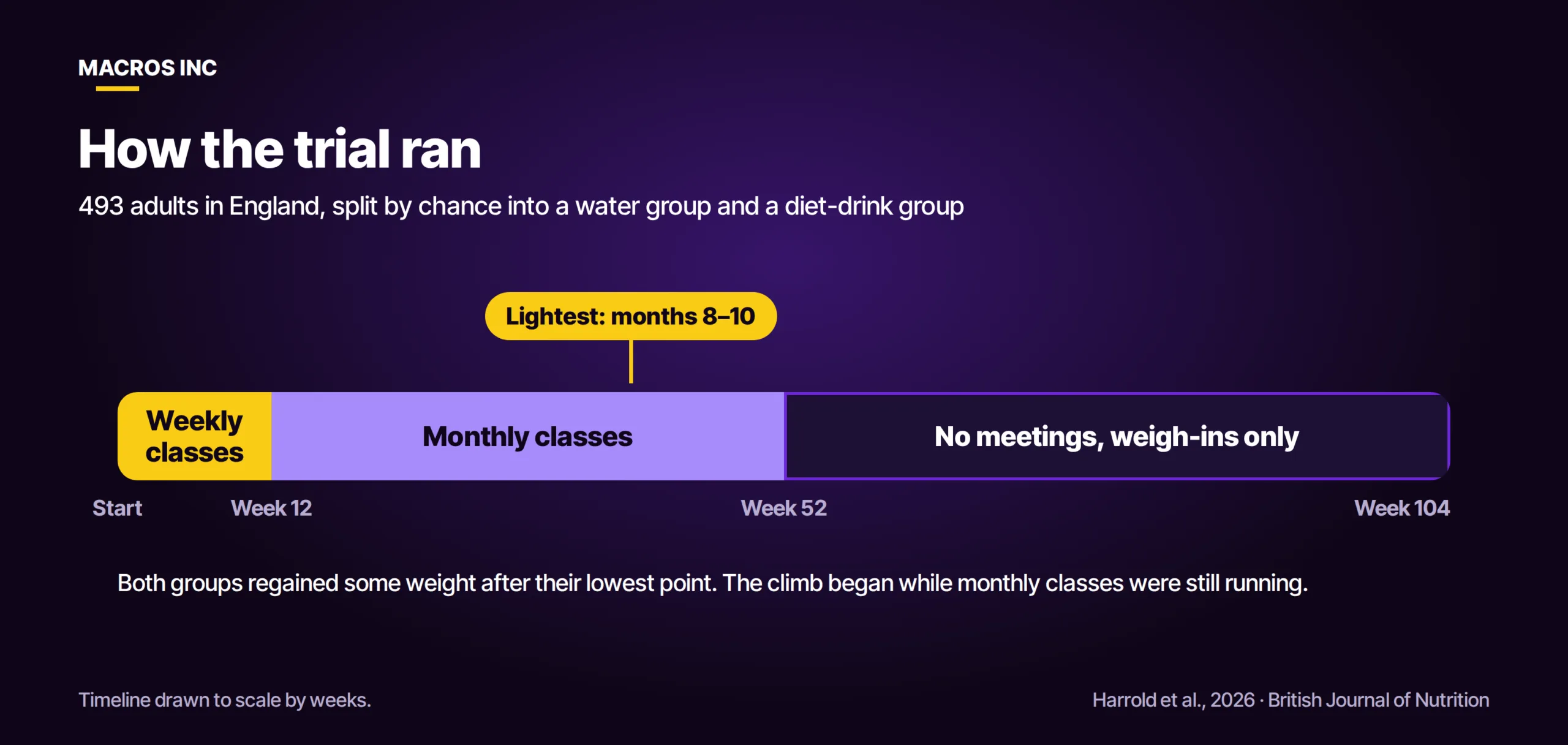
Everyone joined the same weight-loss program. They met with a nutritionist weekly for 12 weeks, then monthly for the next 40 weeks. After that came a full year with no meetings, just weigh-ins, ending at week 104.
What happened
At two years, both groups weighed less than when they started. The water group was down about 3.7 kg and the diet drink group was down about 4.8 kg. The gap between them was not statistically significant.
In pounds, that’s about 8 for water and about 10.5 for diet drinks.
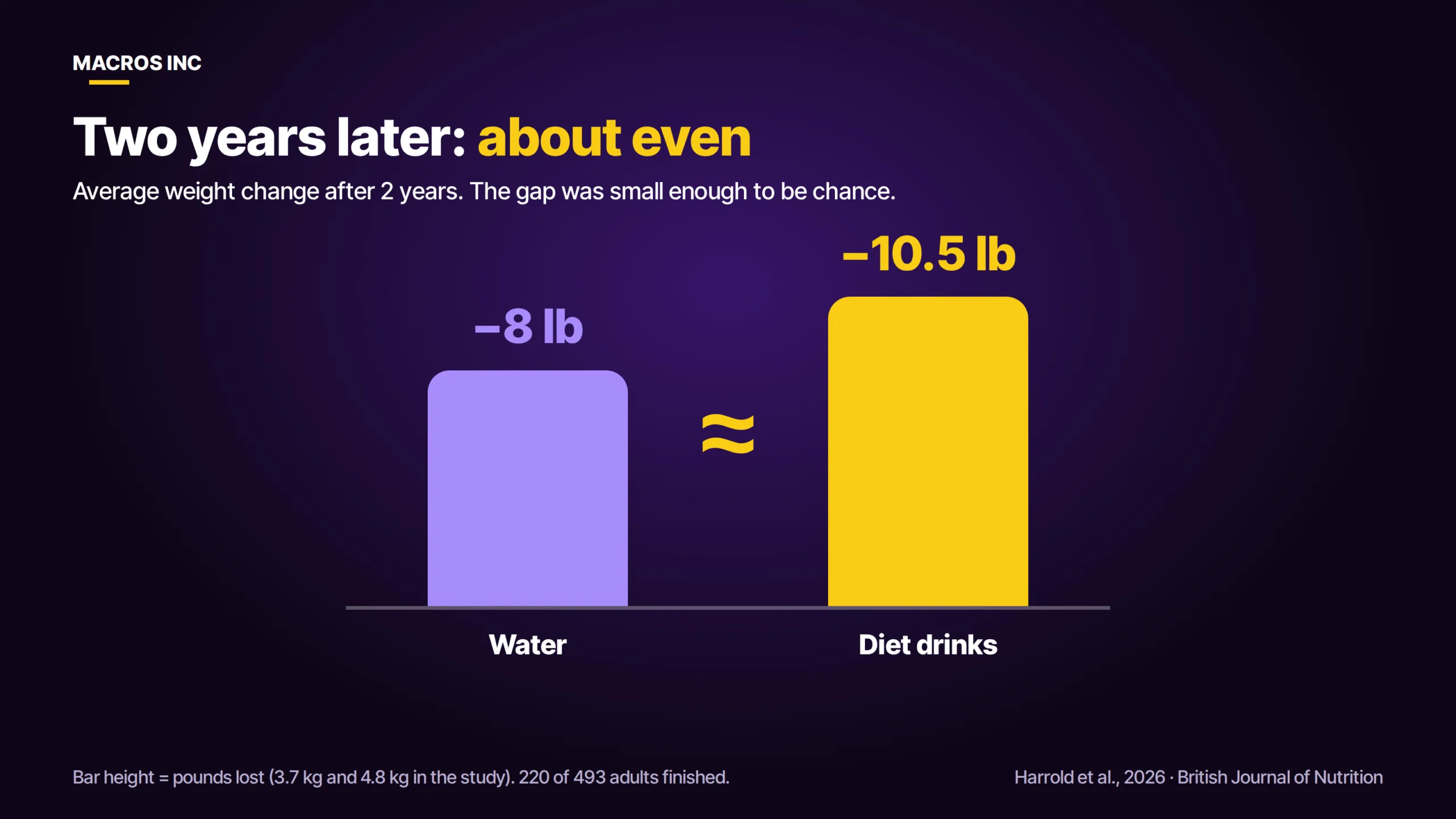
The trial was designed to test whether the two drinks were equivalent for weight. They were.
Two other findings speak to the usual worries. Hunger rose slightly in both groups, with no meaningful difference between them. Reported sugar intake dropped in both groups, a little more with diet drinks. In this trial, diet drinks didn’t push people toward more sugar.
What this trial can’t tell you
- Who paid for it. The American Beverage Association funded the trial and the writer who helped prepare the paper. The authors say the association had no role in the design, analysis, or interpretation, though a representative could review the manuscript. Read the result with that in mind.
- Who finished. Only 220 of the 493 people made it to two years.
- Who was in it. It ran at one site in England, and it excluded people with diabetes.
- What it compared. Diet drinks were compared with water, not regular soda.
- What it measured. The trial looked at weight. It doesn’t settle debates about cancer, gut health, or long-term safety.
- Small lab differences. Cholesterol, blood sugar, and blood pressure differed slightly between the groups. The authors judged the differences too small to matter clinically.
The part most headlines skip
Both groups hit their lowest weight around months 8 to 10. After that, weight crept back up in both groups, a little more slowly with diet drinks.
The climb started while people were still meeting monthly. It kept going through the year with no meetings at all.
The trial wasn’t built to explain why. But the drink didn’t decide it. Both groups followed the same curve.
What to do this week
If you like diet soda and it fits your week, this trial gives you no reason to drop it.
If you prefer water, water did just as well.
If you’ve been blaming the can for a plan that keeps stalling, the can isn’t the problem. Look at the plan.
Tonight, pick the drink you’ll actually stick with and call that decision done. Put your attention on the next meal.
If the plan is the part that keeps quitting on you, that’s what a coach is for.
Source: Harrold et al., 2026, British Journal of Nutrition. doi.org/10.1017/S0007114526108150
No gimmicks. No restrictions.
Start your journey with expert coaching, personalized nutrition, and real results, absolutely free for two weeks.
