4-Day Upper Lower Dumbbell Plan
A complete four-day upper/lower split you can run at home with nothing but a pair of adjustable dumbbells and a bench. Progressive overload across two phases, no machines required.
Program Overview
This program proves you do not need a full gym to build muscle and get stronger. With one pair of adjustable dumbbells and a bench, you can train every major muscle group hard enough to drive real progress from home.
The structure is a four-day upper/lower split. Two upper-body sessions and two lower-body sessions per week, each hitting the same muscle groups from slightly different angles. Because dumbbells cap out lower than a loaded barbell, this plan leans on higher rep ranges, tempo control, and single-leg work to keep the stimulus high without needing hundreds of kilos of iron.
Each session takes roughly 35 to 45 minutes. The pace is efficient because home training rewards short, focused sessions you will actually stick to.
Muscle responds to effort and progressive overload, not to a specific piece of equipment. Adjustable dumbbells, higher reps taken close to failure, slow tempos, and single-leg variations give your muscles every reason to grow. What matters is consistency and pushing each set hard, not whether you are in a commercial gym.
Who Is This For?
This program is for anyone who trains at home and wants a structured plan rather than random dumbbell circuits.
This plan is right for you if:
- You have a pair of adjustable dumbbells and a bench
- You want to train four days per week at home
- You prefer short, efficient sessions
- You want clear progression instead of guesswork
- You cannot get to a gym, or simply prefer not to
If your dumbbells do not go very heavy, lean into higher reps, slower tempos, and pauses. Taking a set of 20 to a genuine near-failure with lighter weight builds muscle just as well as heavier sets of 8. Effort is the variable that matters.
Weekly Schedule
Phase 1: Build the Habit (Weeks 1-4)
Four short sessions per week. Upper A and Lower A are your primary sessions; Upper B and Lower B hit the same muscles from different angles. Rest periods are 90 seconds to 2 minutes on the harder lifts and 60 seconds on isolation work. Phase 1 is about establishing your working weights and locking in the four-day routine.
Pick a weight that leaves 2 to 3 reps in reserve to start. With dumbbells, progression often comes from adding reps before you can add weight, since the jumps between plates can be large. When you hit the top of the rep range on all sets, add a rep or move up to the next weight.
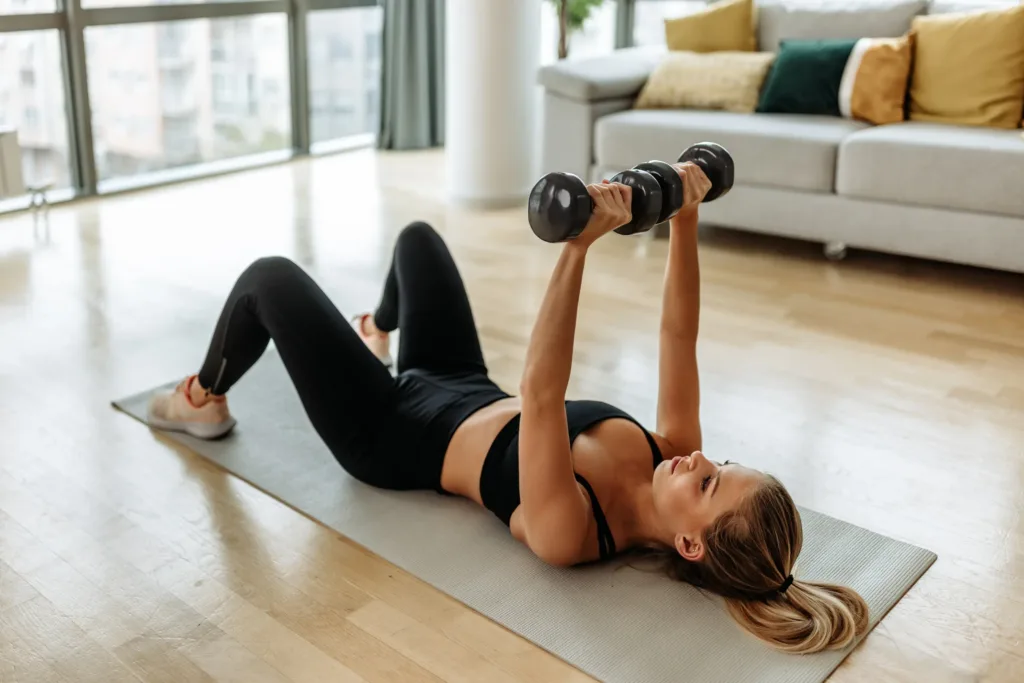
Lie on a bench, dumbbells at chest level. Press up to lockout, lower to a deep stretch. The main horizontal push of the week.
One hand and knee on the bench, opposite foot planted. Row the dumbbell to your hip, squeeze your back, lower with control.
Seated with back support, dumbbells at shoulder height. Press overhead to lockout, lower with control.
Dumbbells at your sides, slight elbow bend. Raise out to shoulder height, lower with control.
Incline bench at 45 degrees, dumbbells hanging at full extension. Curl up without swinging, lower with a three-second descent.
Hold a dumbbell at chest height, sit between your hips, stand tall with your torso braced.
Dumbbells in front of your thighs, push your hips back, lower until you feel your hamstrings, then stand tall.
Rear foot on the bench, dumbbells at your sides. Lower straight down until your back knee nearly touches, drive through the front heel. The video shows the bodyweight version; add dumbbells for load.
Upper back on the bench, dumbbell across your hips. Drive up to a straight line from shoulders to knees, hold two seconds at the top.
Hold a dumbbell, stand on a step, lower your heels for a full stretch, drive onto your toes, hold at the top.
Bench at 30 to 45 degrees, dumbbells at shoulder level. Press up, lower to a deep stretch. Shifts emphasis to the upper chest.
Lie chest-down on an incline bench, dumbbells hanging. Row both to your hips, squeeze, lower with control.
Lie on the floor or bench, dumbbells above your chest with a slight elbow bend. Open your arms to a stretch, bring them back together.
Hinge at the hips, dumbbells hanging. Raise them out to the sides with a slight elbow bend, squeeze your rear delts.
Dumbbells at your sides, neutral grip (palms facing each other). Curl up, squeeze, lower with control.
Dumbbells at your sides. Step forward, lower your back knee toward the floor, drive through the front heel. Alternate legs.
Front foot on a small plate or step, rear foot behind. Lower straight down; the elevation extends the range and increases the glute stretch. The video shows the bodyweight version; add dumbbells for load.
Dumbbell in one hand, hinge at the hip and lower it toward the floor while your back leg rises behind you. Return to standing.
Step up onto the bench with one foot, drive through the heel to stand tall, lower with control.
Same as Lower A. Calves need the frequency and volume to grow.
Low-intensity walking on non-training days supports recovery, digestion, and daily energy expenditure without adding fatigue to your working muscles.
Light stretching and mobility for the hips, thoracic spine, and shoulders. Ten focused minutes keeps the tight spots from heavy training in check.
Phase 2: Turn Up the Effort (Weeks 5-8)
Phase 2 adds a set to the main lift in each session and drops the rep ranges slightly so you can push heavier dumbbells. Where your weights cap out, the progression comes from slower tempos and pauses instead. Same four sessions, more effort per set.
By Week 5 you know your working weights. Add one set to the first exercise in each session and aim to increase load where you can. If your dumbbells cannot go heavier, add a one to two second pause at the hardest point of each rep, or slow the lowering phase to three seconds. Both make the same weight harder and keep driving growth. If you feel run down, hold your weights for a week before pushing again.
One extra set, lower reps, heavier dumbbells. Deep stretch at the bottom.
One extra set, lower reps, heavier weight. One-second squeeze at the top.
Lower reps, heavier dumbbells. Strict form only.
Same reps. Small weight increase only if form stays strict.
Lower reps, heavier dumbbells. Three-second descent stays.
One extra set, lower reps, heaviest dumbbell you can hold at your chest.
One extra set, lower reps, heavier dumbbells.
Lower reps, heavier dumbbells. The video shows the bodyweight version; add dumbbells for load.
Lower reps, heavier dumbbell. Two-second hold stays.
One extra set, lower reps, heavier dumbbell. Same slow tempo.
One extra set, lower reps, heavier dumbbells. Deep stretch.
One extra set, lower reps, heavier weight. Squeeze hard at the top.
Lower reps, heavier weight. Full stretch, full squeeze.
Same reps. Increase reps before increasing weight.
Lower reps, heavier dumbbells. Neutral grip, squeeze at the top.
Lower reps, heavier dumbbells.
Lower reps, heavier dumbbells. The video shows the bodyweight version; add dumbbells for load.
Lower reps, heavier dumbbell. Move slowly and keep your hips square.
Lower reps, heavier dumbbells. Drive through the top foot.
One extra set, lower reps, heavier dumbbell. Same slow tempo.
Low-intensity walking on non-training days supports recovery, digestion, and daily energy expenditure without adding fatigue to your working muscles.
Light stretching and mobility for the hips, thoracic spine, and shoulders. Ten focused minutes keeps the tight spots from heavy training in check.
4-Day Upper Lower Dumbbell Plan PDF
A dumbbell-only upper/lower split for anyone who trains at home and wants real structure instead of random circuits.
This is a 4-day upper/lower split you run for 8 weeks with just dumbbells and a bench, in 35-45 minute sessions. Phase 2 adds a set to the first lift each session and drops reps, leaning on tempo once dumbbells cap out.
- Two Sessions Per Muscle Group Each Week Every muscle group trains twice weekly from different angles.
- Tempo Fills The Gap Dumbbells Leave Slower lowering phases keep the stimulus high once weight caps out.
- One Extra Set Kicks Off Phase 2 The first lift in every session gains a set for weeks 5-8.
Get Your 4-Day Dumbbell Upper Lower Plan
Includes both training phases, the weekly schedule, and exercise cues for all four sessions. Download instantly after you submit the form.
Unsubscribe any time.
Nutrition Guidance
Training at home does not change the nutrition rules. Your goal decides your calories: a surplus to build, a deficit to lean out, maintenance to recomp slowly. Protein and consistency matter more than any single meal.
Our macro calculator sets your targets for whichever goal you are chasing.
The Basics
- Calories: Match your intake to your goal. Surplus to build muscle, deficit to lose fat. Our macro calculator sets your starting point.
- Protein: 1.6 to 2.2g per kg of bodyweight daily. Protein drives recovery and muscle retention regardless of where you train. Browse our high protein recipes for ideas.
- Hydration: Drink water consistently, especially on training days.
- Sleep: Seven to nine hours per night. Recovery happens between sessions, not during them.
Use the macro calculator to set your calories and protein target for your goal, then track your bodyweight as a weekly average. Adjust intake in small increments based on the trend rather than reacting to daily fluctuations.