Resistance Band Leg Workout
Build and tone your legs and glutes with resistance bands. Three sessions a week train your quads, hamstrings, and glutes at home, with no weights and no gym required.
Program Overview
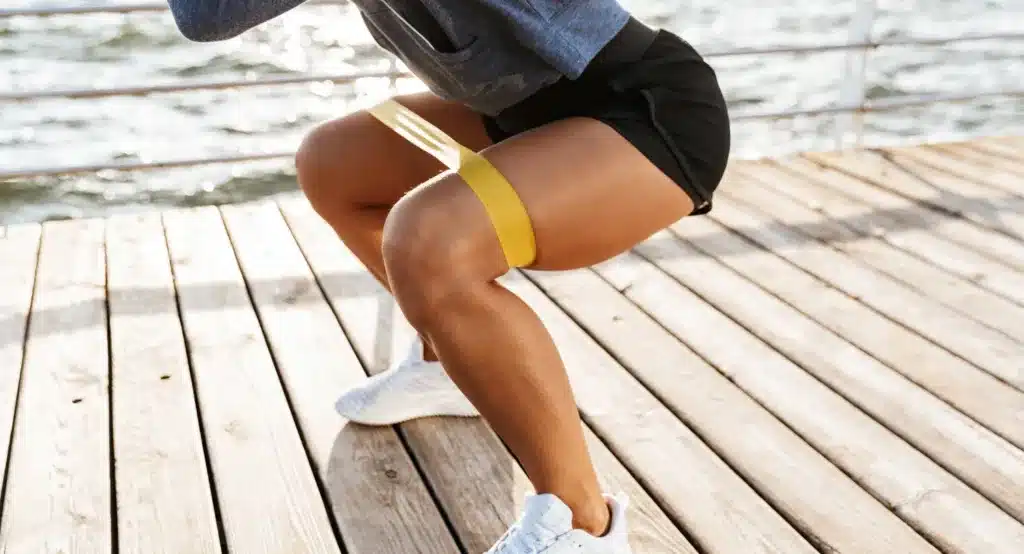
This is a lower-body program built around resistance bands, designed to build and tone your legs and glutes without any weights. Bands are particularly effective for the glutes: the constant tension and the ability to add resistance to movements like hip thrusts, kickbacks, and lateral walks make them a favorite for lower-body training, and they are gentle on the knees and back.
The plan runs three sessions a week: a glute-focused day, a quad and hamstring day, and a balanced leg day. You will combine bodyweight leg movements (squats, lunges, glute bridges) with band-specific glute activation work (lateral walks, clams, kickbacks) that targets the smaller stabilizing muscles most weight training misses. You progress with thicker bands, more reps, and harder variations.
Sessions run 30 to 45 minutes. Loop or mini bands are ideal for the glute activation work, while a longer band with handles helps with the squat and deadlift patterns.
The glutes respond exceptionally well to band work. Movements like banded lateral walks, clams, and hip thrusts put constant tension on the glutes and activate the smaller stabilizing muscles that build a strong, shapely lower body. Bands are also easy on the knees and lower back. Related plans: Resistance Band Full Body Program and Bodyweight Glute Building Program.
Who Is This For?
This program is for people who want to train legs and glutes without weights.
This plan is right for you if:
- You want to build and tone your legs and glutes at home
- You have or will get resistance bands, ideally including loop bands
- You want knee-friendly and back-friendly leg training
- You prefer training without heavy weights
- You can train three days a week
Loop or mini bands are essential for the best glute activation exercises: lateral walks, clams, and banded bridges. Combined with a longer band for the squat and hinge patterns, they cover everything this plan needs. When you finish, browse all our home workout programs for your next step.
Weekly Schedule
Phase 1: Build the Base (Weeks 1-4)
Three sessions per week: glute focus, quad and hamstring, and balanced. Rest 45 to 60 seconds between sets. Focus on feeling the target muscle work, especially the glutes on the activation movements.
Choose a band resistance that makes the reps challenging with 2 to 3 in reserve. On glute activation work, prioritize feeling the glute over doing more reps.
Lie on your back, knees bent, drive your hips up, squeeze your glutes. Add a loop band above your knees.
On hands and knees with a loop band above your knees, lift one knee out to the side, control down.
Lie on your side, loop band above your knees, open your top knee against the band, control down.
Loop band above your knees, sink into a half squat, step sideways keeping tension.
Step back, lower your back knee, drive up. Hold a band under your front foot for resistance.
Stand on the band, hold the handles at your shoulders, squat to depth, stand tall.
Stand on the band, hinge at your hips to grip the handles, drive your hips forward to stand.
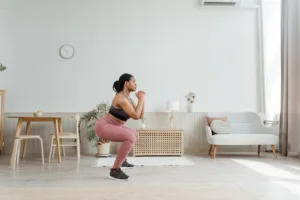
Bodyweight squats to burn out the quads.
Bodyweight reverse lunges, controlled.
Finish with high-rep glute bridges.
Balanced session, banded squats.
Banded hip hinge.
Banded lateral walks for the glutes.
Step behind and across, targeting the outer glute.
High-rep glute bridges to finish.
Low-intensity walking on non-training days supports recovery, digestion, and daily energy expenditure without adding fatigue to your working muscles.
Light stretching and mobility for the hips, thoracic spine, and shoulders. Ten focused minutes keeps the tight spots from heavy training in check.
Phase 2: Increase the Challenge (Weeks 5-8)
Phase 2 uses thicker bands, single-leg variations, and higher reps to keep building. The glutes in particular respond well to added volume and tension.
Use thicker loop bands, progress to single-leg versions of the bridges, and add reps. Slow the tempo on the activation work to increase the glute burn.
One leg at a time with a loop band for more challenge on each glute.
Thicker band or more reps.
Thicker band, slower tempo.
Thicker band, stay lower.
More reps, controlled.
Thicker band, three-second lower.
Thicker band.
More reps, paused tempo.
More reps.
Single-leg progression.
Thicker band.
Thicker band.
Thicker band.
More reps.
Single-leg finish.
Low-intensity walking on non-training days supports recovery, digestion, and daily energy expenditure without adding fatigue to your working muscles.
Light stretching and mobility for the hips, thoracic spine, and shoulders. Ten focused minutes keeps the tight spots from heavy training in check.
Resistance Band Leg Workout PDF
Three band sessions a week for the quads, hamstrings, and glutes, with no weights and no gym required.
This is a 3-day lower body plan you run for 8 weeks with a set of loop bands. Phase 1 (weeks 1-4) runs three different sessions, glute focus, quad and hamstring, and a balanced day, each with 5 exercises for 15 sets and 45 to 60 seconds rest. Phase 2 (weeks 5-8) moves you to thicker bands, swaps two-leg bridges for single leg versions, and adds reps on the squat and deadlift days, because glutes in particular respond well to extra volume and tension.
- Three Sessions, Three Different Emphases A glute day, a quad and hamstring day, and a balanced day, so the whole lower body gets covered without repeating the same session.
- Activation Work That Actually Works Fire hydrants, side clams, and lateral walks with the band above the knee are there to make you feel the glute before the bigger movements.
- Clear Progression With Bands Thicker bands, single leg versions, more reps, and a slower tempo. The PDF tells you which lever to pull when a movement gets easy.
Get Your Band Leg Workout
Includes both training phases, the weekly schedule, and exercise cues for all three sessions. Download instantly after you submit the form.
Unsubscribe any time.
Nutrition Guidance
Training creates the stimulus; nutrition determines the result. Whatever your goal, your calories and protein have to line up with it. Our macro calculator sets your targets, and our high protein recipes make hitting them easier. For the nutrition side, our guides on the best glute exercises and working out at home are worth a read.
The Basics
- Calories: Eat at or around maintenance calories to support performance and recovery. Our macro calculator sets your starting point.
- Protein: 1.6 to 2.2g per kg of bodyweight daily. Protein drives recovery and muscle retention. Browse our high protein recipes for ideas.
- Hydration: Drink water consistently, especially on training days.
- Sleep: Seven to nine hours per night. Recovery happens between sessions, not during them.
Use the macro calculator to set your calories and protein for your goal, then track your bodyweight as a weekly average and adjust in small increments based on the trend.