Pull Day Workout
The complete pull day: back, rear delts, and biceps in one focused session. Run it three times a week or slot it into your push/pull/legs split, with progressive overload across two phases.
Program Overview
This is a complete pull day: a focused session training every muscle that pulls, namely the back, rear delts, and biceps. Pull day is one third of the classic push/pull/legs split, and this program lets you run it as a standalone three-times-a-week plan or slot it into your existing PPL rotation.
Each of the three weekly sessions is a pull day with a slightly different emphasis: one leads with vertical pulling to build back width (the lats), one prioritises horizontal rowing for back thickness, and one is balanced. This variation ensures your lats, mid-back, rear delts, and biceps all get direct heavy work and plenty of volume across the week, building a complete, detailed back rather than just one dimension of it.
Sessions run around 60 minutes. To build a balanced physique, pair this pull training with push and leg work, and eat enough to support growth.
A complete back needs both: vertical pulls like pulldowns and pull-ups build width through the lats, while horizontal rows build thickness through the mid-back. This plan rotates the emphasis so you develop both dimensions rather than favouring one. Related plans: 5-Day Push Pull Legs and 6-Day Push Pull Legs Plan.
Who Is This For?
This program is for lifters who want to build their back and biceps.
This plan is right for you if:
- You want a dedicated, complete pull day
- You run or want to run a push/pull/legs split
- You have at least six months of training experience
- You want to build both back width and thickness
- You will pair this with push and leg training
This is pull-only work. For a balanced physique, pair it with equal push training (chest, shoulders, triceps) and leg training. Our muscle gain plans include the full push/pull/legs structure.
Weekly Schedule
Phase 1: Accumulate Volume (Weeks 1-4)
Three pull sessions per week with different emphases. Each opens with a heavy compound pull, then builds volume across the back, rear delts, and biceps. Rest 2 minutes on compounds, 60 to 90 seconds on isolation.
Start with 2 to 3 reps in reserve on compounds, 1 to 2 on isolation. On pulls, focus on feeling your back rather than your arms. Add weight when you hit the top of the range on all sets.
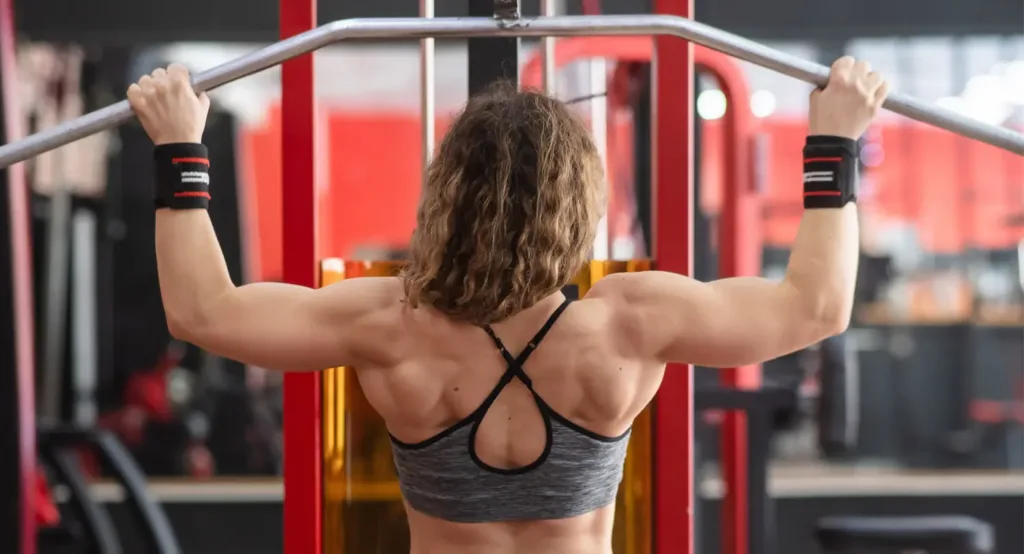
Hang from a bar, pull your chin over, lower with control. Use an assisted machine if needed. The best width builder.
Row the bar to your lower chest, squeeze.
Wide grip, pull to your upper chest.
Pull to your face, elbows high, squeeze the rear delts.
Dumbbells hanging on an incline, curl without swinging, slow descent.
Neutral grip curls.
Explosive rows from the floor each rep. The best thickness builder.
Pull to your lower chest, one-second squeeze.
Hand and knee on a bench, row to your hip, squeeze.
Shrug straight up, hold, lower with control.
Curl without swinging.
Bent over at a cable, raise out to the sides, squeeze the rear delts.
Balanced session leading with vertical pulling.
Row both dumbbells to your hips, squeeze.
Horizontal pulling volume.
Rear delt work.
Arms on a preacher bench, curl without swinging.
Neutral grip curls to finish.
Low-intensity walking on non-training days supports recovery, digestion, and daily energy expenditure without adding fatigue to your working muscles.
Light stretching and mobility for the hips, thoracic spine, and shoulders. Ten focused minutes keeps the tight spots from heavy training in check.
Phase 2: Intensify (Weeks 5-8)
Phase 2 adds a set to the primary pull in each session and drops the rep ranges for heavier loading. The isolation volume holds while the pulls get heavier.
Add a set to the first exercise in each session and push the loads up. On pull-ups, add weight with a belt once bodyweight is easy.
One extra set, add weight with a belt.
One extra set, lower reps, heavier weight.
Lower reps, heavier weight, one-second pause.
Reps before weight.
Lower reps, heavier dumbbells.
Lower reps, heavier dumbbells.
One extra set, lower reps, heavier weight.
Lower reps, heavier weight, one-second squeeze.
Lower reps, heavier weight.
Lower reps, heavier weight.
Lower reps, heavier weight.
Reps before weight.
One extra set, lower reps, heavier weight.
Lower reps, heavier dumbbells.
Lower reps, heavier weight.
Reps before weight.
Lower reps, heavier weight.
Lower reps, heavier dumbbells.
Low-intensity walking on non-training days supports recovery, digestion, and daily energy expenditure without adding fatigue to your working muscles.
Light stretching and mobility for the hips, thoracic spine, and shoulders. Ten focused minutes keeps the tight spots from heavy training in check.
Pull Day Workout PDF
The complete pull day, back, rear delts, and biceps, in three versions you can rotate or slot straight into a push/pull/legs split.
This is a 3-day pull plan you run for 8 weeks with full gym access. Phase 1 (weeks 1-4) gives you three pull sessions with different emphases, width, thickness, and balanced, each opening with a heavy compound pull and running 6 exercises for 20 sets. Phase 2 (weeks 5-8) adds a set to the primary pull in every session and drops the rep range so the pull ups, Pendlay rows, and pulldowns get heavier, while the rear delt and biceps volume holds where it is.
- Width And Thickness Both Covered Vertical pulling for the lats, horizontal rowing for the mid back, and rear delt work on every session. Nothing gets left out.
- Three Sessions That Don't Repeat Each pull day leads with a different heavy movement and uses different accessories, so three exposures a week never feels like the same workout.
- A Rule For The Pull Up Bar Once bodyweight pull ups are easy, the PDF tells you when to add weight with a belt rather than just chasing more reps forever.
Get Your Pull Day Workout
Includes both training phases, the weekly schedule, and exercise cues for all three sessions. Download instantly after you submit the form.
Unsubscribe any time.
Nutrition Guidance
Training creates the stimulus; nutrition determines the result. Whatever your goal, your calories and protein have to line up with it. Our macro calculator sets your targets, and our high protein recipes make hitting them easier. For the nutrition side, our guides on the complete guide to bulking and cutting and high protein meal prep are worth a read.
The Basics
- Calories: Eat in a slight surplus of 200 to 400 calories per day to build muscle while minimising fat gain. Our macro calculator sets your starting point.
- Protein: 1.6 to 2.2g per kg of bodyweight daily. Protein drives recovery and muscle retention. Browse our high protein recipes for ideas.
- Hydration: Drink water consistently, especially on training days.
- Sleep: Seven to nine hours per night. Recovery happens between sessions, not during them.
Use the macro calculator to set your calories and protein for your goal, then track your bodyweight as a weekly average and adjust in small increments based on the trend.