
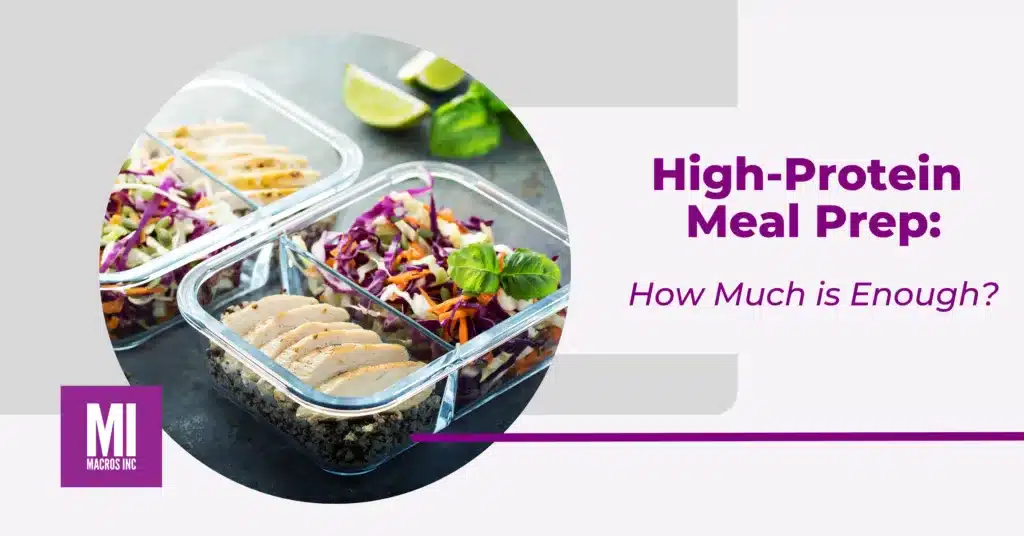
One of the most common mantras in fitness is “you gotta get your protein in.” But how much is enough? How many meals? What should you eat? And how do you actually meal prep in a high-protein way?
Wonder no more. We’ll cover all of that here. First, let’s define what we mean when we call a meal “high protein.”
Jump to a Topic
How Much Protein Counts as “High Protein”?
As a general target, I recommend aiming for about 25 to 40g of protein per meal. There are a couple of reasons for this.
First, let’s talk about muscle protein synthesis (MPS). This is the rate at which your body builds new muscle tissue from pre-existing resources. As you might expect, consuming more protein in one sitting increases MPS, at least up to a point. It takes about 20g of protein to approach maximum rates of MPS, with contentious evidence for benefits at higher values. Some studies find additional benefit up to 40g, while others do not. For satisfying MPS, aim for the higher end as a target, but consider yourself good if you can hit at least 20g. Aiming for around 30 grams of protein per meal is a sensible default that lands you in the right ballpark either way.
The other, perhaps more important reason for this range is practicality. Protein requirements vary from person to person based on body fat percentage, activity levels, and whether you’re in a calorie surplus or deficit. Anecdotally though, I find that most folks fall somewhere between 120 to 180g of protein as a daily target. If you aim for 25 to 40g per meal, that gets you there in about 3 to 5 meals over the day. That meal frequency covers a fair variety of eating habits, which makes it a workable goal for most people.
So we know to aim for about 25 to 40g of protein per meal to call it “high protein.” Now what do we actually eat to hit that?
Protein Sources
In practice, there are many quality protein sources you can incorporate successfully into your diet.
First, a quick breakdown. Proteins are made up of structures called amino acids (AAs). There are 500+ amino acids in existence, but we’re interested in only 20 of them, because those are the ones our body uses to build proteins. We eat protein, break it down into amino acids, and then use those amino acids as building blocks for the proteins in our body, including the ones in our muscle tissue.
Of the 20 useful amino acids, nine are called essential amino acids (EAAs). They’re “essential” because we can’t make them in our bodies on our own. We have to get them from external sources. Those sources fall into two basic camps: animals and plants. For a deeper dive on protein quality and how amino acids translate into muscle building, our guide to the 8 things you need to know about protein covers the fundamentals.
In general, animal-based sources tend to be excellent. Meat, dairy, and eggs all provide plenty of EAAs, and serve as strong bases for a protein-focused meal. Chicken, beef, pork, milk, and so on all hit the 25 to 40g target without much effort. The only caveat: meat is not a panacea. Round it out with fruit and vegetables to get a more complete nutrient profile. There’s more to health than protein, after all.
Plant-based sources are a little different. There’s a common misconception that plant proteins are “incomplete,” which implies they’re missing some of the EAAs. That’s not quite right. What is true is that plant sources tend to be less uniformly rich in EAAs than animal sources. Animal sources have copious amounts of all nine; plant sources have varying concentrations of the nine. The hypothetical problem is sub-optimal amounts of certain EAAs.
This would be true, but only if you consumed a single plant source. If you eat multiple different sources of plant protein, you’re unlikely to run into EAA deficiencies. On top of that, some plant sources do have strong EAA profiles, soy being the clearest example. As far as protein quality goes, it’s entirely possible to meet your needs through plants. It just takes a bit more effort.
So we have our protein target, and a sense of which foods can fill it. How do we narrow things down further?
Calorie Efficiency
If you have an infinite number of calories to play with, hitting your protein target is trivial. You just keep eating. In reality, every person has a calorie target. Some folks are in a calorie deficit aiming to lose weight, some are in a surplus trying to maximize muscle gain, and others are content where they are and looking to maintain. If you don’t know what your target is yet, our macro calculator will give you a starting point based on your stats, activity, and goal.
This boils down to two fundamentals:
- You have a protein goal.
- You have a certain number of calories to reach that goal.
Your calories are like a budget. You only have so many to spend on hitting your needs. To balance things, you want a protein source with high protein and as few tagalong fats and carbs as possible. The more extra fat or carbs that come with it, the more calories it brings. This is also where plant proteins become trickier; they naturally tend to carry more carbs and fat, which makes them denser in calories.
Here’s a quick trick for sizing up whether something is a calorie-efficient protein source. If you can calculate a tip in your head, you can do this.
To call something a high-protein source, it should have about 10 grams of protein for every 100 calories. This isn’t set in stone, and the right ratio depends on your deficit size and protein target. But as a rule of thumb, 10:100 works well and rounds easily.
Take the number of calories the food has, move the decimal one spot to the left, and compare that number to the grams of protein. If the new calorie number is close to or lower than the protein number, you’re good.
Let’s take three common examples: whey protein, salmon, and peanut butter.
Whey Protein Concentrate (32g):
- 120 calories
- 24g protein
120 calories, move the decimal one spot to the left, and 120 becomes 12. Compare that to 24 grams of protein. 12 is way less than 24, so whey is an excellent source of protein.
Atlantic Salmon (100g):
- 212 calories
- 20g protein
212 calories becomes 21.2, which rounds to 21. That’s slightly more than 20g of protein, but very close. Despite being a fatty fish, salmon is still a solid source of protein.
Peanut Butter:
- 190 calories
- 7g protein
190 calories becomes 19. That’s much higher than 7g of protein. Peanut butter is a relatively poor source of protein for the calories, with too many tagalong calories per serving for what you get back.
Get used to running this calculation and shopping for protein gets much easier. Following it also makes it a lot easier to hit your protein target without going over your calorie budget when you meal prep.
Speaking of meal prep.
High-Protein Meal Prep Recommendations
When it comes to prepping meals, I’m a fan of simplicity. You can certainly get more complex as you get more comfortable with the system, but it’s worth starting with the basics. Here’s a simple framework for structuring a meal:
- Start with a protein base as your main priority. Pick something relatively calorie-efficient that gets you to the 25 to 40g target.
- Once the protein is set, add sides to complement it. The first thing to reach for is a serving of fruit or vegetables. These add micronutrients and help with satiety.
- Add other sides based on your calorie budget. These can be starchy carbohydrates, dips and condiments, or other snacks.
For a midday snack, you might put together something like this (sizes and flavors averaged):
- 1 cup of Greek yogurt (145 cal, 22g P)
- An apple (120 cal, 0g P)
- 25g (20 pc) almonds (146 cal, 5g P)
- Total: 411 cal, 27g P
The key to avoiding meal-prep boredom is diversity. Keep at least a few different protein sources on hand to cycle through, with varying accompaniments to mix and match. Alter things like seasonings and marinades on top of that, and the possibilities open up fast. It’s also worth mentioning that adding a protein shake to any meal will instantly boost it into the desired protein range. For a longer treatment of how to plan your weekly prep around a calorie target, our guide on meal prep for weight loss walks through the full process.
As a final note, here are a few high-protein, lower-calorie sources I personally gravitate toward:
| Source | Calories (Per 100g) | Protein (g) (Per 100g) |
| Greek Yogurt, Non-fat | 120 | 23 |
| Atlantic Salmon | 203 | 20 |
| Chicken Thighs | 149 | 18.5 |
| Ground Beef, 90/10 | 190 | 18 |
| Tuna | 90 | 19 |
| Lentils | 352 | 24.5 |
| Tofu, Extra Firm | 88 | 10 |
Need Recipe Inspiration?
If you’re stuck on protein sources, our high-protein recipe library is built around exactly the kind of macro-efficient meals covered above, with calorie and protein totals for every dish.
Wrap Up
Putting it all together:
- Split your calories across the number of meals you want to have over the day.
- Within those calorie targets, aim for 25 to 40g of protein per meal.
- Build around a protein base, add fruits and vegetables next, then any additional sides as calories allow.
- Keep several rotating sources of protein and sides on hand to keep things fresh and interesting.
Happy meal prepping!
If you’d rather have someone work the calorie targets and protein numbers around your actual schedule and food preferences, our nutrition coaching is built around exactly that. We’ll get you matched with a coach who’ll set your numbers, adjust them as you go, and help you keep the routine sustainable.
No gimmicks. No restrictions.
Start your journey with expert coaching, personalized nutrition, and real results, absolutely free for two weeks.