
The quick version: How much protein do you need to build muscle? For people who lift, research supports about 1.6 to 2.2 grams of protein per kilogram of body weight per day (about 0.7 to 1.0 grams per pound). In healthy adults, higher-protein diets have not been shown to change kidney function.
Protein is having a backlash moment. Headlines mock “proteinmaxxing” and say protein has jumped the shark. Longevity stories suggest eating less of it might help you live longer.
Some of that is fair. Protein-fortified candy and 50-gram coffee drinks are marketing, not nutrition.
But if you lift, train hard, or are trying to lose fat without losing muscle, the core advice hasn’t changed. Higher protein for people who train is well supported by the research. Here is what it says, and what it doesn’t.
Jump to a Topic
The RDA is a floor, not a target
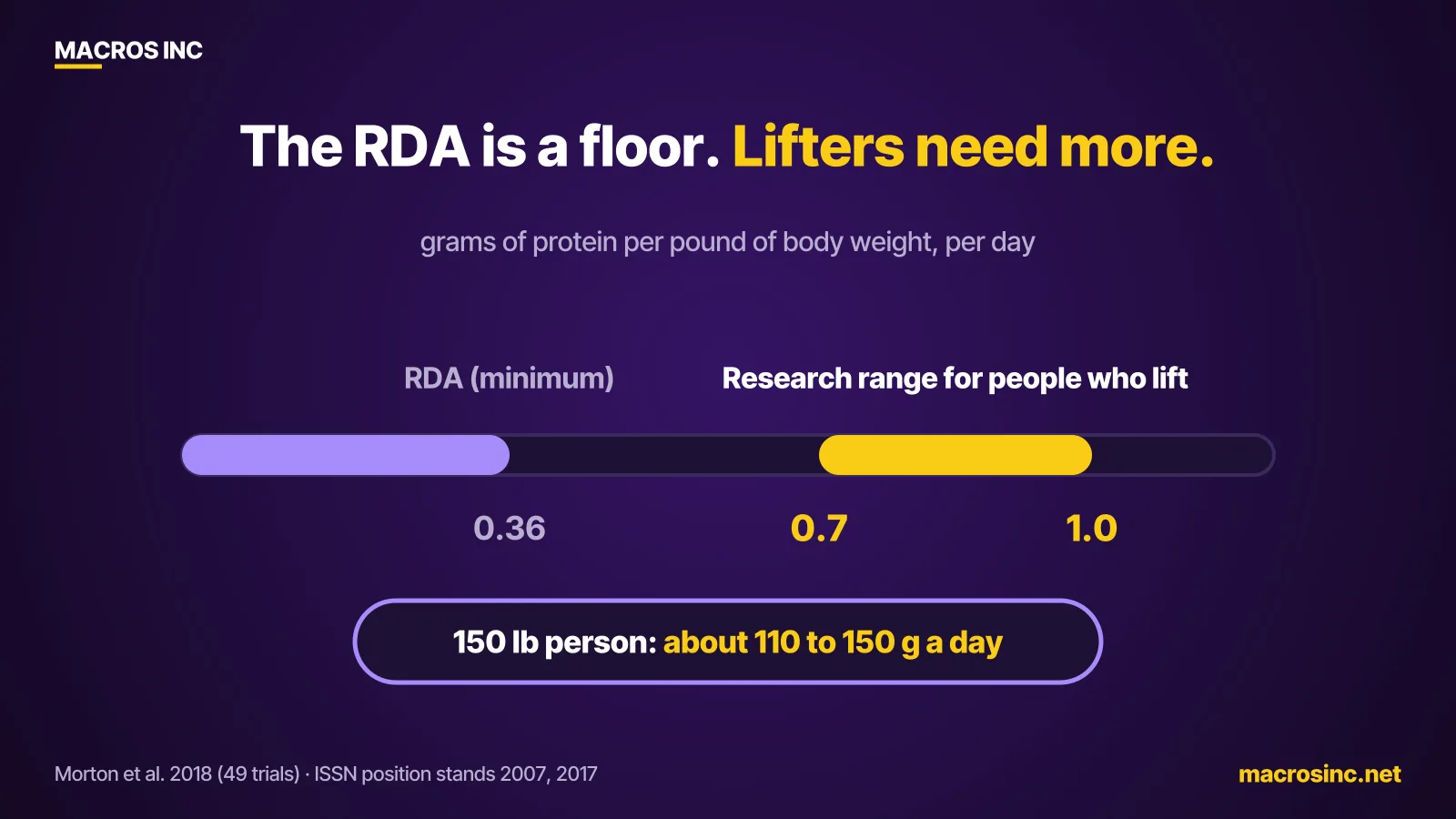
The Recommended Dietary Allowance for protein is 0.8 grams per kilogram of body weight per day, or about 0.36 grams per pound.
It answers a narrow question: what is the minimum that prevents inadequate intake in nearly all healthy adults? Most of the data behind it came from short-term studies in young adults.
That makes it a useful floor. It was never meant to be the target for someone trying to build muscle, get stronger, or hold onto muscle in a deficit.
What the research says for people who train
Sports nutrition position stands. In 2007, the International Society of Sports Nutrition (ISSN) concluded that 1.4 to 2.0 g/kg per day for active people is safe and may improve training adaptations. Its 2017 update held the same range for building and maintaining muscle in most people who exercise.
The largest meta-analysis. Morton and colleagues (2018) pooled 49 randomized trials with 1,863 people doing resistance training. Adding protein increased gains in strength and fat-free mass compared with training alone. It helped more in people who already trained and less as people got older.
The authors also looked for the point where more protein stopped helping. Their best estimate was about 1.6 g/kg per day of total protein, but the uncertainty was wide, from about 1.0 to 2.2. Because of that, they suggested about 2.2 g/kg per day for people who want to cover their bases.
The average added gain was modest: about 0.3 kilograms of fat-free mass. The authors were clear that training itself did far more than the extra protein. Protein amplifies training. It doesn’t replace it.
Is higher protein safe?
For healthy adults, the evidence says yes.
Kidneys are the usual worry. Devries and colleagues (2018) reviewed 28 studies with 1,358 healthy adults. Higher-protein diets were defined as at least 1.5 g/kg per day, at least 20 percent of calories, or at least 100 grams a day, and were compared with normal or lower intakes. When the researchers looked at how kidney function changed over each study, protein intake made no difference.
The caveat is real. If you have kidney disease, set protein with your doctor. For more, see our guide to protein and kidney health.
How much, in practice
For most people who resistance train:
1.6 to 2.2 grams per kilogram of body weight per day (about 0.7 to 1.0 grams per pound)
For a 180-pound lifter, that is roughly 130 to 180 grams a day.
- Start where you are. If you eat 70 grams a day now, getting to 130 is a real win. You don’t need 180 by Friday.
- If you carry a lot of body fat, base the number on your goal weight. It keeps the target realistic.
- Spread it out. The ISSN suggests about 20 to 40 grams per serving. Three or four meals built around protein make the daily number easier to hit and match that guidance. For more, see our guides to protein per meal and how much protein your body can use at once.
- Food first. A shake is a convenience, not a requirement. If you use one, here is how we’d pick a protein powder.
Why protein matters most during fat loss
The Morton analysis only included people eating enough to maintain their weight, so its numbers don’t tell you what to do on a cut. That is where a different study helps.
Longland and colleagues (2016) put 40 young men about 40 percent below their energy needs for four weeks. They lifted and did intervals six days a week. Half ate 2.4 g/kg of protein a day, and half ate 1.2.
- The higher-protein group gained about 1.2 kilograms of lean mass and lost 4.8 kilograms of fat.
- The lower-protein group held its lean mass steady and lost 3.5 kilograms of fat.
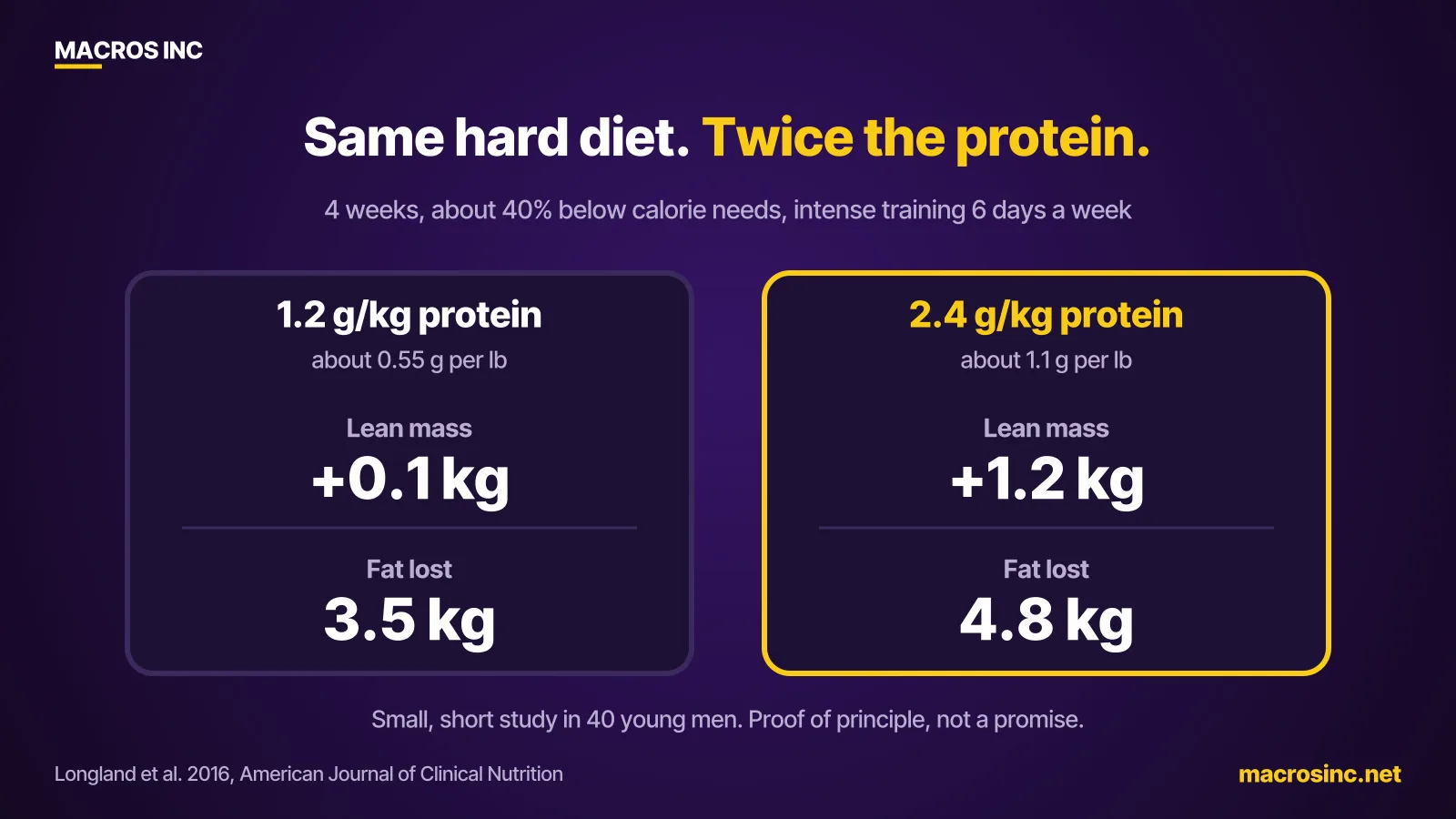
It was a short, intense study in young men, so treat it as proof of principle, not a promise. The ISSN reaches a similar conclusion: trained people in a deficit may need more than usual, in the range of 2.3 to 3.1 g/kg per day. For most lifters cutting, the top of the standard range, around 2.0 to 2.2 g/kg, is a sensible place to aim.
About the low-protein longevity stories
The case for eating less protein to live longer rests on two kinds of evidence.
Animal studies. Mice on protein-restricted diets have lived longer in some experiments.
Observational human data. The best-known human analysis is Levine and colleagues (2014). It used U.S. survey data on more than 6,000 adults over 50.
- Among people aged 50 to 65, those reporting high protein intake had higher overall and cancer death rates over the next 18 years.
- Among people over 65, the pattern reversed: higher protein was linked to lower overall and cancer mortality.
- High protein was linked to higher diabetes mortality at every age.
- The same paper’s mouse experiments found low-protein diets were harmful in very old animals.
That is worth taking seriously. It is also not a reason for someone who trains to cut protein:
- Observational data can’t separate protein from everything else people ate and did.
- The people in these studies weren’t selected for resistance training, which is where the trial evidence for higher protein is strongest.
- Even the best-known study for low protein found that the direction flips with age, which is when keeping muscle gets harder.
Bottom line
- The RDA (0.8 g/kg) is a minimum to prevent inadequate intake, not a target for people who train.
- For lifters, the research supports about 1.6 to 2.2 g/kg per day (0.7 to 1.0 g/lb). Aim toward the top of that range during fat loss.
- In healthy adults, higher-protein diets have not changed kidney function. If you have kidney disease, work with your doctor.
- Low-protein longevity claims rest mostly on mouse studies and mixed observational data. They don’t outweigh trial evidence in people who train.
- Spread protein across your meals, eat mostly real food, and keep training. Protein works because of the training, not instead of it.
Knowing your number is the easy part. Hitting it in a week with a late meeting, a work trip, and an empty fridge is the hard part. If you want a coach to set your target and adjust it as your training and goals change, see how coaching works.
Sources
- Campbell B, Kreider RB, et al. International Society of Sports Nutrition position stand: protein and exercise. J Int Soc Sports Nutr. 2007;4:8. doi:10.1186/1550-2783-4-8
- Jäger R, Kerksick CM, Campbell BI, et al. International Society of Sports Nutrition Position Stand: protein and exercise. J Int Soc Sports Nutr. 2017;14:20. doi:10.1186/s12970-017-0177-8
- Morton RW, Murphy KT, McKellar SR, et al. A systematic review, meta-analysis and meta-regression of the effect of protein supplementation on resistance training-induced gains in muscle mass and strength in healthy adults. Br J Sports Med. 2018;52(6):376-384. doi:10.1136/bjsports-2017-097608
- Devries MC, Sithamparapillai A, Brimble KS, et al. Changes in kidney function do not differ between healthy adults consuming higher- compared with lower- or normal-protein diets: a systematic review and meta-analysis. J Nutr. 2018;148(11):1760-1775. doi:10.1093/jn/nxy197
- Longland TM, Oikawa SY, Mitchell CJ, Devries MC, Phillips SM. Higher compared with lower dietary protein during an energy deficit combined with intense exercise promotes greater lean mass gain and fat mass loss: a randomized trial. Am J Clin Nutr. 2016;103(3):738-746. doi:10.3945/ajcn.115.119339
- Levine ME, Suarez JA, Brandhorst S, et al. Low protein intake is associated with a major reduction in IGF-1, cancer, and overall mortality in the 65 and younger but not older population. Cell Metab. 2014;19(3):407-417. doi:10.1016/j.cmet.2014.02.006
No gimmicks. No restrictions.
Start your journey with expert coaching, personalized nutrition, and real results, absolutely free for two weeks.
