

We’ve pretty much seen it all. Any scenario you can imagine related to diets and weight loss we have encountered. One of the most frequent errors we see (and one of the most common questions we get) is about eating back exercise calories. It’s so common because of how a lot of wearable technology and food logging software works.
If you wear an Apple Watch, your exercise increases your total estimated calorie expenditure. If you log your food in MyFitnessPal, your daily calorie “allotment” goes up to compensate for those exercise calories. In this article we’ll cover why eating back your exercise calories may be holding back your results, and why SOME people should, but you probably shouldn’t.
Jump to a Topic
Should You Eat Back Your Exercise Calories
How Calorie Estimates Are Calculated
The calories you need each day are usually estimated with research-tested estimating equations. For most people they land within about 10% of their measured energy needs, though some individuals will sit further out than that.
For this article, it’s important to understand how most of these calculators and equations work, including the calculators on our website and our food tracking app.
In almost all cases these calculators have two steps:
- They estimate your basal metabolic rate (BMR) based on your age, height, weight, and biological sex.
- They adjust your BMR based on your weekly estimated activity level.
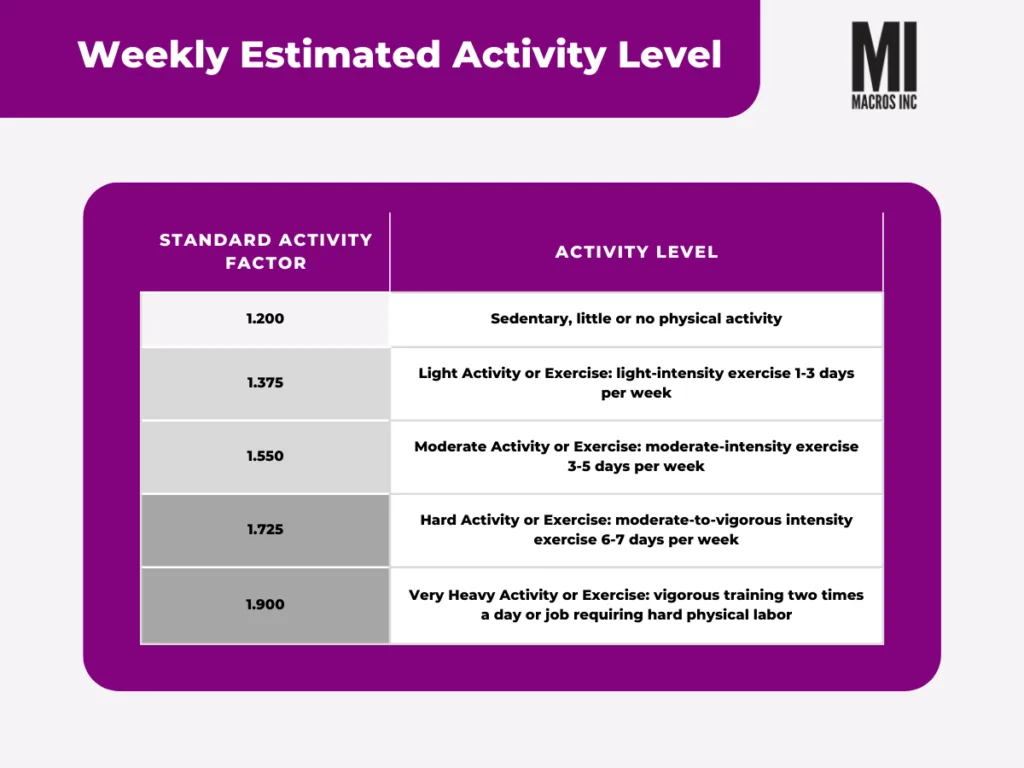
It is incredibly helpful if we use an example here. Let’s take a woman who is 5’4”, 170 pounds and 45 years old, works a desk job and exercises 2 to 3 days a week. For this, we’ll use the original Harris-Benedict equation.
Step 1
In step 1 we would use the female equation which is:
BMR = 655.1 + (9.563 × weight in kg) + (1.850 × height in cm) – (4.676 × age)
We just plug in our information and we get
BMR = 655.1 + (9.563 × 77.1) + (1.850 × 162.6) – (4.676 × 45)
BMR = 1,483
Step 2
In step 2 we adjust for her physical activity level, which counts as lightly active.
- Total Energy Expenditure = BMR × Physical Activity Level
- Total Energy Expenditure = 1,483 × 1.375
- Total Energy Expenditure = 2,039 kcal
This means that when you use a calorie calculator to estimate your expenditure, your exercise and physical activity are already included. Our TDEE calculator works the same way: your training is counted in the activity level you choose. Adding your exercise on top of that estimate substantially overestimates what you really burn in a day.
That’s what happens in almost every case when people “eat back” their exercise calories: they’re adjusting for an adjustment that was already made at baseline.
Calorie Trackers Are Notoriously Inaccurate
Based on what we just learned, it turns out that for most people, calorie calculators already “bake in” our exercise and physical activity habits into our calorie estimations from scientifically verified estimating equations. In addition to this, it turns out that most commercially available fitness trackers are wildly inaccurate.
Before I tell you exactly how inaccurate they are, let’s talk about how these devices estimate exercise-specific energy expenditure. It can get complicated, but most fitness trackers rely mainly on heart rate and movement data such as step count to estimate expenditure. Both carry meaningful error, so the end measurement (calorie expenditure) will be off too.
Apple watches can have up to a 9% error rate on heart rate.
Garmin has been reported to have a similar error rate with upwards of 11% error.
So if the main inputs aren’t very accurate, how far off is the calorie estimate for exercise? In one Stanford study of seven wrist-worn devices, none got its energy expenditure error below 20%, and the worst were off by far more.
That makes the number far too unreliable to plan your food around.
A review of 158 studies across nine brands found that no brand measured energy expenditure accurately. To make matters worse, they don’t consistently overestimate or underestimate. They’re all over the map.
They’re simply poor at estimating energy expenditure from exercise.
I wish this were not the case. Our jobs would be SO. MUCH. EASIER. if they were indeed accurate.
So, taking this back to our food intake.
If you try to eat back the calories your watch says you burned, you’re eating back a number that’s wrong almost every single day.
That is a recipe for failure.
Who Should Eat Back Exercise Calories
At this point it’s clear that for most people, eating back exercise calories makes little sense.
That being said, there are some people who should consider eating back exercise calories: athletes and people with non-regular, unusually high energy expenditures.
In the case of athletes, they often have fairly regular training and exercise schedules and have either tracked their workout volume closely or used much more reliable measures of energy expenditure and can have a much more accurate estimate of how many extra calories they might burn from longer or higher volume training sessions. In these cases, it’s smart to increase calorie intake to offset an unintentional calorie deficit.
Another case where eating back exercise calories makes sense is if you have an unusually high energy expenditure and weight loss is not your primary goal. For example, if you went on a very long multi-day hike, ran an ultra-marathon, or spent the entire weekend doing very heavy manual labor. During periods of non-regular, unusually high energy expenditure it may make sense to increase calorie intake to offset the unintentional deficit.
Summary
In most cases, eating back exercise calories is not a winning strategy, especially if your goal is weight loss. Most calorie calculators already include your estimated physical activity, which means it is not necessary to adjust for slight daily variations in exercise induced calorie expenditure. Additionally, most commercial fitness trackers (e.g., Apple Watch, Garmin, Fitbit) are too inaccurate to rely on for exercise-specific calorie expenditure. It is far more effective to eat consistently, track your body weight over time, and adjust your weekly calorie averages based on your rate of progress.
No gimmicks. No restrictions.
Start your journey with expert coaching, personalized nutrition, and real results, absolutely free for two weeks.
