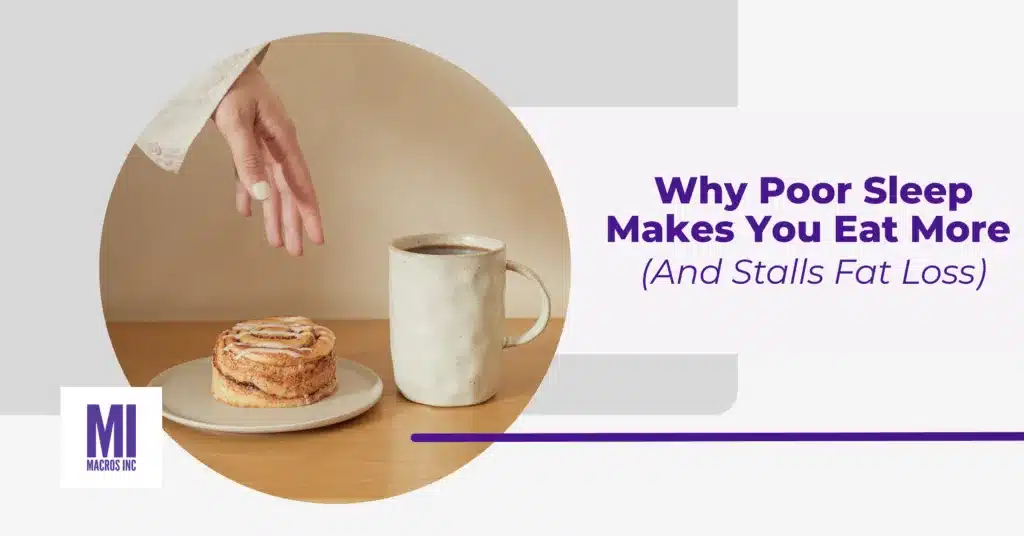
Another poor night’s sleep, and you can’t stop reaching for snacks.
This isn’t a willpower issue. It’s biology — and it’s biology that almost nobody wins against without understanding what’s actually happening.
Jump to a Topic
Why Poor Sleep Makes You Eat More (And Stalls Fat Loss)
What Poor Sleep Does to Your Appetite Hormones
Two hormones regulate hunger signaling: ghrelin and leptin. Think of them as the gas pedal and the brake. Ghrelin says eat more. Leptin says you’re full, stop.
Even one night of poor sleep shifts both in the wrong direction. Ghrelin goes up, leptin goes down. You wake up hungrier than usual, and the signal that tells you you’ve had enough arrives later than it should.
The research backs this up. A meta-analysis drawing on data from 11 studies and 172 participants found that partial sleep deprivation led to an average net intake of 385 extra calories per day. Not from increased activity or a faster metabolism — just more food consumed, pure surplus.
And it’s not random cravings. Sleep-deprived people specifically shift toward higher-fat, higher-calorie foods. Your body is hunting for dense energy, doing exactly what it evolved to do under conditions of deprivation: find fuel by any means available.
Sleep restriction also increases snacking frequency, portion sizes, and late-night eating. The total overage consistently exceeds what your body needs to compensate for being awake longer. It’s overcompensating, not compensating.
It’s Not Just Calories In
Poor sleep doesn’t only affect how much you eat. It can affect how much you burn.
Sleep deprivation tends to reduce NEAT — non-exercise activity thermogenesis, the calories you burn through everyday movement without deliberate exercise. This matters at any age, but particularly in midlife. Hormonal changes during the menopause transition may already be reducing NEAT, and since NEAT accounts for roughly 20% of total daily energy expenditure, that’s a meaningful number. A drop in output combined with an increase in intake can make fat loss feel impossible even when you’re doing everything else right.
Sleep is also when recovery happens. Recovery capacity decreases naturally with age, and deep sleep stages shorten. If sleep is chronically inconsistent, the margin for error shrinks — and you may feel the effects of a bad night faster than you did at 25.
What to Do About It
Prioritize sleep timing over sleep duration. Consistent bed and wake times regulate your circadian rhythm, which governs nearly every hormone in your body. Regular timing improves sleep quality, not just the hours you’re in bed.
Cool your room down. Core body temperature needs to drop to initiate deep sleep. This is particularly relevant if you’re navigating night sweats during the menopause transition.
Watch the late-night alcohol. It feels relaxing, but it fragments sleep architecture, reduces deep sleep stages, and increases cortisol.
Limit screens before bed. Blue light suppresses melatonin, the hormone that governs sleep onset. Even 30 minutes of screen-free wind-down makes a measurable difference. A book, a podcast, or a bath can signal to your brain that the day is over.
Sleep Is Part of the Fat Loss Equation
Fat loss isn’t just a food-and-exercise problem. It involves solving multiple inputs to get a sustainable output. Skimping on sleep while expecting strong fat-loss results is like leaving half your tools in the truck and wondering why the job is taking so long.
If your progress has stalled and your sleep is inconsistent, start there. Better sleep regulation often produces noticeably better hunger control and more natural daily movement — without changing anything else.
Frequently Asked Questions
Can poor sleep cause weight gain? Yes, through multiple mechanisms. Sleep deprivation raises ghrelin (the hunger hormone) and lowers leptin (the fullness hormone), leading to increased calorie intake. It also reduces NEAT, lowering daily calorie burn. Research has found that sleep restriction consistently leads to greater calorie consumption, increased snacking, and a preference for high-fat, calorie-dense foods.
How many extra calories do you eat after a bad night’s sleep? Research combining data across multiple studies found that partial sleep deprivation was associated with an average increase of around 385 extra calories per day. That’s enough to erase a meaningful deficit over the course of a week.
Why do I crave junk food when I’m tired? Sleep deprivation specifically drives cravings for high-fat, energy-dense foods. This is an evolved survival response — when your body senses deprivation, it seeks out the most calorie-concentrated sources available. It’s not a lack of discipline; it’s your brain prioritizing energy acquisition under perceived stress.
What is NEAT and why does it matter for weight loss? NEAT stands for non-exercise activity thermogenesis — the calories you burn through everyday movement like walking, fidgeting, and general activity, separate from deliberate exercise. It accounts for roughly 20% of total daily energy expenditure. Sleep deprivation tends to reduce NEAT, which means less total calorie burn even if your structured workouts stay the same.
How does sleep affect fat loss in midlife specifically? Hormonal changes during the menopause transition can already reduce NEAT and affect recovery capacity. Poor sleep compounds both of these effects. Deep sleep stages also naturally shorten with age, reducing the body’s ability to recover from training. For women in midlife, sleep quality is a particularly high-leverage variable in fat loss and body composition.
Fat loss stalls for a lot of reasons, and sleep is one of the most overlooked. At Macros Inc, your coach looks at the full picture — not just your macros. Start your free 14-day trial.
No gimmicks. No restrictions.
Start your journey with expert coaching, personalized nutrition, and real results, absolutely free for two weeks.